Corporate Chauffeur Account Benefits: A Smarter Approach to Business Travel

What if the real value of corporate chauffeur account benefits isn’t a new booking feature, but fewer transport decisions to repeat? For companies arranging regular journeys, the benefits are best measured in continuity: a transport relationship that supports recurring requirements and varied itineraries with care and discretion.
Business travel should run smoothly without adding avoidable coordination to demanding schedules. A structured chauffeur relationship can bring consistency to airport transfers, roadshows, and journeys where a vehicle is required at disposal. It also gives travellers a private setting between appointments. The right arrangement depends on how often your team travels, who needs transport, and how varied each itinerary is.
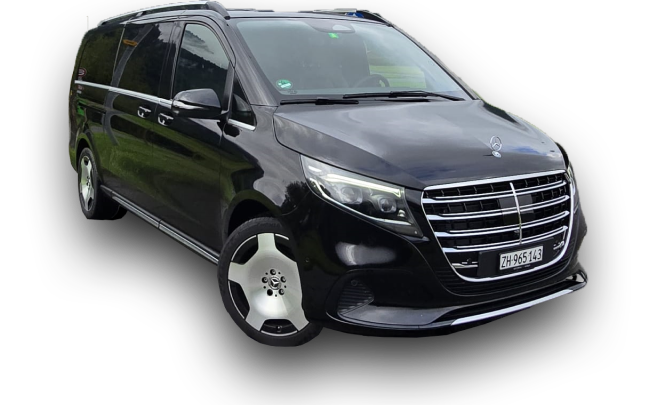
This article explains how to assess those benefits against your company’s actual travel patterns, rather than relying on generic promises of luxury. You’ll learn when a structured relationship may make sense, which details to consider, and what to prepare before arranging corporate transport. EPIC Limousines provides corporate travel management with Mercedes-Benz S-Class, V-Class, and Sprinter options for different passenger and journey requirements.
Key Takeaways
- Assess corporate chauffeur account benefits by looking at how recurring journeys affect coordination, schedules, and passenger needs.
- Consider a structured arrangement when executive itineraries repeat or involve several journey types. Occasional travel may call for a simpler approach.
- Before planning corporate transport, document each trip’s purpose, passenger requirements, itinerary, and timing.
- Match the vehicle to the journey and passenger requirements, with S-Class, V-Class, and Sprinter options available through EPIC Limousines.
- Consider how corporate travel management, roadshows, airport transfers, and at-disposal services can support a varied business travel programme.
Corporate Chauffeur Account Benefits: What Businesses Actually Gain
Repeated business journeys can turn transport into a chain of separate tasks. An assistant may need to communicate the same passenger preferences, coordinate similar itineraries, and keep track of arrangements across multiple trips. Each booking may be straightforward on its own, but the overall process can feel fragmented. A structured chauffeur relationship brings continuity to that work, particularly when executive schedules, client meetings, airport transfers, or group journeys need careful coordination.
The corporate chauffeur account benefits aren’t simply a matter of premium vehicles. Their practical value depends on how well the arrangement fits a company’s travel pattern, supports discretion, and simplifies recurring coordination. To judge the fit, look at the journeys your team arranges and the work involved in planning them.
What does a corporate chauffeur account mean?
A corporate chauffeur account is an organised business relationship for arranging chauffeur-driven transport. Instead of treating every journey as an entirely separate engagement, the company and chauffeur service build an ongoing relationship around the company’s transport requirements. That continuity makes it easier to communicate recurring preferences and understand the context of planned journeys.
In practice, a company can use this relationship to organise trip details, passenger requirements, and itineraries across its business travel. It sits within the broader discipline of corporate travel management principles, where transport is considered alongside the purpose and organisation of business travel.
Which businesses may value a structured chauffeur arrangement?
There’s no single company size or trip-frequency threshold that makes an arrangement worthwhile. The better question is whether transport coordination creates recurring work or requires particular care. A company may benefit when executives have tightly arranged itineraries, guests need discreet transport, or several passengers must travel as part of a coordinated plan.
Travel coordinators and executive assistants may also value continuity because they often arrange journeys on someone else’s behalf. An established relationship gives them a clearer framework for sharing trip purpose, passenger needs, timing, and itinerary details, while allowing each journey to be planned on its own merits.
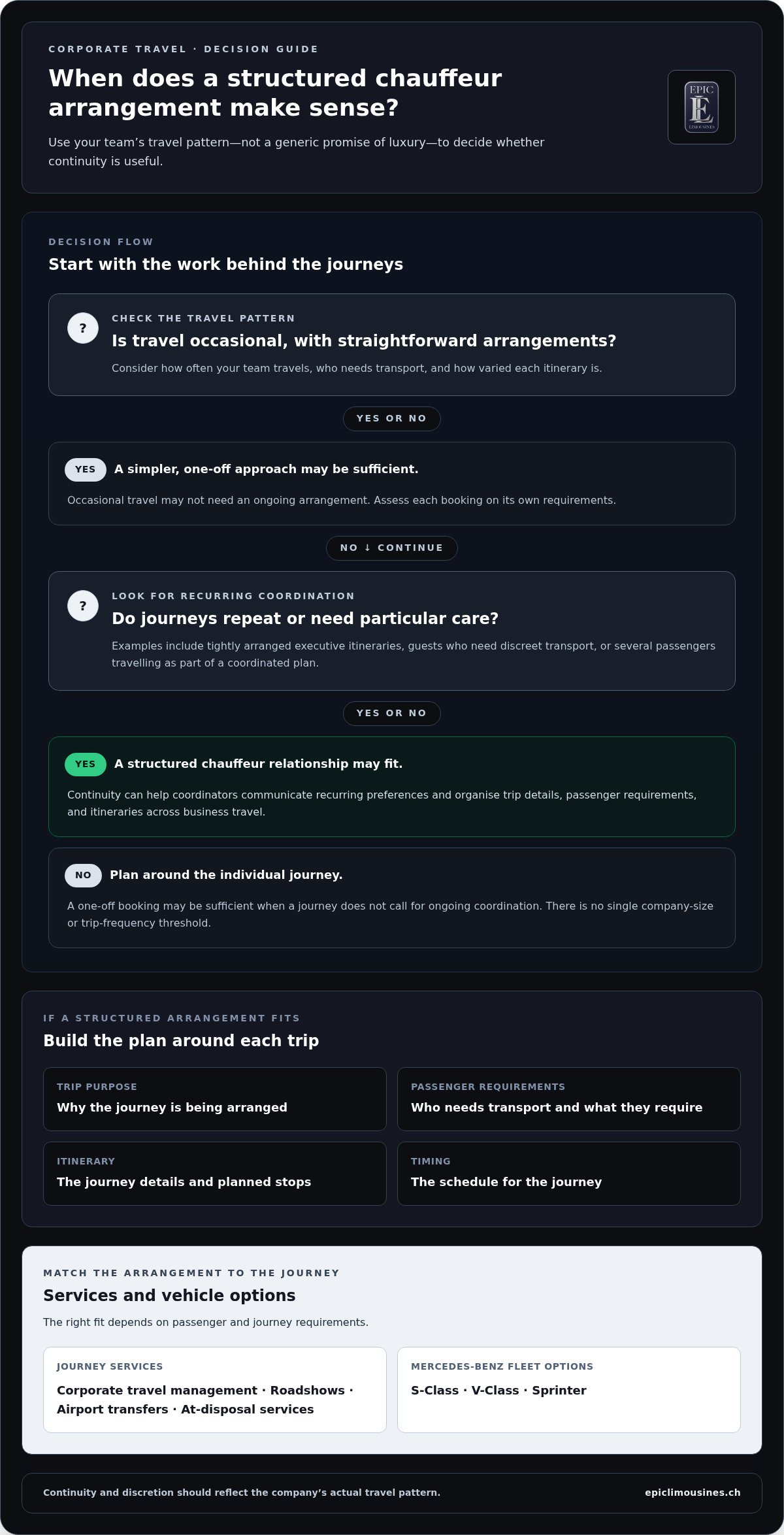
To judge the fit, look at the pattern behind the bookings. Are journeys repeated, varied, or difficult to coordinate? Do passengers value privacy between appointments? Does the company arrange individual executive transfers, roadshows, airport journeys, or transport for a group? These questions reveal where a structured arrangement can help and where a one-off booking may be sufficient.
EPIC Limousines provides corporate travel management, chauffeur-driven roadshows, airport transfers, and at-disposal services. Its Mercedes-Benz S-Class, V-Class, and Sprinter fleet supports arrangements for different passenger and journey requirements. The central measure is not how elaborate an account sounds, but whether the relationship offers the continuity and discretion your travel programme calls for. In the sections that follow, consider how that fit can support productive travel and how to plan an arrangement around your team.
How a Corporate Chauffeur Account Can Support Productivity and Discretion
Business travel doesn’t begin and end at the meeting room door. The journeys between appointments can shape how prepared or composed a passenger feels on arrival. With chauffeur-driven transport, passengers aren’t responsible for driving or navigating. Depending on the journey and their own needs, they can review a briefing, organise notes, prepare questions, or simply take a pause before the next commitment.
That’s where corporate chauffeur account benefits can extend beyond an individual ride. A continuing transport relationship helps a company communicate recurring preferences and itinerary context without treating each journey as an unrelated task. Coordinators still need to provide details for each trip, but continuity makes it easier to organise arrangements around the passenger’s schedule and the purpose of the journey.
How can chauffeur-driven travel protect working time?
Consider an executive travelling to a client meeting. The journey may offer time to review the agenda, read presentation notes, or mentally prepare for a discussion. After a demanding meeting, that same time might be better spent taking a breath before the next appointment. A chauffeur handles the driving, leaving the passenger free to use the journey in the way that suits them.
A chauffeur can create the conditions for focused travel, but no transport arrangement can guarantee what a passenger accomplishes en route. Work depends on the passenger, the itinerary, and the circumstances of the journey. The value lies in having the option to prepare or pause, rather than needing to focus on driving and navigation.
Continuity can also reduce small planning burdens. If a coordinator regularly arranges similar journeys, an ongoing relationship provides a consistent context for communicating schedule changes, passenger requirements, and trip purpose. A connected approach to transport planning helps coordinators manage recurring needs in a way that reflects the company’s travel patterns.
Why do privacy and confidentiality matter in business travel?
Executive and client-facing journeys may involve sensitive schedules, important meetings, or conversations passengers would rather not have in a public setting. A private chauffeur-driven journey offers separation from the wider flow of travel and supports a more discreet experience. Passengers should still use their own judgment about discussing confidential matters, particularly where the subject calls for additional care.
EPIC Limousines places emphasis on privacy, security, and confidentiality in its chauffeur services. These priorities matter when arranging transport for executives, guests, or colleagues whose itineraries deserve thoughtful handling. Clear communication about the journey and passenger requirements helps shape an appropriate arrangement.
For travel planners, the useful question is how transport can support both the schedule and the person travelling. EPIC’s corporate travel management brings chauffeur-driven transport into that planning conversation, with arrangements shaped around varied business itineraries. A considered approach can make the journey feel less like another task and more like a composed interval in a demanding day.
Corporate Chauffeur Account vs. One-Off Transport: When Does Structure Help?
A one-off booking and an ongoing chauffeur relationship can both suit business travel. The difference is not simply the number of journeys. Consider how much coordination each trip needs, whether itineraries connect across a working day, and how often similar arrangements recur. Corporate chauffeur account benefits are most relevant when an ongoing relationship helps organise real needs, not when a company adopts structure for its own sake.
The comparison below focuses on the arrangement itself. When planning, consider the practical needs of each journey, such as how trip details are shared, how schedules connect, and whether transport requirements recur.
| Consideration | One-off booking | Ongoing arrangement |
|---|---|---|
| Coordination | Trip details are arranged for each journey. | Recurring requirements can be discussed within a continuing relationship. |
| Schedule | Often suits a clear, standalone itinerary. | Can help organise connected journeys or changing requirements. |
| Travel pattern | May suit occasional, distinct trips. | May suit recurring executive travel, roadshows, or varied transport needs. |
| Decision to make | Is this journey straightforward to plan independently? | Would continuity make coordination more coherent? |
When might one-off chauffeur bookings be enough?
For an occasional journey with a clear route, defined timing, and limited coordination needs, arranging transport for that trip may be entirely appropriate. A company might need a single transfer for a visiting executive, with no connected itinerary or recurring requirements. Individual bookings aren’t inherently unsuitable; they can be a proportionate choice when the journey is self-contained.
Review your own travel pattern rather than assuming you need an account because chauffeur transport is part of your travel programme. If each trip has different passengers and straightforward arrangements, a separate booking may provide all the structure the journey requires.
When can an ongoing arrangement add practical value?
A continuing relationship may be useful when an executive’s itinerary involves several connected journeys, when a roadshow requires coordinated transport, or when a company arranges different types of trips for several passengers. Instead of starting from zero each time, the coordinator can build on an established understanding of the company’s transport needs. This supports clearer communication and more coherent planning.
Assess the coordination involved, too. Do assistants repeatedly have to explain similar requirements? Are several journeys tied to one schedule? Does the passenger need a discreet, tailored experience? These are practical criteria for deciding whether continuity would be useful. A structured arrangement adds value when its approach fits the answers.
EPIC Limousines provides corporate travel management, roadshows, airport transfers, and at-disposal services. For companies considering an ongoing arrangement, the key is to connect those transport needs into a coherent plan while keeping each passenger’s itinerary in view. Occasional travel may call for a simple booking; recurring or interdependent journeys may benefit from greater continuity. Choose the structure that reflects how your team actually travels.
How to Plan a Corporate Chauffeur Arrangement Around Your Team
A useful chauffeur arrangement begins with a clear picture of the journeys your team needs, not a vehicle choice made in isolation. A concise travel brief aligns the purpose of each trip with passenger requirements, itinerary, and timing. It also gives a coordinator a practical reference when arranging executive travel, client journeys, or a roadshow.
For a broader view of how transport fits into corporate logistics, see this corporate travel management guide. The same planning discipline helps a company understand where corporate chauffeur account benefits may support its actual travel pattern.
What should a company include in its travel brief?
Keep the brief focused on details that affect the journey. Record its purpose, passenger count, planned stops, and schedule, then note any privacy considerations or specific vehicle request. For a client visit, for example, include the meeting-related stops and relevant timing. For a roadshow, outline the sequence of appointments so the itinerary can be understood as a whole.
Use a concise format that’s easy to update. If passenger numbers, stops, or timing change, revise the brief and share the current itinerary with the people coordinating transport. Clear information supports a considered arrangement and helps everyone work from the same plan.
How should transport needs shape the vehicle choice?
Start with the passengers and the nature of the journey. An individual executive transfer, travel involving several passengers, and a roadshow can call for different considerations. Think about who is travelling, whether they’re moving together, and how the journey fits into the day. These details help guide a suitable vehicle choice without relying on assumptions about capacity or vehicle features.
EPIC Limousines’ fleet includes Mercedes-Benz S-Class, V-Class, and Sprinter vehicles. Share the passenger requirements and itinerary so the arrangement can be tailored to the journey. You can include a specific vehicle request in the brief, alongside the purpose and timing, so it can be considered as part of the overall plan.
Before arranging transport, work through these planning steps:
- Define the purpose. Clarify whether the journey supports executive travel, a client meeting, or a sequence of roadshow appointments.
- Identify the passengers. Note how many people are travelling and whether they’ll share the same itinerary.
- Map the journey. List the planned stops and schedule in the order they’re expected to take place.
- Record preferences. Include privacy considerations and any specific vehicle request relevant to the passengers.
- Review changes. Update the itinerary when requirements shift, so the arrangement reflects the current plan.
This preparation connects transport decisions to the team’s needs rather than to generic assumptions. For a tailored corporate chauffeur arrangement, share your team’s transport requirements with EPIC Limousines.
EPIC Limousines: A Discreet Chauffeur Partner for Corporate Travel
Corporate transport is most effective when the arrangement reflects the people travelling and the purpose of each journey. EPIC Limousines provides corporate travel management alongside chauffeur-driven roadshows, airport transfers, and at-disposal services. These options can support different parts of a business itinerary, from a direct transfer to transport planned around a sequence of appointments.
EPIC’s approach places comfort, security, confidentiality, and privacy at the centre of the experience. These priorities matter for executive travel and client-facing journeys, where a composed, discreet setting can be as important as the route itself. EPIC brings more than 10 years of experience transporting people to its corporate and private chauffeur services.
What can businesses arrange through EPIC Limousines?
Companies can arrange chauffeur-driven transport for executive and corporate travel, including roadshows and airport transfers. At-disposal services can also form part of an itinerary when a vehicle is required in connection with a broader schedule. The arrangement can be shaped around the journey’s purpose, passenger requirements, and planned timing.
EPIC’s fleet includes Mercedes-Benz S-Class, V-Class, and Sprinter vehicles. Companies can discuss a vehicle choice in light of who is travelling and the nature of the journey. For VIP itineraries where privacy is a particular consideration, EPIC’s diplomatic transport guide offers related context on discreet chauffeur travel.
How can a company take the next step?
A clear initial brief brings the relevant details into the conversation. Share the itinerary, passenger needs, journey purpose, planned stops, and timing. If your team has a specific vehicle request or privacy considerations, include those as well. For a roadshow, outline the sequence of appointments; for an airport transfer, provide the journey details and schedule. This gives EPIC a practical foundation for discussing an arrangement tailored to your corporate transport requirements.
The corporate chauffeur account benefits that matter most are those that fit the company’s actual travel pattern. A thoughtful discussion can help establish whether your needs call for individual journeys, recurring transport, or a combination of both. It also keeps attention on service priorities such as discretion, comfort, and each passenger’s requirements, rather than assuming every account works in the same way.
For a considered conversation about your itinerary and transport needs, Talk to EPIC Limousines about your corporate transport needs.
Make Your Next Business Journey More Deliberate
Turn your travel pattern into a clear decision. Before arranging transport, identify which journeys create the most coordination, what passengers need along the way, and where a consistent approach would genuinely help. This gives your company a practical basis for deciding whether corporate chauffeur account benefits match its priorities, rather than adopting a structure simply because it sounds more comprehensive.
Consider starting with one upcoming itinerary. Note its purpose, passenger requirements, timing, and any privacy considerations, then use those details to shape a conversation about suitable transport. A thoughtful arrangement should support the people travelling while fitting naturally into the way your team plans business journeys.
EPIC Limousines brings more than 10 years of experience transporting people, with a Mercedes-Benz S-Class, V-Class, and Sprinter fleet and a stated focus on privacy, security, and confidentiality. To explore an arrangement shaped around your company’s needs, discuss your corporate transport requirements with EPIC Limousines.
With a clear brief and the right chauffeur service, your next journey can begin with greater confidence and less uncertainty.
Frequently Asked Questions
What does an at-disposal chauffeur service mean?
An at-disposal chauffeur service means a chauffeur and vehicle remain available for a planned period, rather than making only one point-to-point transfer. It can suit a business day with several appointments or stops that may change. EPIC Limousines offers at-disposal services. To shape the arrangement, share the intended schedule and transport requirements; the itinerary remains the central reference for planning the day.
Can EPIC Limousines arrange transport for individual travellers and groups?
Yes. EPIC Limousines provides chauffeur-driven transportation for both individual travellers and groups. The suitable arrangement depends on passenger numbers, travel purpose, and itinerary. For a group journey, include the number of passengers and the timing; for an executive travelling alone, outline the schedule and any privacy considerations. These details help tailor transport for client visits, meetings, or coordinated journeys.
Does EPIC Limousines serve corporate journeys outside Switzerland?
Yes. EPIC Limousines operates in Switzerland and also serves Germany, France, and Italy. For a cross-border corporate journey, prepare one concise brief with the intended route, travel dates, passenger count, schedule, and business purpose. Note where the journey begins and ends and any planned stops along the way. This gives the transport team a clear picture of the full itinerary for individual travellers or groups.
Which amenities are provided or available on request?
Every vehicle includes personal hand sanitizer, masks, free bottled water, and refreshing towels. Mints, newspapers, Wi-Fi, and phone chargers are available on request. If any of these optional items would be useful, include the request in the travel brief alongside the itinerary. Distinguishing standard amenities from optional requests helps passengers know what to expect and coordinators communicate preferences clearly.
Can a chauffeur service support client hospitality?
Yes. Chauffeur-driven transport can be part of a considered welcome for visiting clients or business partners, providing a private and comfortable setting for the journey. EPIC Limousines serves individual travellers and groups, with comfort, security, confidentiality, and privacy as stated priorities. To align transport with the occasion, share the visit’s purpose, passenger requirements, and schedule. This helps the planned journey reflect the client’s itinerary and hospitality needs.
Can EPIC Limousines also provide transportation for private travel?
Yes. EPIC Limousines serves corporate and private clients, so chauffeur-driven transportation can support personal journeys as well as business travel. For a private occasion, describe the purpose of the trip, who will be travelling, and the planned itinerary. You can also include a specific vehicle request. This information helps tailor the transport to the occasion, whether the journey is for an individual or a group.