Corporate Event Shuttle Service: A Buyer’s Guide for 2026

What makes a corporate event shuttle service run smoothly? Often, it is not just the vehicles but how each journey is coordinated. Late arrivals, changing schedules and unclear pickup instructions can quickly disrupt an event programme, even when the fleet is suitable.
It’s understandable to start with passenger numbers and vehicle types. But dependable transport also requires a clear plan for guest groups, departure times, pickup points and repeat journeys. The arrangement should suit attendees while giving executives or smaller parties an appropriate level of comfort and privacy.
This 2026 buyer’s guide explains how to compare shuttle formats, assess vehicle options and clarify planning requirements before booking. It covers practical questions about passenger and luggage capacity, routing, dispatch arrangements and communication when plans change. Epic Limousines provides chauffeur-driven event transport and corporate travel management, with Mercedes-Benz Sprinter transfers for group travel and S-Class or V-Class services that may suit executives or smaller parties. Each booking depends on confirming the event’s requirements, so careful coordination can make the guest journey more polished and easier for organisers to manage.
Key Takeaways
- Choose between scheduled shuttle journeys, point-to-point transfers and an at-disposal chauffeur based on the event timetable and how guests will travel.
- When assessing a corporate event shuttle service, compare the provider’s relevant event experience, communication and ability to work to an agreed itinerary.
- Match vehicles to guest groups, then confirm passenger and luggage capacity, accessibility needs and the presentation you want.
- Map arrival waves, journeys between venues and departures against the programme to clarify pickup instructions and reduce event day friction.
- Before confirming a booking, clarify routing, dispatch arrangements, operating hours and how schedule changes will be communicated.
What a Corporate Event Shuttle Service Should Deliver
A corporate event shuttle service is more than a vehicle assigned to a booking. It is a coordinated sequence of chauffeur-driven journeys connecting arrival points, venues and scheduled activities, with routes and timings shaped around the event programme.
Quotable definition: “An event shuttle coordinates people, vehicles and timings around an event schedule, so guests can move between key points with clear instructions and a considered plan.” That coordination distinguishes a planned shuttle operation from separate point-to-point bookings. Individual transfers address specific journeys, while a shuttle plan considers how guest groups move across the wider programme. On-demand taxi journeys are arranged individually and may not align with shared arrival windows or scheduled departures.
The organiser’s goals are practical: punctual arrivals, straightforward pickup instructions, smooth departures and less time spent resolving transport questions. These aims are part of the wider work of event management, where transport and guest movement connect with the timing and flow of the programme. The service plan should support that flow, not sit apart from it.
Which corporate events benefit from a shuttle plan?
Conferences, company gatherings, client receptions and multi-session business programmes may benefit when guests share arrival windows, need to travel between venues or are expected to depart at similar times. Start with the event timetable and confirmed guest requirements. Identify who needs transport, between which points and at what planned times. Build the arrangement around those movements instead of assuming every attendee follows the same itinerary.
What is included in a chauffeur-led event transfer?
The foundation is a vehicle and chauffeur for the agreed transport requirement. Discuss and confirm routes, stops, waiting arrangements and service duration before booking. Don’t assume that extras such as live updates, meet-and-greet, reporting or dedicated event coordination are included. Ask whether they’re available for the proposed arrangement and record any agreed details in the itinerary.
Before confirming, match the proposed vehicle configuration to passenger numbers, luggage and any accessibility requests. Confirm capacity for the specific configuration rather than relying on a general vehicle description. Also clarify the event date, operating hours, routing feasibility and dispatch arrangements. These details establish what the provider is committing to and give organisers a reliable basis for sharing pickup instructions.
Shuttle, Point-to-Point or At-Disposal Chauffeur: Which Format Fits?
The right format depends on how guests will travel, not simply on the vehicle’s presentation. A scheduled shuttle suits shared movements at planned times. Dedicated transfers suit individual itineraries. An at-disposal chauffeur may fit a programme that needs a vehicle and chauffeur to remain available for an agreed period. A mixed plan can serve general attendees and executives without putting everyone on the same schedule.
| Format | Best suited to | Flexibility | Organiser coordination |
|---|---|---|---|
| Scheduled shuttle loop | Recurring trips along shared routes, such as between an arrival point and event venue | Follows a set timetable and route | Requires clear boarding points, departure times and passenger estimates |
| Point-to-point transfer | Guests with distinct arrival times, destinations or itineraries | Journey details are agreed for each transfer | Requires individual journey details and pickup coordination |
| At-disposal chauffeur | Programmes with several movements or changing requirements during an agreed period | Offers flexibility within the agreed service arrangement | Requires confirmation of timing, routing and how requests will be coordinated |
When does a scheduled shuttle work best?
A scheduled shuttle works well when guest movements are predictable and repeat along a shared route. Before choosing one, map the schedule, boarding locations and expected passenger demand. For example, a conference with several planned arrival windows may need a different timetable from a reception where most guests arrive together. Confirm guest numbers and operating windows first. Don’t settle on a vehicle count before those requirements are clear.
When should you choose dedicated transfers or at-disposal service?
Point-to-point journeys are worth considering for speakers, clients or executives whose arrival times and destinations differ from the main group. An at-disposal arrangement may suit a programme that requires a chauffeur to remain available for agreed periods. Compare formats by schedule fit, movement pattern and flexibility, rather than prestige alone. Epic Limousines offers chauffeur-driven Sprinter, V-Class and S-Class transfers, as well as at-disposal services. Confirm the suitable vehicle configuration and service details for your booking.
Premium transport needn’t feel impersonal. A considered mix can give attendees straightforward shared journeys while preserving privacy and tailored arrangements for smaller parties. Clear pickup points, agreed timings and a defined coordination process can make the experience feel composed for guests and manageable for organisers. For an overview of Epic Limousines’ services, visit Epic Limousines.
How to Evaluate a Corporate Event Shuttle Provider
A corporate event shuttle service should fit the programme as carefully as it fits the vehicle plan. Look beyond a polished proposal. Assess the provider’s relevant event transport experience, responsiveness during booking, clarity of communication and ability to work within an agreed itinerary. Ask who your contact will be and how operational details will be confirmed before the event.
Before choosing an event transport provider, check its relevant event experience, vehicle and luggage suitability, accessibility requirements, itinerary feasibility, communication process and approach to schedule changes.
What should an event transport brief include?
Give providers a shared planning baseline. Include the event dates, requested service windows, confirmed or estimated passenger numbers, pickup and drop-off points, and programme schedule. Note guest categories, luggage expectations and accessibility requirements that may affect vehicle selection or boarding arrangements. Label estimates and unresolved details clearly so they aren’t mistaken for confirmed instructions.
Ask the provider to review routing, timing and dispatch feasibility before finalising the plan. Confirm how guests will receive pickup instructions, which contact point organisers should use, and how itinerary updates or requested changes will be handled. Treat reporting, live updates, meet-and-greet and dedicated event coordination as items to verify, not assumed inclusions.
Which fleet considerations matter for corporate guests?
Match each vehicle to the journey and passenger group instead of selecting by appearance alone. A Mercedes-Benz Sprinter may be considered for group transfers, a V-Class for a smaller party, and an S-Class for an individual executive journey. For each proposed configuration, confirm seating and luggage capacity directly with the provider, along with suitability for any stated accessibility needs.
When attendee movements overlap with executive itineraries, ask how both can be coordinated against the same event schedule. For example, a group transfer may share a departure window with a separate executive pickup, but the two journeys may need different boarding instructions and timings. Confirm the routes, stops, service duration and dispatch arrangements for each part of the proposal.
Clear answers matter as much as vehicle choice. A provider should explain what is confirmed, what still needs verification and how agreed itinerary details will be communicated. This gives organisers a sound basis for planning and helps ensure guests receive instructions suited to their journey. Keep the final itinerary and any confirmed changes in one version that relevant organisers can refer to.
How to Plan Guest Movements and Avoid Event Day Friction
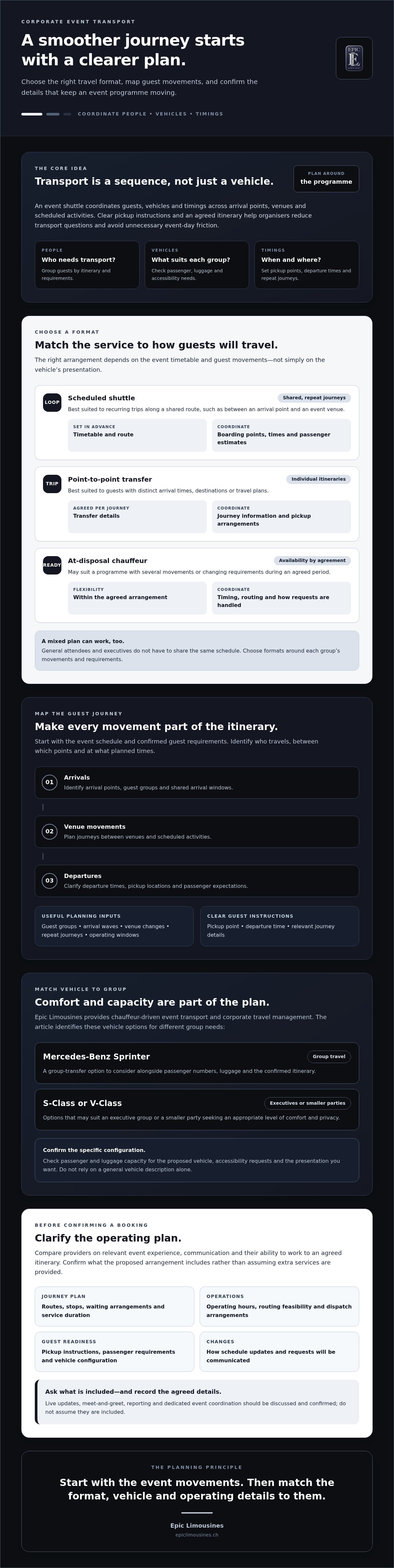
A smooth event journey depends on decisions made before the first pickup. Treat transport as part of the event timetable: map arrival waves, transfers between venues and departure periods, then assign clear responsibilities for confirming each movement. For a broader view of business transport planning, see this corporate travel management guide.
- Step 1: Gather requirements. Record the event schedule, guest groups, estimated passenger numbers, pickup and drop-off points, luggage expectations and accessibility requests. Mark estimates as provisional.
- Step 2: Map the movements. Plot arrival waves, journeys between venues and departures against programme timings. Identify shared journeys and guests with separate schedules so the plan reflects how people will travel.
- Step 3: Assign contacts. Name an event-side coordinator and confirm the provider’s contact arrangements for the booking. Agree who can approve itinerary changes and how updated instructions will reach the relevant people.
- Step 4: Confirm the itinerary. Review routes, stops, boarding windows, service duration and dispatch arrangements with the provider. Issue one approved itinerary, then share it with guests and organisers in clear, consistent language.
- Step 5: Review after the event. Note delays, unclear instructions, changes and passenger feedback. Use those observations to refine movement planning for a future programme.
How should organisers coordinate passengers and schedules?
Make pickup instructions easy to follow: state the location, departure time and relevant group or journey details in one approved version. Set realistic boarding windows so guests can find the pickup point and board without disrupting the programme. Confirm how changes will be relayed and who is responsible for sending them. Don’t assume live tracking, instant dispatch or real-time updates are included. Verify the arrangements for the booking.
How can the service support a discreet executive experience?
When executives have individual schedules or privacy expectations, plan their movements separately from shared attendee journeys. Agree in advance how guests should be identified or received, what information should remain private, and whether any security arrangements are required. If the event brief calls for diplomatic or VIP transport, consult this diplomatic and VIP transport guide as a relevant planning reference.
A corporate event shuttle service is easier to coordinate when the timetable, contacts and change process are agreed in advance. Share the draft movement plan with the provider and ask them to confirm feasibility before distributing final guest instructions. For an overview of the transport services available, visit Epic Limousines.
Booking a Corporate Event Shuttle Service with Epic Limousines
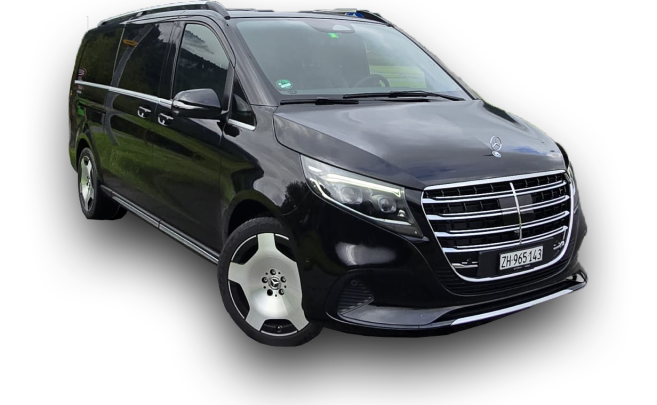
Epic Limousines is a Swiss provider of chauffeur-driven event and corporate transport, with Mercedes-Benz Sprinter, V-Class and S-Class vehicles. A Sprinter may suit a group movement, a V-Class a smaller party, and an S-Class an executive journey. The right choice depends on the itinerary and the specific passenger and luggage configuration, which should be confirmed for each booking.
A useful enquiry gives the provider enough context to assess the journeys, rather than simply naming a vehicle. Share the event schedule and movement requirements, then ask which format and vehicle allocation best fit the confirmed needs. Availability, routing feasibility, operating hours and dispatch arrangements also need confirmation before the service is agreed.
What information helps Epic prepare an event proposal?
Include the event date, requested service window, itinerary, and pickup and drop-off points. Provide confirmed passenger estimates where possible, noting any figures that may change, and describe expected luggage. Identify guest categories, such as general attendees or executives, and state preferred vehicle types if you have them. Include special requirements, including accessibility needs or privacy considerations, so they can be reviewed as part of the proposal.
These details allow the proposed journeys to be considered together. For example, the plan may need to cover group transfers alongside separate executive movements. Final vehicle allocation and service details remain subject to confirmation. A vehicle name alone doesn’t establish that its configuration will suit your passenger and luggage requirements.
What should you confirm before approving the booking?
Review the written proposal against the event brief. Check the agreed schedule, routes and stops, service scope, vehicle configuration and named coordination contacts. Confirm how itinerary changes should be requested and communicated, what waiting arrangements apply, and whether any additional requirements have been accepted. Ask the provider to confirm availability for the event date and the feasibility of the requested operating hours and routing.
Before sharing final instructions with guests, make sure the approved itinerary is clear and consistent with the confirmed service. Resolve remaining assumptions, such as provisional passenger numbers or timing details, instead of leaving them implicit. A precise agreement helps both organiser and provider work from the same plan.
For an overview of the available services, visit Epic Limousines. Share your event requirements and preferred vehicle options, then confirm availability and operational details before approving a booking.
Shape a More Considered Event Journey
A dependable corporate event shuttle service begins with the movement plan. Match scheduled group journeys, dedicated transfers or at-disposal service to the programme and guest requirements. Then confirm vehicle configuration, routing, passenger and luggage needs, contact roles and the process for communicating changes. These details can create a composed guest experience while keeping transport coordination manageable for organisers.
Epic Limousines provides chauffeur-driven corporate and event transport in Switzerland, with Mercedes-Benz Sprinter, V-Class and S-Class vehicles. Its services also include corporate travel management and roadshows, along with specialized event transport. Confirm vehicle suitability, event-date availability and operating arrangements for each booking.
Share your event schedule, passenger estimates and preferred arrangements to explore a tailored plan. Discuss your corporate event transport requirements with Epic Limousines and take the next step towards a polished, well-coordinated journey for your guests.
Frequently Asked Questions
What is a corporate event shuttle service?
A corporate event shuttle service coordinates chauffeur-driven journeys for attendees or guests around an event schedule. It can include repeated transfers, individual point-to-point movements or a combination of formats, depending on passenger numbers, timings, routes and programme needs. Before booking, ask the provider to specify the agreed service scope, vehicle allocation and communication process. This distinguishes confirmed arrangements from assumptions and gives organisers a clear basis for sharing transport instructions with guests.
How do I choose the right vehicle for a corporate event shuttle?
Choose a vehicle based on confirmed passenger estimates, luggage, accessibility requirements and the journey pattern. A Mercedes-Benz Sprinter may be considered for group transfers, while a V-Class may suit a smaller party and an S-Class an executive journey. These are starting points, not capacity guarantees. Ask the provider to confirm the exact seating and luggage configuration proposed for your booking, and check that it suits the people and belongings travelling.
Can a corporate event shuttle include executive transfers?
Yes, a transport plan can combine group movements with separate executive journeys if the provider confirms the requested arrangements. Include executives’ arrival times, itinerary differences and privacy expectations in your initial brief. A proposal might consider Sprinter, V-Class and S-Class vehicles for different guest groups, subject to configuration and availability. Confirm whether one provider can coordinate every requested journey, and clarify how timings, contact roles and schedule changes will be managed.
How far in advance should I book a corporate event shuttle?
Begin enquiries once you have the event date, a working schedule and an initial passenger estimate. The appropriate lead time depends on the date, service scope and provider availability, so there isn’t one deadline that suits every event. Ask when availability can be confirmed, when passenger numbers need to be finalised and how later changes are handled. For a plan involving several vehicles or coordinated movements, share the itinerary as early as practical.
What information should I provide when requesting an event shuttle proposal?
Provide the event date, requested service window, itinerary, pickup and drop-off points, passenger estimates and expected luggage. Identify guest categories, preferred vehicle types, accessibility needs and any privacy or security requirements. Name the event-side contact responsible for updates, and label provisional details clearly. This brief helps the provider assess routing and service feasibility, consider a suitable format and identify what still needs confirmation before the proposed arrangements are approved.
How is a corporate event shuttle service quote determined?
Request a proposal based on your actual itinerary and agreed service scope, rather than relying on a generic estimate. Ask which requirements affect the quoted amount, such as service duration, journey plan, vehicle selection and requested arrangements. Confirm what the proposal includes, how changes are treated, and whether waiting time or additional journeys require separate agreement. Review the written terms against your event brief so the scope and any assumptions are clear before approval.