Secure and Private Business Travel: A Swiss Guide for 2026

What if the biggest privacy risk on a business journey isn’t the meeting room, but the details shared while arranging the ride? Secure and private business travel involves more than choosing a discreet vehicle. It starts with sharing only the information needed, selecting a service that fits the traveller’s requirements and confirming what the provider will deliver.
Sensitive calls, changing appointments and executive itineraries all call for thoughtful coordination. A chauffeur service should be punctual and professional, but those expectations alone don’t show whether it suits a particular journey. Match the service to the level of support required, and discuss specialist VIP protection separately rather than assuming it comes with every transfer.
This guide explains how to assess privacy, security and service quality when arranging chauffeur-driven business travel across Switzerland. It covers what to ask about booking and itinerary information, how to compare service formats for different passenger and group needs, and how to plan transfers between appointments with less coordination stress.
Key Takeaways
- Assess secure and private business travel by asking how the service handles booking details, itinerary changes and journey coordination.
- Choose a transport option based on your priorities for privacy, control and coordination. No single option suits every itinerary.
- Before confirming, define the journey requirements and share only the passenger, timing and itinerary details needed to arrange it.
- Consider whether an S-Class, V-Class or Sprinter best suits the passengers and group requirements.
- Epic Limousines offers corporate travel management, roadshow transport and chauffeur-driven transfers. Discuss any specialist VIP protection separately and confirm its scope.
Why secure and private business travel requires more than a discreet vehicle
A discreet vehicle can contribute to a composed business journey, but privacy and protection depend on more than appearance. Passenger names, pickup details, meeting times and itinerary changes can reveal sensitive personal or commercial information if shared more widely than necessary. For organisers, careful transport planning is one part of supporting employees’ wellbeing and considering a company's duty of care.
Secure business travel means thoughtfully coordinating transport, information and support to reduce avoidable exposure, without promising a risk-free journey. Secure and private business travel calls for deliberate decisions about who receives journey details and what level of service is required. A premium vehicle alone does not guarantee privacy.
What privacy means during a business journey
Privacy involves appropriate discretion around a traveller’s identity, conversations and destination details. A passenger may need to take a confidential call en route, while an itinerary may reveal the timing of a sensitive meeting. Consider what the transport provider needs to coordinate the requested service, then limit booking communications to those essential details.
Before booking, ask how passenger and itinerary information is collected, who can access it, how long it is retained and whether it is shared. Verify the provider’s actual data-handling practices rather than assuming a particular procedure applies. The same principle applies to changes: find out who should receive updates and share only what’s needed to arrange the revised journey.
When chauffeur transport is not the same as protection
A chauffeur-driven vehicle provides transport for the booked journey. It doesn’t automatically include protective security, and the vehicle model alone can’t determine how secure an arrangement is. The appropriate service depends on the traveller’s needs, itinerary and assessed level of risk.
If specialist support may be required, ask whether VIP protection is available as a distinct service, then confirm its scope, personnel and operational arrangements directly. Epic Limousines offers Diplomatic & VIP Protection Transport, but this should not be assumed to accompany an ordinary chauffeur transfer. Clarifying the distinction at the outset helps set realistic expectations and avoids relying on a feature that hasn’t been confirmed.
For routine executive transport, the priority may be discreet coordination and a vehicle suited to the passenger or group. A journey with specific protection requirements calls for a separate conversation about the support needed. Clear boundaries make planning more precise, limit unnecessary circulation of information and help the organiser select a service that fits the actual requirement.
How to assess privacy and security in a chauffeur service
A sound assessment starts with specifics, not reassuring language. Before booking, establish what the chauffeur service includes, who will coordinate the journey and how updates will be handled. For secure and private business travel, distinguish confirmed service features from assumptions about protection.
Questions to ask before confirming a business transfer
Request a clear description of the booked service, including what it excludes. Confirm the pickup and destination details, the agreed schedule, and how delays, additional stops or itinerary changes should be communicated and approved. Ask who will coordinate the journey and whether the traveller or organiser should send updates.
Check vehicle suitability before booking. Confirm the vehicle type, passenger capacity and luggage requirements, particularly when several colleagues or substantial work equipment are travelling. Don’t infer capacity or suitability from a vehicle’s appearance or model name. Make sure the proposed arrangement fits the actual group and journey.
If the traveller needs protective support, treat it as a separate requirement. Ask what specific protection service is proposed, which personnel are responsible and what arrangements are included. The U.S. State Department personal security guidelines can inform broader pre-trip planning, but they don’t verify a transport provider’s capabilities.
How to judge discretion without relying on slogans
Look for precise answers about booking contacts, the itinerary information required and the preferred way to share sensitive requests. For example, an organiser might ask whether a passenger’s full name is necessary for a booking or whether a designated contact can coordinate changes. The provider should explain its process clearly, without requiring unnecessary personal or business details.
Ask how booking and passenger information is collected, accessed, retained and shared. Verify the answers instead of assuming a policy or procedure applies. Treat confidentiality guarantees, security certifications and broad claims of protection as claims to substantiate. Request relevant details and confirm their scope before relying on them.
- Service scope: What’s included, and what isn’t?
- Coordination: Who handles changes, delays and approvals?
- Fit: Does the confirmed vehicle suit the passenger and luggage requirements?
- Protection: Is specialist support required, and has its scope been confirmed separately?
- Privacy: Are data-handling practices explained and verified?
Rely on security features only when the provider has clearly described and confirmed them. For a point of comparison, review Epic Limousines’ chauffeur-driven business transport and ask which service format fits your itinerary.
Private chauffeur travel versus other business transport options
The right transport format depends on the itinerary, the coordination required and how much control the organiser wants over each transfer. A chauffeur service, standard taxi and self-drive arrangement each involve different practical trade-offs. None is automatically the safest choice. Assess the provider, journey details and traveller’s needs rather than relying on the category alone.
| Option | Control and coordination | Privacy considerations |
|---|---|---|
| Private chauffeur | Journey details can be arranged in advance with a provider. Confirm how changes are managed. | Ask who receives booking and itinerary information, and what discretion practices apply. |
| Standard taxi | May suit a simple point-to-point journey. Availability and arrangements depend on the provider. | Check how the booking is made and what passenger details are shared. |
| Self-drive | The traveller manages the vehicle, route and timing, with more responsibility for coordination. | Consider who handles navigation, parking and schedule changes, as well as any personal information shared during booking. |
Which transport format suits your business itinerary?
A pre-arranged point-to-point transfer can suit a straightforward journey with known pickup and drop-off details. If the day includes several appointments or a schedule that may change, a vehicle-at-disposal service may be worth considering. Confirm the scope and arrangements directly. For broader planning across transfers and appointments, see this guide to corporate travel management in Switzerland.
Choose the vehicle based on the travelling party and its luggage, not status alone. A Mercedes-Benz S-Class may suit an individual traveller or smaller party, while a V-Class or Sprinter may better suit a group or additional luggage. Confirm passenger capacity and luggage fit with the provider before booking. Don’t infer either from the model name.
When the brief calls for specialist VIP protection
If the itinerary requires protective support, define the need before selecting transport. Ask the provider to confirm the specific service, responsible personnel, scope and operational responsibilities. Don’t assume a private chauffeur booking includes protection. For further context, review diplomatic transport and VIP chauffeur services.
For secure and private business travel, match the transport format to the journey, then verify the details that matter: who coordinates changes, what the service includes and how passenger information is handled. This gives organisers a clearer basis for balancing discretion, convenience and the traveller’s specific requirements.
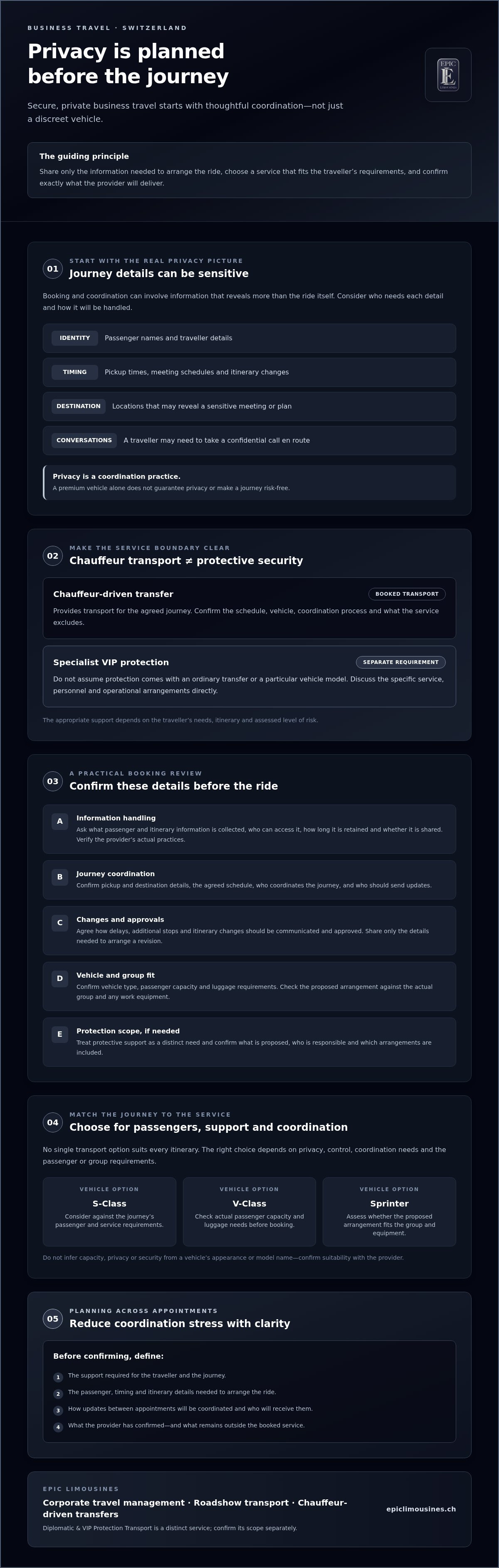
A practical checklist for arranging secure and private business travel
A well-prepared booking can reduce coordination friction while keeping unnecessary passenger and business details out of routine messages. Use these steps to define the requirement, share only what’s needed and confirm the arrangement before the journey.
- 1. Define the journey. Note the number of passengers, luggage needs, pickup and drop-off points, appointment timings and how flexible the schedule may be. Decide whether you need a point-to-point transfer, a vehicle at disposal or another confirmed service format.
- 2. Set information boundaries. Share only the passenger, timing and itinerary details the provider needs to coordinate the requested service. Avoid adding sensitive meeting context or unrelated personal information. If a detail needs careful handling, ask the booking contact how best to provide it.
- 3. Identify any protection requirement. If the traveller needs more than chauffeur transport, state that clearly before booking. Ask whether the specific protection service is available, then confirm its scope, responsible personnel and arrangements directly. Don’t assume it’s included in a standard transfer.
- 4. Confirm the vehicle fit. Check the agreed vehicle category, passenger capacity and luggage requirements with the provider. The booking confirmation should make clear what has been arranged, rather than leaving the organiser to infer suitability from a vehicle model.
- 5. Agree on coordination. Establish who will manage the journey and which contact the organiser or traveller should use for updates. Confirm how delays, approved itinerary changes and additional stops should be communicated, and who must approve them.
- 6. Reconfirm before travel. Review the pickup instructions, timing, contact arrangements and agreed service scope. If a privacy or security procedure has been described as part of the service, verify its details directly instead of relying on a general assurance.
Keep the final confirmation focused. The relevant contact needs enough information to deliver the booked service, but broad circulation of an executive’s full schedule may not be necessary. A clear point of contact and an agreed process for updates can limit repeated messages and reduce last-minute uncertainty.
Use this checklist to make secure and private business travel a considered part of itinerary planning, not an assumption based on the vehicle alone. To discuss your journey requirements with Epic Limousines, contact the team about chauffeur-driven business travel.
How Epic Limousines can support private business travel across Switzerland
Epic Limousines provides corporate travel management, roadshow transport and chauffeur-driven transfers for business journeys across Switzerland. These services can support a well-planned itinerary when the format is matched to passenger needs, appointments and coordination requirements. For secure and private business travel, discuss the arrangements you need and confirm which privacy procedures apply before relying on them.
Choose the vehicle and service format around the brief
The Mercedes-Benz S-Class may suit individual executive travel when it fits the journey. The Mercedes-Benz V-Class and Sprinter are also available for passenger groups. The right choice depends on the party, luggage and itinerary, so confirm capacity, vehicle suitability and availability for your journey. A vehicle category alone doesn’t determine privacy or protection.
Discuss the journey with a dedicated service provider
When enquiring, outline the schedule, number of passengers, coordination priorities and any discretion requirements. Share only the details needed to assess and arrange the requested service, and ask how itinerary information is handled. If a traveller requires protective support, request details of the specialist VIP protection service, including its scope and operational arrangements. Don’t assume protection is included with a chauffeur transfer.
Clear communication at the enquiry stage helps establish what’s requested and what has been confirmed. It also gives the provider an opportunity to clarify whether the proposed service format fits the itinerary, without turning assumptions into commitments. If the schedule involves multiple appointments, mention that when discussing corporate travel management or roadshow transport.
For a discreet business travel enquiry, share your passenger, itinerary and privacy requirements with Epic Limousines. Ask which service format and vehicle options may suit the journey, and confirm availability and applicable arrangements directly.
Make your next business journey more considered
Secure and private business travel begins with clear decisions: choose a transport format that fits the itinerary, confirm what the provider’s service includes, and share only the passenger and schedule details needed to coordinate the journey. Discretion matters, but it shouldn’t be mistaken for protective security. If specialist support is required, confirm its scope and arrangements separately.
Epic Limousines provides corporate travel management, roadshow services and chauffeur-driven transport across Switzerland, with Mercedes-Benz S-Class, V-Class and Sprinter vehicles. The right option depends on the passenger, group and luggage requirements of your journey. Diplomatic transport with VIP protection is a distinct service, so discuss and confirm its scope directly.
A thoughtful enquiry is a practical first step toward a smoother, better-coordinated itinerary. Discuss your business travel requirements with Epic Limousines, including passenger needs, schedule and privacy priorities. With clear expectations in place, you can plan the journey with greater confidence and focus on the work ahead.
Frequently Asked Questions
What does secure and private business travel mean?
Secure and private business travel means choosing transport and coordination arrangements that match the traveller’s privacy and security needs. A pre-arranged chauffeur transfer can provide a defined journey, but it doesn’t automatically include protective security. Before booking, confirm the service scope, what passenger and itinerary details are needed, and how changes will be communicated. If the traveller requires specialist protection, raise that as a separate requirement and confirm the arrangements directly.
Is a chauffeur service the same as VIP protection?
No. A chauffeur service is driver-led transport, while VIP protection is a distinct specialist service that must be explicitly requested and confirmed. Ask the provider what the protection service covers, which personnel are responsible and what operational arrangements apply. Don’t infer protective support from a premium vehicle, discreet presentation or chauffeur booking. Clear answers help you assess whether the confirmed service matches the traveller’s requirements.
How can I keep business travel details private?
Share only the passenger, timing and itinerary information needed to arrange the journey. Use the provider’s designated booking contact for sensitive instructions, and ask who needs access to operational details. Before sending information, clarify how updates should be communicated. Verify the provider’s stated practices for collecting, accessing, retaining and sharing booking data. Don’t assume confidentiality is guaranteed unless the service terms clearly explain what applies.
What should I ask before booking a private business transfer?
Confirm the vehicle category, passenger and luggage suitability, pickup instructions and what the service includes or excludes. Ask who coordinates the booking and how delays, additional stops or schedule changes are communicated and approved. If discretion is a priority, find out how to share sensitive requests. For any protective security requirement, request a separate explanation of the service scope and responsibilities before deciding whether it meets the brief.
Can one chauffeur service support several business appointments?
A vehicle-at-disposal arrangement may suit a day with multiple appointments or a schedule that could change, subject to the provider’s terms and availability. When enquiring, give the expected itinerary and explain where timing may be flexible. Confirm waiting arrangements, authorised stops and the process for communicating updates. Don’t assume these details are included in a booking. Ask the provider to specify what has been agreed.
Does a premium vehicle make business travel more secure?
No. A premium vehicle may suit the traveller’s comfort, passenger and luggage needs, but the model alone doesn’t establish the journey’s security level. Assess the actual service scope and verify any relevant privacy or protection arrangements directly with the provider. If specialist support is needed, request details separately. Choose the vehicle for the journey’s practical requirements, then confirm that the overall arrangement fits the traveller’s needs.