
Calculating ROI on Executive Transport: A Practical Business Guide

What if the lowest transport fare creates the highest total cost for a business trip? The invoice is easy to see; the value of an executive’s time spent travelling, arranging bookings, or managing delays is harder to capture. That’s why calculating ROI on executive transport calls for more than comparing fares. It requires a consistent view of the full journey and the value a transport choice may create.
This guide shows you how to build a transparent model that finance teams can review. You’ll set a fair baseline, compare chauffeur services, taxis, and self-drive options using the same cost categories, and assess potential benefits without treating assumptions as guaranteed savings.
You’ll also learn how to estimate executive time value using an agreed compensation method, record costs in CHF, and assess productivity, administration, and disruption risks when evidence supports them. The result is a practical framework for travel decisions, including how to evaluate corporate travel management and at-disposal services against your organisation’s actual requirements.
Key Takeaways
- Assess transport by attributable business value, not fare alone, and define what counts as a benefit before comparing options.
- When calculating ROI on executive transport, use a consistent formula and include the full journey cost, including relevant administration.
- Compare chauffeur transport, taxis, and self-drive only where they suit the trip, using the same cost, timing, passenger, and operational criteria.
- Run a focused pilot with an agreed baseline, representative trip types, measurement period, and data owner.
- Apply the framework to transfers, at-disposal services, roadshows, and corporate travel, matching requirements to S-Class, V-Class, or Sprinter vehicles.
Why calculating ROI on executive transport takes more than comparing fares
The question isn’t whether premium transport is inherently worthwhile. It’s whether a particular arrangement creates enough measurable business value to justify its full cost for the journeys your organisation actually makes. A lower fare may be the better choice for a straightforward transfer. For a day with several appointments, the business may also need to consider how travel affects an executive’s working time and the continuity of the schedule.
In business terms, return on investment compares benefits attributable to a choice with the costs required to achieve them. The general principles behind Return on Investment (ROI) can help frame the calculation. For transport decisions, use relevant inputs: costs recorded in CHF, a realistic alternative, and a clear explanation of which benefits can reasonably be linked to the transport option.
What does executive transport ROI measure?
ROI is a decision-support measure, not a guarantee of future performance. Its financial side may include the fare and other journey-related expenses, as well as the value of work time that can credibly be recovered during travel. Count only time that is genuinely usable for work; don’t assume every minute in a vehicle becomes productive time. If administration differs between options, record it separately using a consistent method.
Keep distinct categories visible rather than folding every possible advantage into one optimistic figure:
- Fare savings: the difference in full transport cost between comparable options.
- Time value: work time recovered, valued using a method the finance team accepts.
- Operational continuity: the potential business impact of schedule interruptions, assessed against the company’s own records.
- Service quality: privacy, comfort, and the travel experience, which may matter to the organisation but aren’t automatically financial returns.
Report non-financial benefits separately using clear measures, such as recorded schedule changes or passenger feedback. Don’t present them as cash savings unless the organisation can support that valuation.
Which business travel decisions can the calculation support?
The method is most useful when applied to a defined pattern of travel. Assess a one-off transfer on its own terms, while recurring executive trips may reveal a more consistent picture of cost, time, and administration. Multi-stop days and planned business events may need a broader view because several journeys and schedule dependencies form one travel requirement.
Separate occasional transfers from sustained or coordinated needs. A single airport journey may call for a simple comparison; repeated trips, roadshows, or at-disposal requirements may warrant evaluation across a representative set of journeys. The broader planning context is covered in this corporate travel management guide.
Ultimately, calculating ROI on executive transport depends on company-specific inputs: trip purpose, passenger needs, working practices, and the quality of available records. No universal savings claim can replace those details. Make assumptions visible, distinguish financial returns from service considerations, and give decision-makers a fair basis for choosing the option that fits each business requirement.
Build an executive transport ROI calculation from reliable inputs
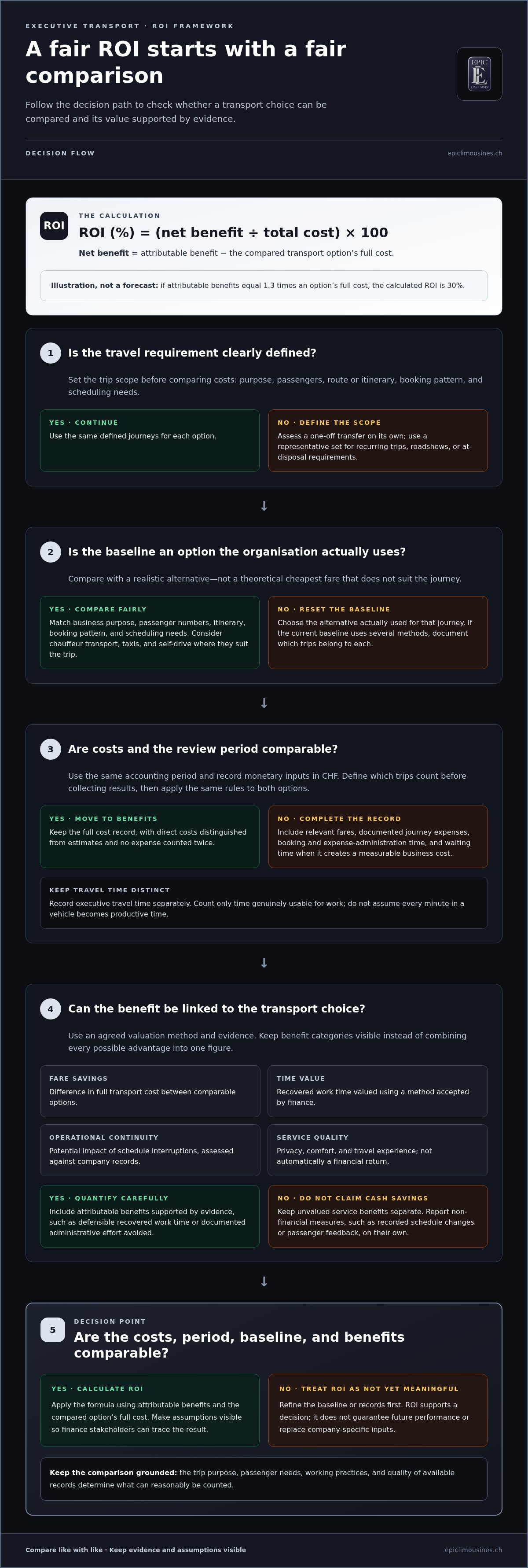
A useful model starts with a defined option, a fair baseline, and benefits that can be tied to the transport decision. Use the same accounting period and record monetary inputs in CHF. Keep financial benefits separate from service considerations, and make assumptions visible so finance stakeholders can trace how you reached the result.
ROI (%) = (net benefit ÷ total cost) × 100
For this model, net benefit = attributable benefit − the compared transport option’s full cost. Attributable benefits might include the defensible value of recovered work time or documented administrative effort avoided. For example, if a hypothetical option produced attributable benefits equal to 1.3 times its full cost, its calculated ROI would be 30%. This illustrates the formula; it isn’t a forecast or a claim about any service.
ROI is meaningful only when costs, period, and baseline are comparable.
Set a fair baseline and comparison period
Choose the alternative the organisation actually uses, not a theoretical cheapest option that isn’t realistic for the journey. Match trips by business purpose, passenger numbers, route or itinerary, booking pattern, and scheduling needs. If the current baseline uses several methods, document which journeys belong to each one instead of combining them without explanation.
Select a review period that captures the frequency and variability of those trips. A short window may overrepresent an unusual delay or unusually simple journey; a longer one may better reflect recurring travel patterns. Define which trips count before collecting results, and apply the same rules to the baseline and the option being assessed.
Gather full costs and defensible value inputs
For each option, build a complete cost record in CHF. Include relevant fares, documented journey expenses, booking and expense-administration time, and waiting time where it creates a measurable business cost. Avoid counting the same expense twice, and distinguish direct costs from estimates. Record executive travel time separately, including how much is genuinely available for work under the organisation’s normal working practices.
Agree in advance how time will be valued. A company might use an approved hourly value based on its own compensation and overhead assumptions, but finance should review the method and it should be applied consistently. Keep source records alongside the calculation, such as invoices, expense records, booking logs, and time entries. Label estimates, state who supplied them, and test whether changing an uncertain input materially changes the result.
Clear ownership of travel data and consistent reporting support a more credible model. These controls are also part of wider corporate travel management. Organisations assessing chauffeur-driven corporate travel can review Epic Limousines’ corporate transport services as one option for their defined requirements.
Compare chauffeur transport with alternatives on equal terms
A fair comparison starts with realistic options for the journey, not every transport method in theory. A taxi, self-drive vehicle, or chauffeur service may suit different passenger numbers, schedules, and itineraries. A higher fare doesn’t prove positive ROI, and it doesn’t rule it out. The result depends on the full cost and evidenced value for the specific requirement.
Use a consistent comparison sheet. The table below identifies categories to assess; enter actual company records and journey details rather than assuming one option is always less expensive or more productive.
| Category | Chauffeur service | Taxi | Self-drive |
|---|---|---|---|
| Cost inputs | Fare and documented booking or administration costs. | Fare and any recorded booking or administration costs. | Vehicle cost, fuel, parking, and other documented journey expenses. |
| Journey time | Record passenger travel time and any usable work time. | Apply the same time measures and definitions. | Include driving time and relevant preparation or parking time. |
| Passenger needs | Assess required capacity against the vehicle selected. | Assess whether the option accommodates the passengers and itinerary. | Consider who will drive and whether the arrangement suits the group. |
| Operational fit | Record booking, waiting, and multi-stop requirements. | Record how the option fits the schedule and planned stops. | Account for vehicle collection or return and itinerary demands where applicable. |
Which costs and trade-offs belong in the comparison?
Include expenses relevant to each option: transport charges, parking, vehicle-related costs, booking administration, waiting time, and other documented journey expenses. Don’t assign self-drive vehicle costs to a taxi or count a cost that doesn’t apply. For multi-stop itineraries, compare the same stops and passenger requirements; otherwise, the options aren’t like for like.
Track passenger time consistently across alternatives. If the model counts time spent travelling as a cost, it can’t also count those same minutes as a productivity benefit. Capacity matters, too: an option that can’t meet the passenger or itinerary requirements isn’t a meaningful baseline for that journey.
How should time, continuity, and discretion be assessed?
Count usable work time only when the executive’s role and the journey conditions make work feasible. Use the same definition for each option, and support claimed time savings with recorded journey durations or documented work practices. To assess continuity, track delays, missed connections, or schedule disruptions in company records, then describe their effect on business activity. Don’t assume a disruption was avoided simply because it didn’t occur during a comparison period.
Privacy, security, and passenger experience can be important decision criteria, but they aren’t automatically monetary returns. Report them separately unless the organisation has a defensible way to value their business impact. For journeys with specialist protection needs, Epic Limousines provides diplomatic and VIP protection transport.
This disciplined approach makes calculating ROI on executive transport more credible: assess each option against the same journey, cost categories, and evidence, while keeping qualitative priorities visible without mistaking them for cash savings.
Test your executive transport ROI assumptions with a focused pilot
A limited pilot lets a company test whether its ROI model reflects actual travel before extending a decision across a broader policy. Treat it as a structured evaluation, not a showcase for a preferred option. Before the first journey, agree which existing arrangement will serve as the baseline, which trip types are in scope, how long the test will run, and who owns the data. This gives finance, travel coordinators, and passengers a shared point of reference.
Choose pilot journeys and success measures
Select journeys that reflect real passenger numbers, timing requirements, and itinerary patterns. If the business case concerns recurring transfers, include representative transfer journeys; if it concerns multi-stop days, include those too. A pilot limited to unusually simple or unusually demanding trips may not reflect typical use. Record exceptional conditions, such as an itinerary change or unusual disruption, so you can interpret them separately rather than letting them silently shape the overall result.
Keep the measures focused on the original decision. Depending on the business case, a scorecard might include:
- Total documented cost: record relevant transport and administrative costs in CHF using the same categories for the pilot and baseline.
- Usable work time: capture travel time and count only the portion the role and journey conditions make available for work.
- Schedule changes: note delays, missed connections, waiting, or other disruptions, with their recorded operational effects.
- Passenger feedback: collect consistent comments on comfort, privacy, and ease of travel, and report these as qualitative observations.
Choose a measurement period that gives the pilot a fair chance to capture the travel pattern being assessed. Set clear start and end points, and define how incomplete records, cancelled trips, and changes in passenger or itinerary requirements will be handled. A named data owner can maintain consistent definitions, follow up on missing entries, and retain the source records behind the summary.
Review results without overstating the business case
At the review, compare observed outcomes with the baseline agreed before the pilot began. Show actual costs and recorded results separately from estimates, passenger opinions, and benefits that remain unproven. Disclose assumptions that could materially affect the conclusion, such as the method used to value executive time or the treatment of unusual trips. This helps stakeholders see what the pilot demonstrates and where uncertainty remains.
Look beyond a single headline ROI figure. Check whether the pattern holds across relevant journey types and booking arrangements, or whether the result is concentrated in one circumstance. If the pilot produces mixed evidence, refine the scope or measurement method rather than generalising from a narrow sample. Use the findings to adjust travel policy and guide future decisions, not to promise that the same outcome will recur.
For organisations assessing chauffeur-driven transfers, at-disposal services, or coordinated corporate travel, a pilot can clarify which requirements matter most. Epic Limousines provides these chauffeur services for business travel; see Epic Limousines’ executive transport services.
Apply the ROI framework to Epic Limousines executive transport
Once the comparison method is defined, apply it to a specific business requirement rather than treating chauffeur transport as a single, uniform expense. Epic Limousines provides chauffeur-driven transfers, at-disposal services, roadshow transport, and corporate travel management. Assess each format against the company’s actual itinerary, passenger needs, baseline option, and agreed measures. The calculation should show what the records support, not presume savings or productivity gains.
Match the service format to the journey requirement
For a defined journey with a clear start and end point, compare a transfer with the method currently used for the same trip. For a schedule involving several appointments or changing stops, an at-disposal service may be a more relevant format to evaluate because the requirement involves chauffeur availability over a period, not just a point-to-point journey. For a roadshow or broader corporate travel need, assess the itinerary as a coordinated pattern instead of isolating one leg.
Then select the vehicle category that fits the brief. The Mercedes-Benz S-Class, V-Class, and Sprinter offer distinct categories for comparison; relate the choice to passenger numbers, itinerary, and other documented requirements. Don’t assume a particular vehicle category will create a financial return. Record the selected format and why it fits, then assess its full cost and any attributable benefits against the agreed baseline.
Turn the calculation into a practical next step
Prepare a concise brief before requesting or reviewing a transport arrangement. This keeps the evaluation grounded in operational needs and gives decision-makers a clear record of what they are comparing. Include:
- Journey pattern: define whether the requirement is a transfer, multi-stop schedule, roadshow, or recurring corporate travel.
- Baseline: identify the existing realistic alternative and comparable trips for the assessment.
- Service format: state the required arrangement and the vehicle category being considered, based on passenger and itinerary needs.
- Evaluation measures: specify which costs, usable work time, schedule changes, and passenger feedback will be recorded, and who owns the data.
This gives Epic Limousines a clear basis for discussing a tailored executive transport brief, while leaving the ROI conclusion to the evidence gathered by the company. Keep anticipated time or operational benefits as assumptions until the organisation measures them. Service quality, privacy, and passenger comfort can still inform the decision, but report them separately from financial returns unless there is a defensible basis for valuation.
For a discreet conversation about your organisation’s journey pattern and service requirements, discuss your executive transport requirements with Epic Limousines. A well-defined brief supports a relevant assessment; calculating ROI on executive transport remains specific to the trips, costs, and outcomes your business can document.
Make your next transport decision with confidence
A useful ROI model can support more than a single approval. It gives your organisation a consistent way to review future travel choices as schedules, passenger needs, and business priorities evolve. Keep assumptions visible, revisit them when circumstances change, and let measured evidence guide adjustments rather than relying on a result that may not apply to every journey.
Calculating ROI on executive transport is ultimately about making a considered decision for your own requirements. Financial measures can sit alongside service priorities such as discretion and passenger comfort, giving stakeholders a fuller view without presenting qualitative value as guaranteed savings. With a clear brief, your team can evaluate whether a tailored chauffeur arrangement fits the way your executives travel.
Epic Limousines provides premium chauffeur-driven transport using Mercedes-Benz vehicles. Discuss a tailored executive transport solution and take the next step with a clear brief.
Frequently Asked Questions
Is ROI on executive transport only about reducing transport costs?
No. A sound assessment can include direct journey expenses and measurable business value, not just a lower fare. For example, a company might examine whether a transport arrangement better supports a tightly scheduled client day, then compare recorded schedule changes with its usual approach. Keep operational evidence separate from financial returns unless its impact can be credibly valued. A higher-cost option may still fit a business need, but comparable evidence is needed to establish whether it delivers positive ROI.
Can executive transport ROI include the value of an executive’s time?
Yes, provided the company uses a consistent valuation method and counts each hour only once. Distinguish time genuinely available for focused work from time spent travelling, waiting, or handling trip-related tasks. An internal hourly value estimates potential business value; it doesn’t necessarily represent money saved or additional revenue earned. When calculating ROI on executive transport, label that distinction clearly and test whether a different reasonable time value changes the conclusion.
How long should an executive transport ROI pilot run?
There’s no fixed duration that suits every organisation. Set a review date that allows the pilot to include the journey types and scheduling variation relevant to the decision. If travel is infrequent, a meaningful sample of comparable trips may be more informative than an arbitrary calendar window. Decide in advance how to handle cancellations, incomplete records, or unusual events, and report clearly if the sample is too limited to support a broader conclusion.
What data should finance retain when reviewing executive transport ROI?
Keep enough documentation for another reviewer to reproduce the comparison. This typically includes journey records, invoices, trip purpose, passenger and itinerary requirements, the selected baseline, and the method used to value time. Record the review period, unusual circumstances, and estimates with their sources. A concise calculation file can link each input to supporting records. Follow your organisation’s policies for financial documentation and the handling of personal or travel information.
Does executive transport ROI include environmental impact?
Environmental impact can be reported alongside financial ROI if the organisation has selected a consistent emissions method and has suitable journey data. For example, a company could track emissions for comparable itineraries as a separate indicator in its travel review. Don’t combine that figure with financial returns unless the business has explicitly chosen and documented a method to value it. Separate reporting makes the basis of each measure clear and avoids treating one as a substitute for the other.
What is the difference between ROI and a transport budget comparison?
A budget comparison shows what different arrangements cost or are expected to cost. ROI asks whether defined benefits justify the cost over a stated period. A budget review might show that one option requires less expenditure, while an ROI assessment also considers evidenced time value or operational effects. The budget view remains useful for cost control; ROI adds a benefits perspective. Both are most useful when they use the same trips and assumptions.
Can executive transport show positive ROI when travel is occasional?
It can be assessed, but occasional travel may leave too little evidence to support a broad claim. Compare trips with similar purposes and requirements, such as a small set of planned client visits, rather than extrapolating from one unusual journey. If the financial case remains uncertain, present service or operational priorities separately and describe the decision as a broader business case. That gives decision-makers a fair view without overstating what limited data can establish.