Client Transportation Best Practices: A Practical Checklist for a Seamless Journey

What if the smoothest client journey begins before the vehicle arrives? The route may be straightforward, but unclear passenger needs, schedule changes, or missed pickup details can turn a planned trip into a distraction. The most effective client transportation best practices start with the passenger and the purpose of the journey, then align the vehicle, timing, stops, and communication around them.
That passenger-first approach matters to both the traveller and the host. A comfortable, well-coordinated journey gives clients space to settle in, while thoughtful planning makes the arrangements feel like a natural extension of the visit.
This practical checklist takes you from booking through arrival. It explains how to choose a chauffeur-driven format for an individual traveller, a small group, or a larger party, coordinate multiple stops and itinerary changes, and keep passengers informed. When the details are considered in advance, transportation across Switzerland can feel calm, discreet, and well managed from pickup to arrival.
Key Takeaways
- Use client transportation best practices to shape each journey around its purpose, passenger needs, and expected experience.
- Gather the practical details that help align timing, vehicle choice, luggage, and communication before travel begins.
- Match point-to-point transfers, at-disposal service, or event transport to the itinerary rather than defaulting to one format.
- Make pickup instructions, contact responsibilities, and arrival arrangements clear so everyone knows what to expect.
- Use professional chauffeur service to simplify coordination when a journey involves multiple stops or guests.
Client Transportation Best Practices Start with the Passenger Experience
Client transportation is a planned passenger journey shaped by its purpose, the people travelling, the timing, and the information they need along the way. The route matters, but it is only one part of the arrangement. An executive travelling alone has different needs from invited guests arriving together or attendees moving between event commitments.
That distinction changes how you measure success. Reaching the destination meets the basic requirement, but a well-planned journey also makes the arrangements easy to understand and the experience comfortable and composed. Passengers know where and when to meet, who is coordinating the pickup, and what to expect if the itinerary includes more than one stop. The host can focus on the meeting or event instead of resolving avoidable uncertainty.
Transportation also contributes to the host’s professional impression. Clear instructions, a suitable vehicle, and attentive chauffeur service show consideration without requiring grand gestures. The modes of transport available are only one part of the decision. The passenger’s experience depends on how well the chosen format fits the occasion and how clearly the arrangements are communicated.
Passenger-centred transportation is planned around what travellers need to know, where they need to go, and how they are expected to feel along the way. This principle is a practical starting point for client transportation best practices. The checklist in this guide applies to private, corporate, and event-related journeys, with the level of planning matched to each itinerary.
What makes client transportation feel seamless?
Seamlessness comes from details working together: clear arrangements, considerate service, a vehicle suited to the passenger and occasion, and an arrival that feels unhurried. Before the journey, passengers should know the pickup time and point, how to identify their transport, and whom to contact about a change. An airport guest, for example, needs concise meeting instructions that account for their arrival. A meeting guest may need a clear handoff plan. Useful communication removes guesswork without overwhelming the traveller.
Which client journeys benefit from advance planning?
A single transfer may need only a confirmed pickup, destination, and passenger instructions. A multi-stop executive itinerary requires coordination across appointments, waiting periods, and possible timing changes. Airport journeys call for clear arrival and meeting arrangements; guest transfers may involve several passengers with different schedules. Private events can require planned arrival windows and departure arrangements. Match the level of coordination to the journey instead of applying a one-size-fits-all process.
For the host, a useful first question is not simply, “Where is the passenger going?” Consider what the traveller needs to be ready for, what could complicate the schedule, and which details will help them feel informed. This keeps planning proportionate: straightforward transfers stay simple, while more involved itineraries receive attention to their moving parts.
Plan Client Transportation Around Needs, Timing, and Itinerary
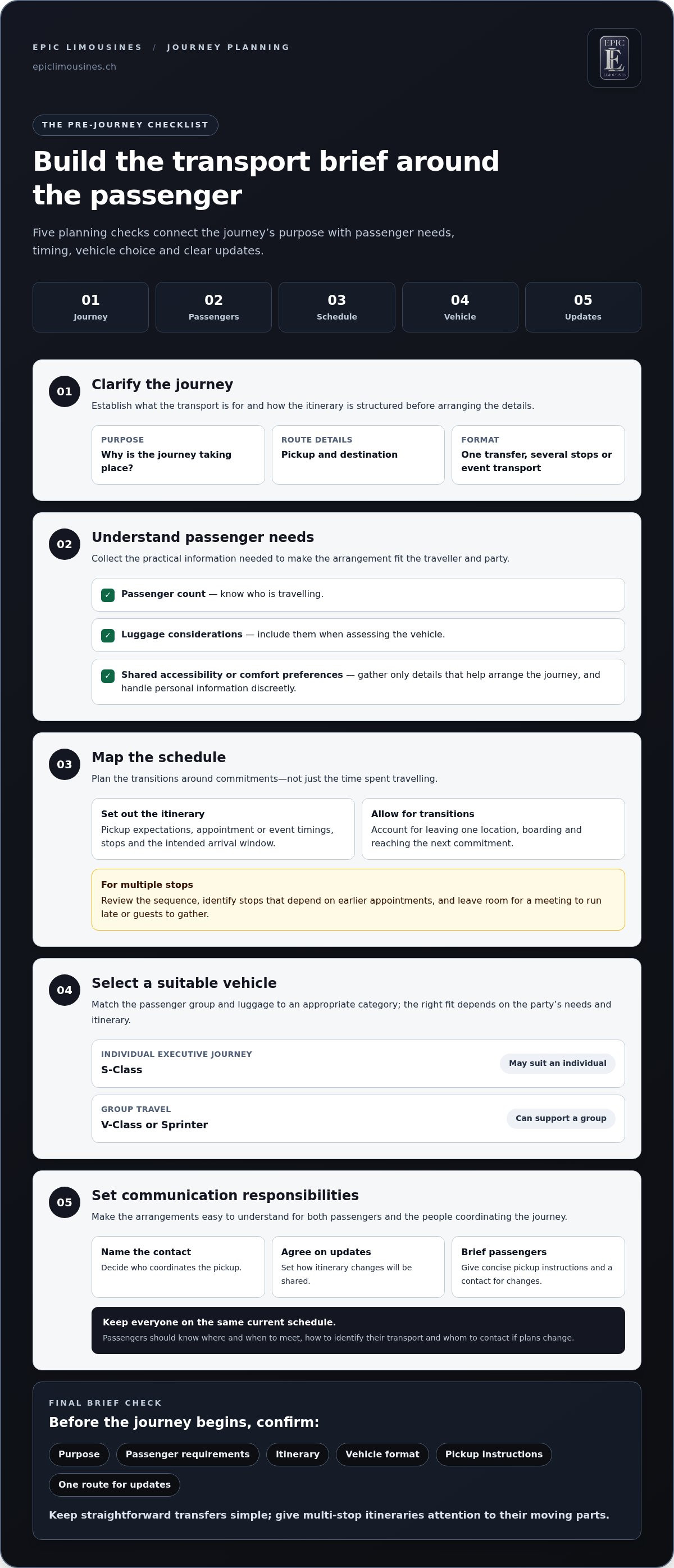
A considered plan turns a transport request into a clear working brief. Start with the journey’s purpose, then establish who is travelling, what the schedule requires, which vehicle format suits the group, and how updates will be shared. These client transportation best practices connect passenger needs with the realities of the itinerary instead of treating each detail in isolation.
- Clarify the journey. Record the purpose, pickup and destination details, and whether the arrangement is a single transfer, several stops, or transport for an event. The purpose helps determine the level of coordination required.
- Understand passenger needs. Note the passenger count, luggage considerations, and any accessibility or comfort preferences the traveller has shared. Gather only information that helps arrange the journey, and handle personal details discreetly.
- Map the schedule. Set out pickup expectations, appointment or event timings, stops, and the intended arrival window. Account for the time passengers need to leave one location, board, and reach the next commitment. Travel time is not the only transition to plan.
- Select a suitable vehicle. Match the passenger group and luggage to an appropriate category. An S-Class may suit an individual executive journey, while a V-Class or Sprinter can support group travel, depending on the party’s needs and itinerary.
- Set communication responsibilities. Name the coordination contact, agree how itinerary changes will be shared, and give passengers concise pickup instructions. Make sure everyone involved is working from the same current schedule.
For multiple stops, leave room in the itinerary for the unexpected. A meeting may finish later than planned, or guests may need time to gather before departure. Review the sequence, identify which stops depend on earlier appointments, and make timing expectations clear to the people coordinating the journey rather than assuming every transition will take a fixed amount of time.
Before a client journey begins, settle the purpose, passenger requirements, itinerary, vehicle format, pickup instructions, and one route for updates.
What should the transport brief include?
Keep the brief practical and easy to act on. Include passenger numbers, luggage needs, pickup details, and the journey’s purpose, along with any comfort or accessibility preferences the passenger has shared. List every stop and its timing expectation, then identify the person coordinating the arrangement. This gives the chauffeur and planning team a shared reference without collecting unnecessary personal information.
How should planners prepare for schedule changes?
Decide in advance who can communicate an update and how it will reach the chauffeur. If a meeting moves or an event runs late, the designated contact should share the revised instruction through the agreed channel and ensure the passenger receives the same information. Maintain one current itinerary instead of allowing separate versions to circulate. Build flexibility into the coordination plan, not into promises of fixed journey times.
Epic Limousines provides chauffeur-driven transfers and at-disposal services for journeys planned around the passenger’s needs and itinerary.
Choose the Right Client Transportation Format for the Journey
No single transport format suits every itinerary. A direct airport arrival, a day of appointments, and a private event have different coordination needs. Start with the shape of the journey, then match the vehicle category to the passenger group, luggage, occasion, and desired privacy. This keeps the arrangement purposeful rather than defaulting to the same solution for every client.
Point-to-point transfer: Suits a defined pickup and destination with a clear travel window. Share accurate meeting instructions and arrival details in advance. If the plan includes scheduled stops or extended waiting, consider whether a direct transfer still fits.
At-disposal service: Suits itineraries with several appointments, waiting periods, or a schedule that may evolve. The chauffeur remains at the client’s disposal for the agreed arrangement, supporting continuity between planned commitments.
Event transport: Works well when guests need coordinated arrivals or departures around an event schedule. A central transport contact and consistent passenger instructions help keep arrangements clear across the group.
Vehicle choice is part of the same decision. An S-Class may suit an individual passenger or a journey where privacy is a priority. A V-Class or Sprinter can suit group travel, with the choice shaped by passenger count, luggage, and occasion. Do not assume that a larger party has uniform luggage needs or preferences. Consider the complete journey before choosing a format.
When is a point-to-point transfer the practical choice?
Choose a point-to-point transfer when the pickup, destination, and travel window are established, such as a guest journey between an arrival point and a meeting. Provide precise pickup guidance and relevant arrival information so the passenger knows where to go and what to expect. A direct transfer differs from an itinerary with several timed stops, which may need more ongoing coordination.
When does an at-disposal or event service make sense?
An at-disposal arrangement can suit an executive with multiple appointments or a private client whose plans involve a sequence of commitments. Event transport benefits from a central coordinator who can keep pickup instructions, passenger details, and schedule updates aligned. For broader business travel planning, see this corporate travel management guide.
Before selecting a format, ask whether the journey has one destination or several, whether the schedule is fixed or likely to shift, and whether passengers are travelling individually or together. These questions connect itinerary structure to the service arrangement and vehicle category. Applying this part of client transportation best practices helps hosts arrange suitable travel without asking passengers to adapt to a format that does not fit their plans.
Use This Client Transportation Checklist Before and During the Journey
A clear checklist helps the host keep each handoff composed, from final preparation to arrival. Use it as a shared reference for the people coordinating the journey, not as another layer of administration. These client transportation best practices help keep instructions consistent, protect passenger privacy, and communicate changes without creating unnecessary concern.
Before pickup: confirm the essentials
Before the journey, review the agreed itinerary and practical details that affect the passenger experience. Make sure the host and relevant coordinator know who is responsible for updates. Limit personal information to those who need it to coordinate the transport, and share instructions in a form that is easy to follow.
- Preparation: Recheck the pickup and destination, every planned stop, and timing expectations. Confirm that the planning team is using the current itinerary.
- Passenger instructions: Make sure the passenger has clear pickup guidance, including the meeting point and the agreed way to identify the chauffeur or vehicle.
- Vehicle and luggage: Confirm that the selected vehicle category suits the passenger group and luggage needs. Pass on relevant comfort or accessibility preferences shared for the journey.
- Contact responsibility: Identify the designated coordinator and the agreed channel for updates. The host and relevant team members should know who will communicate changes.
During and after the journey: keep coordination composed
Once travel begins, communication should be discreet, concise, and useful. Send an update when it changes an instruction or next step, rather than repeatedly messaging the passenger. If the schedule shifts, share the revised detail calmly through the agreed channel, then make sure the passenger and the people coordinating the arrival have consistent information.
- Pickup: Keep the handoff orderly. If the passenger needs help finding the meeting point, provide clear directions through the designated contact.
- Journey communication: Send actionable updates, such as a changed stop or revised arrival arrangement. Avoid unnecessary interruptions or over-familiar messages.
- Schedule changes: Have the designated contact relay the change to the chauffeur and relevant team members. Use the current itinerary so conflicting instructions do not circulate.
- Arrival: Confirm that the passenger has reached the intended destination, then hand off any remaining coordination to the appropriate host or event contact.
A calm process depends on clarity, not constant communication. Match the level of coordination to the itinerary, keep the passenger informed, and respect their preference for privacy throughout the journey. Epic Limousines provides chauffeur support for client transfers and at-disposal travel through its chauffeur services.
Make Professional Chauffeur Service the Natural Next Step
A professional chauffeur arrangement can ease the host’s coordination role when a journey involves several passengers, multiple stops, a structured event, or a schedule that may change. Instead of managing each movement personally, the host can work from a defined transport plan that brings passenger instructions, vehicle choice, and itinerary together. A straightforward transfer can stay simple; a more involved schedule benefits from a service format designed around its structure.
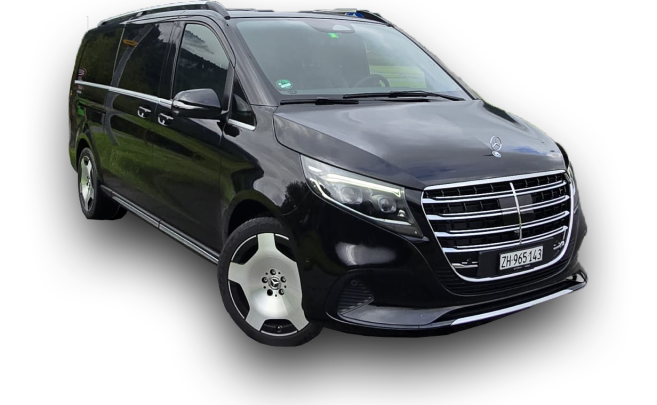
Epic Limousines provides private, corporate, event, and VIP transport across Switzerland. Its chauffeur services include transfers and at-disposal arrangements, using Mercedes-Benz S-Class, V-Class, and Sprinter vehicles. The choice can reflect the traveller, group, luggage, occasion, and desired level of privacy, rather than treating every client journey as interchangeable.
What a chauffeur partner can bring to client journeys
A dedicated chauffeur and a coordinated journey give the host a clear focus for transport arrangements while the passenger can travel without managing each leg themselves. A defined transfer may suit a guest’s arrival, while an at-disposal arrangement can support a sequence of business appointments. Event journeys may need a central plan for guest movements. Discreet specialist travel has its own considerations; Epic’s diplomatic transport guide explores this context.
The benefit is not a promise that plans will never change. It is a considered way to manage the details: an agreed itinerary, clear communication responsibilities, and transport suited to the purpose. That structure can reduce the host’s need to relay separate instructions or resolve avoidable confusion as the journey unfolds.
Turn the checklist into a tailored transport plan
To begin, bring together four essentials: the journey’s purpose, the full itinerary, passenger needs, and timing expectations. Add practical notes such as luggage considerations, pickup instructions, and the person responsible for updates. These details help match the traveller’s requirements to the appropriate service format, whether the plan calls for a single transfer, a multi-stop schedule, or event transport.
These are the foundations of client transportation best practices: thoughtful planning, suitable chauffeur service, and communication that keeps the passenger experience at the centre. Epic Limousines tailors transfer and at-disposal services to the shape of your journey, with vehicle categories for individual travellers and groups.
Share your journey requirements with Epic Limousines to discuss a tailored chauffeur arrangement.
Make Your Next Client Journey Even More Considered
Let each journey set a stronger standard for the next. After arrival, note what helped the passenger feel at ease and where coordination could be clearer. A brief, discreet review can turn client transportation best practices into a thoughtful routine, refined over time without adding unnecessary steps to the host’s role.
Consider assigning one person to own the transport brief from planning through arrival. That continuity helps keep passenger instructions aligned if the itinerary changes and makes future arrangements easier to adapt to the occasion. The result is not simply a smoother transfer, but a more considered expression of hospitality.
When you’re ready to plan transportation for your guests, clients, or event, contact Epic Limousines to arrange a chauffeur service.
Frequently Asked Questions
What are the most important client transportation best practices?
The most important client transportation best practices are to assign one coordinator, give the passenger clear instructions, and keep the latest itinerary accessible to everyone involved. Before travel, consider what the passenger needs to know at each handoff, not just at the first pickup. For a guest arriving for a meeting, for example, a named contact and clear arrival plan can prevent uncertainty if the host is occupied.
How far in advance should client transportation be arranged?
Arrange transportation as soon as the journey details are stable enough to plan. Earlier planning is especially useful for events, group travel, or itineraries involving several scheduled stops, because it gives the host time to align passenger details, vehicle category, and instructions. A simple transfer may need fewer coordination steps. Set the planning timeline according to the complexity and importance of the journey rather than relying on a universal booking window.
Can a chauffeur service accommodate itinerary changes?
Itinerary changes can be communicated for coordination, but their effect depends on the revised route, timing, and commitments already in the schedule. Send the update through the designated contact and state exactly what has changed: the pickup time, stop, destination, or passenger instructions. Avoid sending different versions to separate people. For a multi-appointment day, notify the coordinator as soon as a change is known so the journey plan can be adjusted coherently.
How do I choose the right vehicle for clients and their luggage?
Choose a vehicle category by considering the number of passengers, the amount and type of luggage, the occasion, and the privacy the traveller prefers. A solo executive with light luggage may have different needs from several guests carrying cases to an event. Epic Limousines offers Mercedes-Benz S-Class, V-Class, and Sprinter vehicles. Share a realistic picture of the group and luggage so the arrangement suits the complete journey.
What information should I provide when arranging client transportation?
Provide the journey purpose, passenger count, pickup and destination details, requested timing, stops, luggage considerations, and a reliable coordination contact. For an airport pickup, include the passenger’s arrival details and clear meeting instructions; for an event, specify the relevant arrival or departure window. Share only personal information that helps coordinate the journey, and make sure the passenger knows whom to reach if their plans change.
Is a chauffeur service suitable for corporate guests and private clients?
Yes. Chauffeur-driven transport can suit corporate guests and private clients when the arrangement is planned around the traveller and occasion. A business visitor may benefit from a coordinated transfer between appointments, while a private guest may value a more individual journey. Epic Limousines provides transport for private, corporate, event, and VIP journeys, with the service format shaped around the itinerary rather than a single standard approach.
What should happen if a passenger’s schedule changes on the day?
The passenger or host should notify the designated coordinator promptly, sharing the new timing or destination and any effect on later stops. The coordinator can then relay one clear update to the chauffeur and relevant people, and ensure the passenger receives the same instructions. If the change affects an event handoff or another appointment, revise that arrangement too. Keep the message calm and practical so the traveller can focus on the next step.