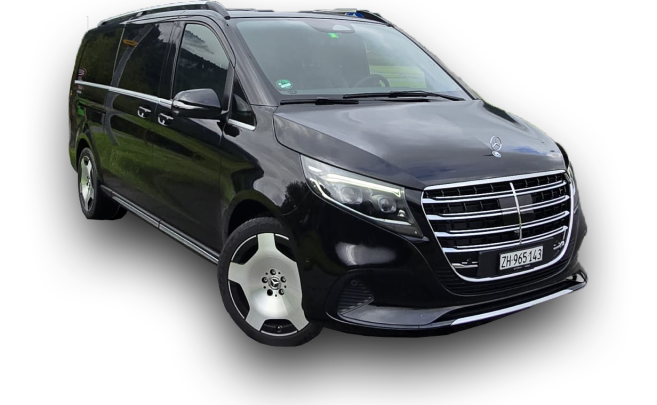
Diplomatic Car Service: A Discreet Planning Guide
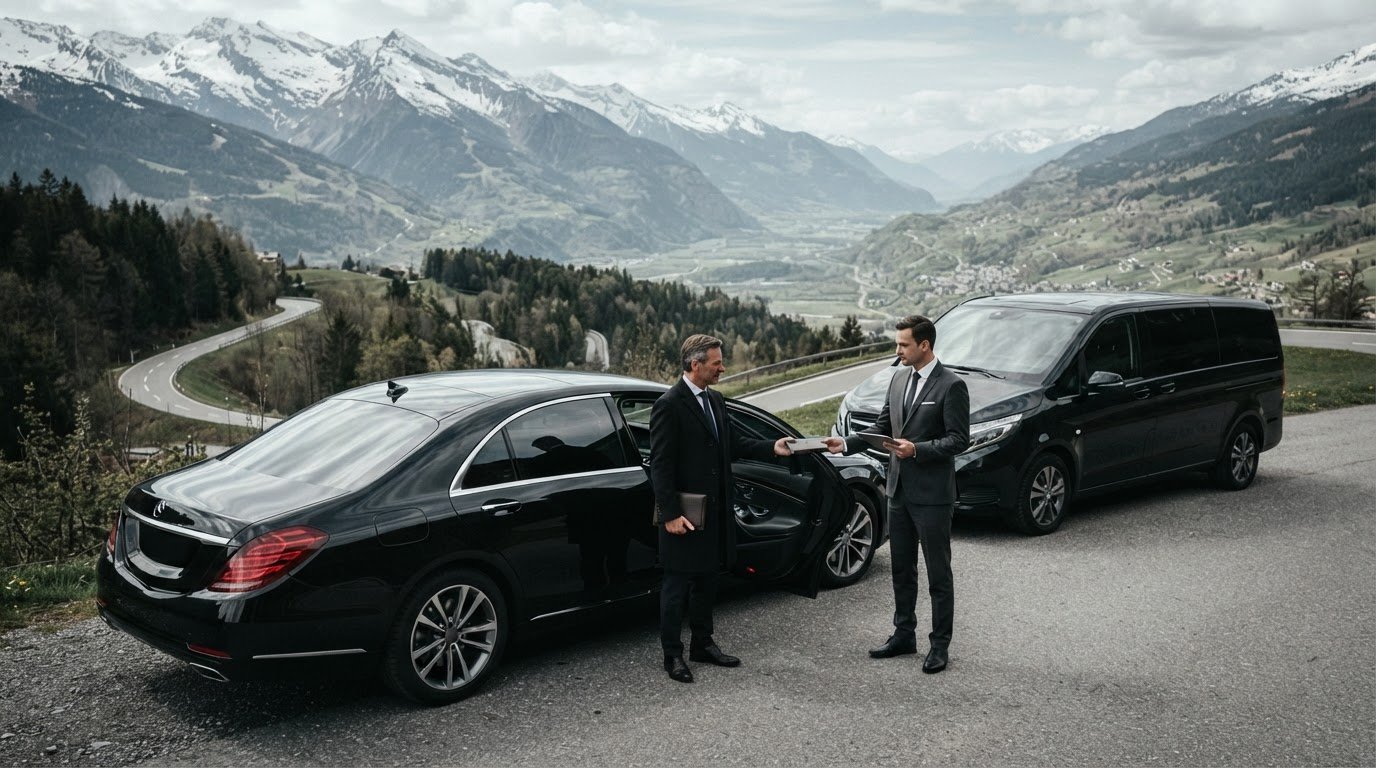
What makes diplomatic transport dependable isn’t the vehicle alone, but the coordination behind every handover, itinerary change and passenger interaction. A clear protocol for diplomatic car service helps the mission, transport coordinator and chauffeur understand their respective roles while keeping sensitive details on a need-to-know basis. When those arrangements are defined in advance, the journey can feel composed even when plans shift.
It’s reasonable to expect discretion, punctuality and respect for mission requirements, alongside a comfortable and flexible experience for each passenger. This guide explains how to prepare a concise transport brief, share only the information needed for the service, and coordinate arrivals and updates with minimal disruption. It also covers choosing a vehicle format suited to the journey, from a Mercedes-Benz S-Class for an individual passenger to a V-Class or Sprinter for a group. With thoughtful planning and a professional chauffeur service, diplomatic transport can fit smoothly into a wider mission plan.
Key Takeaways
- A clear protocol for diplomatic car service assigns responsibilities across the mission, transport coordinator and chauffeur.
- Share the journey details needed for smooth transport while limiting access to sensitive passenger and itinerary information.
- Distinguish transport arrangements from mission-led security responsibilities; a premium vehicle and chauffeur don’t guarantee personal security.
- Use a structured checklist to prepare passenger requirements, pickup instructions, luggage, accessibility needs and approved contacts.
- Match the vehicle category to the journey, with S-Class, V-Class and Sprinter options for different passenger and group needs.
What a Protocol for Diplomatic Car Service Should Achieve
A diplomatic car-service protocol is an agreed, assignment-specific framework for planning the journey, communicating necessary information, maintaining discretion and managing handovers. It gives the mission, transport coordinator and chauffeur a shared understanding of the service without suggesting that one procedure suits every delegation.
A useful protocol turns expectations into practical instructions: who provides the itinerary, which pickup details the chauffeur needs, how changes are communicated, and who receives the passenger at a handover. It can also record service preferences, such as the preferred form of address or arrival arrangements. These details help the service meet the mission’s requirements and support a composed passenger experience. They don’t replace the mission’s security arrangements or determine who has authority over them.
Courtesy and ceremony should be distinguished from operational security. A preferred greeting, seating arrangement or presentation may shape the chauffeur’s service. Decisions about personal security, protective measures or changes to a mission’s security plan belong to authorised mission representatives. A transport provider carries out agreed transport arrangements rather than making those decisions. Diplomatic immunity is a separate legal principle; a transport brief neither grants nor changes any legal status or protection.
How diplomatic transport differs from ordinary executive travel
Routine executive travel may involve a pickup and destination with limited coordination. Diplomatic transport can call for a more carefully agreed brief because official roles, mission preferences and confidentiality affect what is shared and how the service is delivered. The itinerary might include several scheduled movements, named handover contacts or specific instructions for greeting a passenger.
Requirements vary by mission, passenger and assignment. One journey may prioritise a discreet arrival and direct transfer; another may involve coordinated movements for several passengers. Base the protocol on the actual assignment rather than assumptions about a person’s title or status.
Who should define and approve the transport brief?
The mission’s designated organiser should provide and approve passenger instructions and protocol preferences. That organiser can identify the authorised contact for updates and clarify which itinerary details are necessary for the transport arrangement. Keeping the brief focused helps prevent sensitive information from circulating more widely than needed.
The transport coordinator turns approved instructions into operational details, while the provider and chauffeur carry out the agreed service. Their role is to deliver the journey with professionalism, discretion and courteous communication, not to set mission policy or assume security authority. Clear ownership also makes changes easier to route to the right person and keeps responsibilities distinct.
How to Coordinate Diplomatic Chauffeur Transport Before the Journey
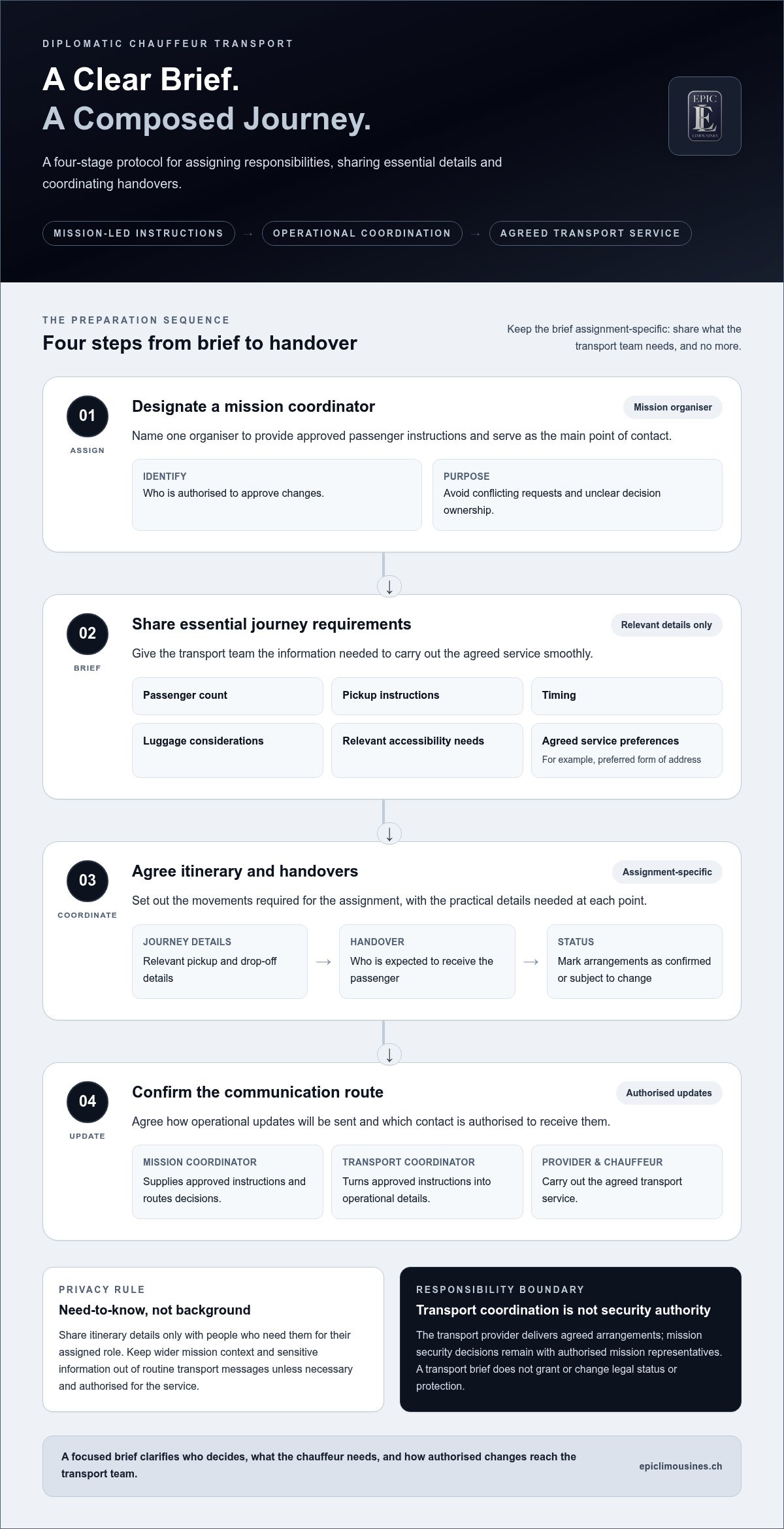
A calm journey starts with a concise brief and clear ownership of decisions. A practical protocol for diplomatic car service should make it easy to identify who supplies the instructions, what the chauffeur needs to deliver the trip, and where authorised updates should go. Use this sequence to prepare the arrangement:
- 1. Designate a mission coordinator. Name one organiser to provide approved passenger instructions and act as the main point of contact. Identify who can approve changes, so the chauffeur isn’t left to interpret conflicting requests.
- 2. Share essential journey requirements. Provide the passenger count, pickup instructions, timing, luggage considerations and any accessibility needs relevant to the service. Include agreed preferences, such as the preferred form of address, when they affect the passenger experience.
- 3. Agree the itinerary and handovers. Set out the movements needed for the assignment, including relevant pickup and drop-off details and who is expected at each handover. Mark which arrangements are confirmed and which may still change.
- 4. Confirm the communication route. Agree how operational updates will be sent and which contact is authorised to receive them. Make sure the coordinator, transport provider and chauffeur understand their respective roles.
What belongs in a confidential transport brief?
Include enough information to carry out the journey smoothly, but leave out unrelated background. The chauffeur may need the pickup point, agreed timing, passenger count, luggage requirements and relevant accessibility information. Share itinerary details only with people who need them for their assigned role. Keep wider mission context or sensitive information out of routine transport messages unless it is necessary and authorised for the service.
For context, the U.S. Department of State has discussed specialised vehicles in diplomatic security arrangements. Its article on diplomatic security vehicle standards concerns that security context. It shouldn’t be treated as a transport provider’s security procedure or as a specification for every diplomatic journey. Vehicle and security decisions remain within the mission’s arrangements.
How to manage changes while protecting privacy
Before departure, agree who can approve a change to timing or itinerary and how that decision reaches the transport team. If plans shift, the coordinator can send the relevant operational update through the organiser’s chosen channel, sharing only what the recipient needs to act. Avoid publishing passenger movements, casually forwarding itinerary messages or repeating sensitive details to people who aren’t involved.
This approach allows flexibility without blurring authority. Epic Limousines provides diplomatic chauffeur transport coordinated around the assignment’s approved requirements.
What a Diplomatic Car Service Can, and Cannot, Guarantee
A premium vehicle and professional chauffeur can support a composed, well-coordinated journey, but they don’t guarantee personal security or risk-free travel. A transport service can deliver agreed vehicle and journey arrangements with discretion and careful communication. Decisions about passenger protection, including any assessment of security needs, remain with the mission and its authorised representatives. A protocol for diplomatic car service should make that boundary clear.
| Area | Who is responsible | What it covers |
|---|---|---|
| Transport responsibilities | Transport provider and chauffeur | Delivering the agreed vehicle and chauffeur service, following approved pickup instructions, and coordinating the journey as briefed. |
| Mission responsibilities | Mission and authorised security representatives | Setting protection requirements, assessing security considerations and making decisions about protective arrangements. |
| Joint coordination | Mission organiser and transport coordinator | Agreeing service details, relevant timing, passenger requirements, handovers and the communication route for updates. |
Transport responsibilities versus mission security responsibilities
The transport provider carries out the agreed journey; it doesn’t set the mission’s security policy or replace its security team. If the mission directs a change to the transport arrangement, the provider can coordinate the transport implications with the designated organiser. Operational arrangements should follow the mission’s direction. Discretion, punctuality and clear communication are service priorities, not promises that every risk can be prevented.
How to compare service models without overclaiming
Choose a service format according to the journey, passenger needs and coordination requirements, rather than relying on unsupported security labels.
- Point-to-point transfer: Suits a defined journey between an agreed pickup and destination. The brief can focus on timing, pickup instructions, luggage and the passenger handover.
- Hourly chauffeur service: Can suit an itinerary with several scheduled movements or a changing programme, with the mission organiser directing any adjustments.
- Group transport: A V-Class or Sprinter can suit different group and delegation requirements. Confirm passenger and luggage needs in the brief so the vehicle category fits the assignment.
Compare each format by how well it supports coordination, limits information-sharing to what is needed, and fits the passenger group. For further context on chauffeur arrangements, read this diplomatic transport guide. A carefully planned service can contribute to a mission-led journey while leaving protection decisions where they belong: with authorised mission representatives.
A Practical Diplomatic Car-Service Protocol Checklist
A reusable checklist helps turn a mission’s approved requirements into a clear service brief, while keeping unnecessary personal and itinerary details out of routine communications. Its purpose is consistent coordination without unnecessary disclosure. Adapt each item to the assignment rather than treating the checklist as a universal diplomatic rule.
Before confirming the journey
- Briefing: Identify the mission’s designated organiser and approved communication contact. Note passenger count, relevant accessibility needs, luggage considerations and any stated protocol preferences.
- Service format: Confirm the preferred arrangement and vehicle needs in light of the passenger group and journey. Avoid requesting personal information that has no bearing on providing the transport.
- Pre-journey coordination: Record the pickup instructions, agreed timing and itinerary details needed to deliver the journey. Decide which details the transport provider needs and which should remain within the mission.
- Updates: Agree the communication channel and identify who can approve changes to the timing or itinerary. Keep the authorised contact details accessible to the people coordinating the assignment.
This is the practical core of a protocol for diplomatic car service: a concise, mission-approved brief that gives each person the information needed for their role without broadly circulating sensitive details.
During and after the transport assignment
- Service delivery: Follow the agreed pickup instructions and use the approved channel for operational updates. If timing or instructions change, communicate the relevant update to the designated contact rather than forwarding the full itinerary widely.
- Passenger experience: Keep interactions courteous and discreet, following the organiser’s stated preferences for greetings, communication and handovers.
- Post-journey review: Invite the organiser to note what supported a smooth journey and what could be clarified for the next assignment. Keep only information the organiser requires for coordination or review, and handle it with care.
When diplomatic movements are part of a wider corporate travel programme, the same principles of defined responsibilities and controlled information-sharing can support broader planning. The guide to Swiss corporate travel management offers related coordination context.
Epic Limousines’ diplomatic transport service provides chauffeur arrangements shaped around a mission’s approved brief.
How Epic Limousines Delivers Diplomatic Transport with Discretion
Epic Limousines provides chauffeur-driven transport for diplomatic and VIP journeys across Switzerland, as a transport partner within the mission’s wider plan. The service is organised around the agreed brief: the passenger’s journey, preferred vehicle category, relevant protocol preferences and approved channel for operational updates. This gives organisers a clear framework for coordinating the drive while keeping the mission’s authority and security arrangements distinct from the transport service.
Matching the vehicle category to the delegation
The right vehicle depends on who is travelling and how the journey is arranged. A Mercedes-Benz S-Class suits individual executive travel where a premium saloon is appropriate. A Mercedes-Benz V-Class is an option for passengers travelling together, while a Mercedes-Benz Sprinter can serve group-transport requirements. The brief can establish the intended use and relevant passenger or luggage needs, helping align the vehicle category with the assignment without assuming one format suits every delegation.
Turning the agreed protocol into a composed journey
A clear transport brief connects practical details with thoughtful hospitality. Agreed timing helps organise movements; passenger preferences guide the service style; and a defined communication route gives the organiser a consistent point of coordination if instructions change. Discretion is reflected in careful handling of journey information and courteous, unobtrusive chauffeur service. These service priorities support a composed passenger experience, but don’t replace the mission’s security arrangements or guarantee a particular security outcome.
For broader context on chauffeur arrangements and executive journeys, explore the executive travel service guide. The same planning principles can help organisers turn a protocol for diplomatic car service into a practical, tailored brief, from passenger requirements to the flow of journey updates.
With the planning framework in place, you can discuss diplomatic transport with Epic Limousines and shape a chauffeur arrangement around your mission’s requirements.
Plan Your Next Diplomatic Journey with Confidence
A dependable diplomatic journey begins with a clear brief: define who approves instructions, share only the details needed for transport, and agree how updates will be communicated. A thoughtful protocol for diplomatic car service supports discretion, comfort and coordination while keeping passenger protection decisions with the mission’s authorised representatives.
Epic Limousines provides diplomatic and VIP protection transport across Switzerland, with Mercedes-Benz S-Class, V-Class and Sprinter vehicles for different passenger and group requirements. A tailored chauffeur arrangement brings the approved itinerary and passenger preferences together in a composed travel experience without replacing the mission’s security arrangements.
With responsibilities clearly set, organisers can focus on the purpose of the journey while transport details are handled with care. Discuss a discreet diplomatic transport arrangement with Epic Limousines and plan a journey around your mission’s needs.
Frequently Asked Questions
What is a protocol for diplomatic car service?
A protocol for diplomatic car service is an assignment-specific framework for planning transport, communicating essential details, maintaining discretion and coordinating handovers. It sets out who provides instructions, who approves changes and what the chauffeur needs to deliver the journey. It should reflect the mission’s preferences and passenger requirements, rather than assume every delegation follows the same process. Transport coordination supports the mission’s arrangements but doesn’t replace its security plan.
What information should be included in a diplomatic transport brief?
A diplomatic transport brief should include the information needed to provide the agreed journey: passenger count, pickup instructions, timing, luggage considerations and relevant accessibility needs. It can also record protocol preferences, the designated organiser and the approved contact for operational updates. Share itinerary details only with people who need them for their role. Avoid adding personal or mission information that has no practical bearing on the transport arrangement.
Does a diplomatic chauffeur service provide personal protection?
A chauffeur service provides transport, not an automatic guarantee of personal protection. A premium vehicle and professional chauffeur can support a discreet, coordinated journey, but they don’t replace the mission’s security arrangements or guarantee risk-free travel. Decisions about protective measures and security requirements remain with the mission and its authorised representatives. Epic Limousines provides diplomatic and VIP protection transport within the wider plan established by the mission.
How can a diplomatic car service protect passenger privacy?
Passenger privacy is supported by limiting itinerary and personal details to the people who need them to perform their roles. Use an approved communication contact and channel, keep transport instructions focused on the journey, and avoid casually forwarding or repeating passenger movements. A concise brief can cover pickup, luggage and accessibility needs without circulating unrelated background. Organisers should also clarify which details the transport team needs and which should remain within the mission.
What should happen if a diplomatic itinerary changes?
If an itinerary changes, the mission’s designated organiser or another authorised decision-maker should approve the update and send the relevant operational details through the agreed channel. The transport coordinator can then communicate the change needed to deliver the journey without sharing the full mission itinerary unnecessarily. Agreeing in advance who can approve changes helps prevent conflicting instructions and keeps the chauffeur focused on the latest authorised transport arrangements.
Which vehicle is suitable for diplomatic transport?
The suitable vehicle depends on the passenger group and journey requirements. A Mercedes-Benz S-Class may suit individual executive travel where a premium saloon is appropriate. A Mercedes-Benz V-Class can accommodate passengers travelling together, while a Mercedes-Benz Sprinter is a group-transport option. Consider passenger count, luggage and accessibility needs when preparing the brief, so the selected category aligns with the assignment without assuming one vehicle suits every delegation.
How far in advance should diplomatic transport be arranged?
Arrange diplomatic transport as soon as the journey requirements are sufficiently clear to prepare a useful brief. Early planning gives the mission organiser and transport coordinator time to align the itinerary, passenger needs, vehicle category, pickup instructions and approved communication route. If details are still developing, identify who will provide updates and approve changes. There is no single planning timeline that suits every assignment, so coordinate around its complexity and the mission’s process.