Diplomatic Chauffeur Service in Switzerland: A Guide to Confidential Document Transport
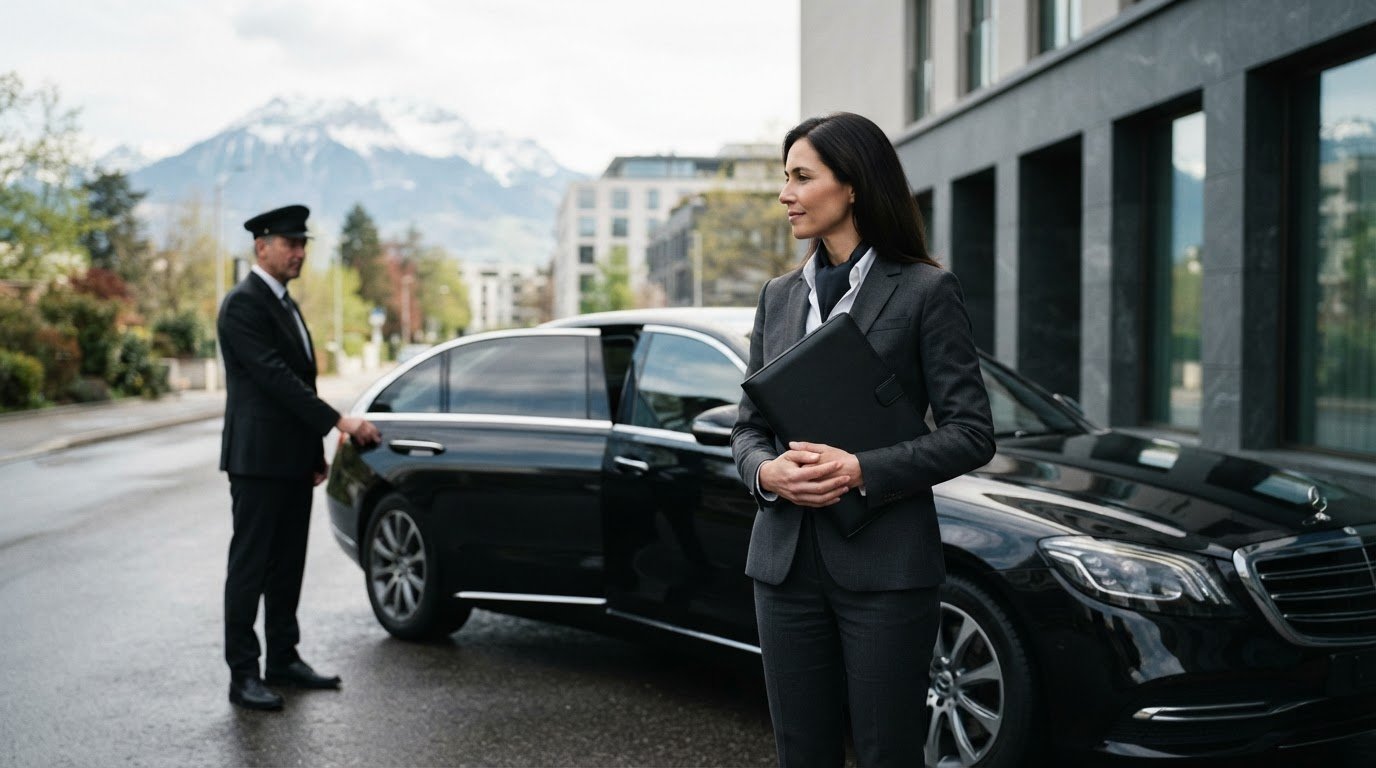
The most discreet journey depends on clear mission protocols, not on the vehicle alone. A diplomatic chauffeur service switzerland can support personnel carrying confidential documents with a private, carefully coordinated passenger journey. However, passenger transport is not the same as formal document custody. Sensitive materials should remain under the control of the authorised traveller or mission, even when the schedule changes at short notice.
This guide explains how to plan a smooth journey, define responsibilities between the mission and transport provider, and choose a suitable vehicle for the delegation. Epic Limousines provides diplomatic and VIP protection transport in Mercedes-Benz S-Class, V-Class, and Sprinter vehicles, with discretion and attentive coordination at the centre of the service. You’ll find practical details to align before departure, ways passenger transport can support the mission’s own document-handling arrangements, and vehicle considerations that help keep the journey comfortable and organised.
Key Takeaways
- Plan around authorised travellers, itinerary changes, agreed communication, and a clear pre-departure briefing.
- Share only the information needed to coordinate the journey. Keep document contents within the mission’s own handling procedures.
- Choose a vehicle based on the delegation, luggage, itinerary, privacy needs, and protection requirements.
- A diplomatic chauffeur service switzerland supports discreet passenger transport. Formal document custody remains a separate responsibility.
- Epic Limousines provides S-Class, V-Class, and Sprinter chauffeur transport for diplomatic and VIP journeys.
Diplomatic Chauffeur Service in Switzerland: What Confidential Document Transport Requires
For a mission coordinator, the priorities are clear: discretion, punctuality, privacy, and dependable passenger movement. A journey involving confidential papers also requires careful coordination, but the vehicle is only one part of the plan. Travellers need clear instructions, the itinerary should reflect official engagements, and responsibility for sensitive materials must be explicit throughout the journey.
Chauffeur-supported document transport means passenger transport for authorised personnel carrying their own sensitive materials. It is not a document courier or a formal chain-of-custody operation. A chauffeur transports passengers; the service should not be described as taking possession of, verifying, or safeguarding documents under a separate custody process.
Mission protocols determine how documents are handled, who may access them, and what steps apply if plans change. Those decisions belong to the mission and relevant authorities, alongside any applicable rules. The Vienna Convention on Diplomatic Relations provides background on the international framework for diplomatic relations, but it is not a transport brief or a substitute for mission-specific instructions. Keep these responsibilities separate when planning the journey.
How diplomatic transport differs from a standard chauffeur journey
Official schedules can shift when meetings run longer or engagements change. A tailored journey therefore starts with practical coordination: agreed pickup and destination details, expected timing, authorised passenger information, and a clear way to communicate updates. Share only what is needed to arrange passenger movement. Mission-specific instructions should guide coordination, while the chauffeur is not responsible for determining document classification or confirming a traveller’s authority to carry documents.
What a chauffeur service can contribute to the journey
A professional chauffeur service contributes attentive passenger transport, considered scheduling, and a privacy-conscious approach. Vehicle choice can match the journey’s practical needs: a Mercedes-Benz S-Class may suit individual executive travel, a V-Class can accommodate a small group, and a Sprinter may suit a larger party. The mission or authorised traveller retains control of the documents and follows its own handling procedures throughout.
Before departure, make the division of responsibilities clear to everyone involved. The coordinator provides the route and timing information needed for transport; travellers follow the mission’s instructions for carrying and controlling their materials; the chauffeur focuses on the passenger journey. This clarity prevents a premium chauffeur arrangement from being mistaken for secure document logistics. It also gives the team a practical basis for handling itinerary changes without disclosing document contents or assuming custody has transferred.
How to Plan Confidential Document Transport Without Confusing Privacy and Security
A smooth journey starts with a focused brief. Give the chauffeur enough information to coordinate passenger movement, while keeping document contents and mission-sensitive details within authorised channels. For a diplomatic chauffeur service switzerland, this distinction supports practical coordination without treating a private passenger journey as a document-security operation.
Transport coordination does not replace the mission’s document-security protocols. Rules for handling, storing, or transferring materials must come from authorised mission procedures and relevant authorities. Official information from the Swiss Federal Department of Foreign Affairs (FDFA) provides broader context on Switzerland’s diplomatic activity, but it does not replace instructions for a particular mission or assignment.
What to coordinate before the journey
Work through the practical details in sequence, sharing only what is needed to arrange the ride:
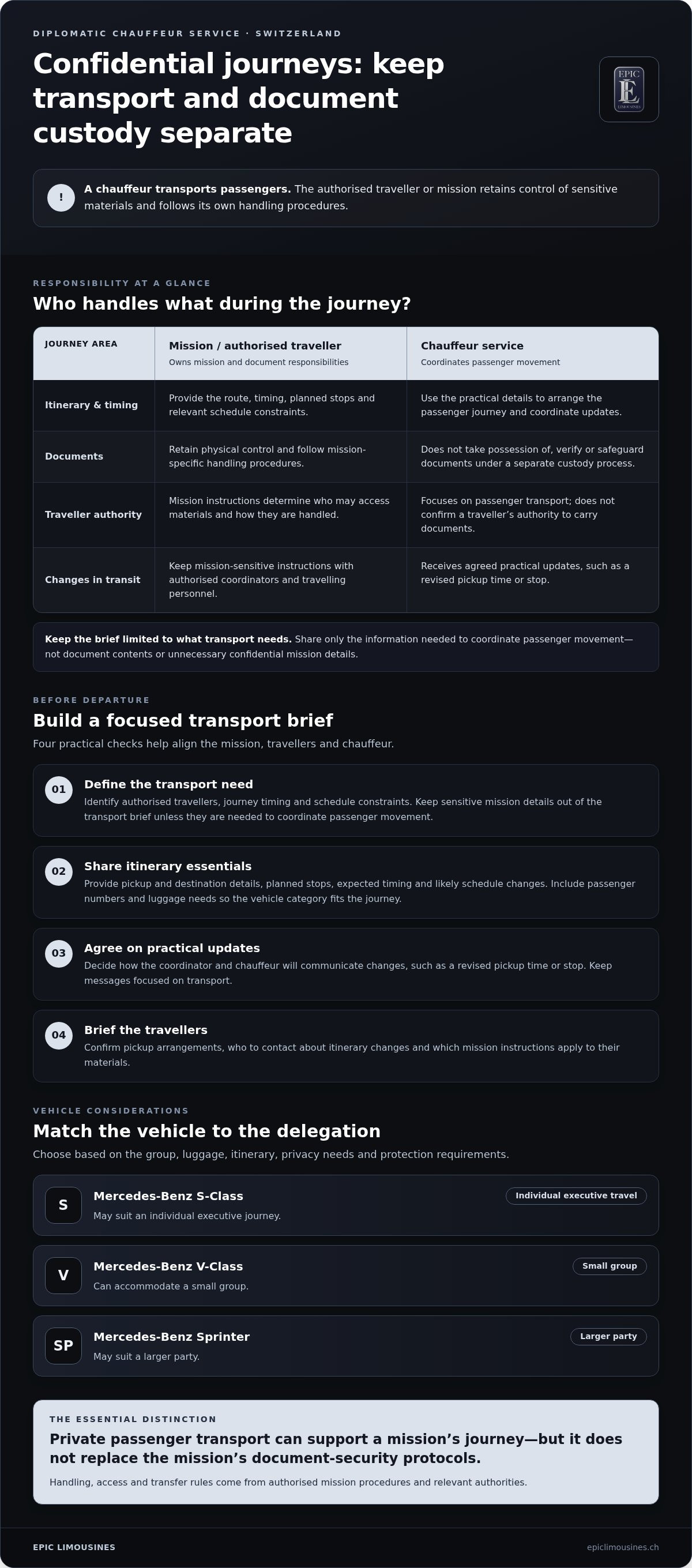
- Define the mission’s transport needs. Identify the authorised travellers, journey timing, and any schedule constraints. Keep sensitive mission details out of the transport brief unless they are needed to coordinate passenger movement.
- Share the itinerary essentials. Provide pickup and destination details, planned stops, expected timing, and likely schedule changes. Include passenger numbers and luggage needs so the vehicle category suits the journey.
- Agree on communication. Decide how the coordinator and chauffeur will exchange practical updates, such as a revised pickup time or stop. Keep messages focused on transport, not document contents or confidential mission details.
- Brief the travellers. Make sure passengers know the pickup arrangements, who to contact about itinerary changes, and which mission instructions apply to their materials.
This approach avoids sending unnecessary information through transport channels. A chauffeur may need to know that a stop has changed, for example, but not why the meeting is sensitive or what papers a passenger is carrying. Keep mission-specific instructions with authorised coordinators and travelling personnel.
How to maintain clear responsibility during transit
Before departure, state plainly who retains physical custody of the documents. If the authorised traveller is responsible, they should keep the materials under their control and follow the mission’s procedures throughout the journey. The transport arrangement should not imply that the chauffeur has accepted custody, checked document classification, or taken responsibility for a formal handover.
If the schedule changes, use the agreed contact method to share only the update needed to adjust passenger movement. Any decision about whether documents may be moved, stored, or transferred remains with authorised mission personnel. Clear roles help the team respond calmly without disclosing more than transport coordination requires.
For diplomatic and high-profile passenger journeys, Epic Limousines’ diplomatic and VIP chauffeur transport can be arranged around the mission’s travel requirements, keeping passenger coordination distinct from document control.
Choosing a Diplomatic Chauffeur Arrangement: Vehicle, Privacy, and Protection
Choose an arrangement based on the travelling party and the mission’s requirements, not simply the vehicle category. Consider who is travelling, the itinerary, luggage, and the level of privacy or protection the assignment calls for. A diplomatic chauffeur service switzerland can be tailored to passenger movement, but vehicle choice alone does not provide specialist security or document logistics.
Use this comparison as a starting point. The best fit depends on the whole journey, including stops and the travellers’ space requirements.
- Mercedes-Benz S-Class: Suited to individual executive travel or a journey centred on one principal traveller. Consider the itinerary, luggage, and preference for a private passenger environment.
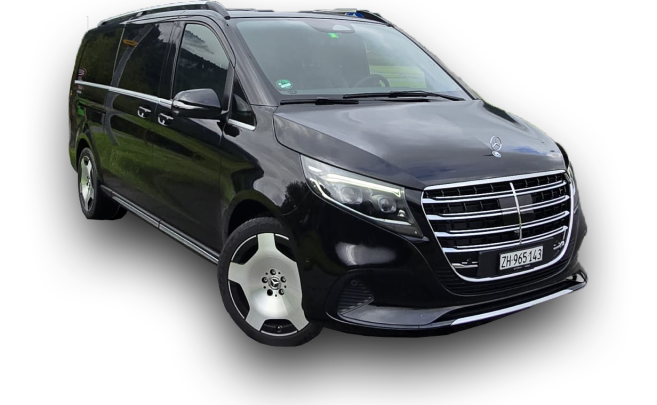
- Mercedes-Benz V-Class: A practical option for a small group travelling together. Assess how passengers and luggage will fit and whether staying in one vehicle supports the schedule.
- Mercedes-Benz Sprinter: May suit a larger party travelling together. Consider the group’s luggage, planned stops, and itinerary before selecting this vehicle category.
These are distinctions between passenger journeys, not document-storage specifications. Confidential papers do not automatically require a particular vehicle or special storage arrangement. The authorised traveller or mission remains responsible for deciding how materials are carried and controlled.
Matching Mercedes-Benz vehicles to the travelling party
Start by describing the passenger group and route, then consider comfort, luggage, and the travellers’ privacy preferences. An executive travelling alone on a direct itinerary may have different needs from a small delegation with several planned stops. A larger party may prefer travelling together, while luggage can also affect the practical fit. Epic Limousines provides chauffeur-driven S-Class, V-Class, and Sprinter transport, with the arrangement tailored to the journey rather than assumed document-security features.
When VIP protection transport belongs in the plan
Identify protection needs in the mission brief rather than inferring them from a diplomatic title or confidential document. If the assignment calls for protection-focused transport, Epic Limousines’ diplomatic and VIP protection transport is a relevant option. Treat its scope separately from standard passenger transport and specialist security or document logistics. It should not be understood as a guarantee against every risk or incident.
Keep the transport brief operational: passenger details, itinerary, luggage, and coordination needs. Mission-specific security decisions remain with authorised mission personnel. For context on diplomatic privileges and immunities, consult the Swiss Federal Department of Foreign Affairs’ Diplomatic Privileges and Immunities in Switzerland resource. It does not replace instructions for a particular assignment. A clear division between vehicle selection, passenger coordination, and protection planning helps coordinators make a practical choice while keeping each responsibility in its proper place.
A Practical Planning Checklist for Confidential Document Journeys in Switzerland
A concise checklist gives coordinators a shared reference without putting sensitive mission information into a transport brief. For a diplomatic chauffeur service switzerland, plan passenger transport separately from the mission’s document-control instructions. Include only details needed to arrange the journey, and have the appropriate authorities verify any legal, diplomatic, or document-handling requirements that apply to the assignment.
Before confirming the journey, review these essentials:
- Authorised travellers: Identify who is travelling and share passenger details through the appropriate coordination channel.
- Itinerary: Set out pickup instructions, destinations, planned stops, schedule constraints, and the mission contact responsible for updates.
- Vehicle category: Match the arrangement to the travelling party, luggage, and journey plan. Do not assume confidential materials require special vehicle storage.
- Communication: Agree on a practical channel for transport changes and keep messages limited to what is needed to coordinate the ride.
- Responsibilities: Confirm who retains physical control of the documents and which mission procedures govern their handling during transit.
- Contingencies: Decide how the designated mission contact will communicate a delay, changed stop, or revised pickup instruction.
Before departure: align the itinerary and responsibilities
Review the passenger schedule, pickup instructions, stops, vehicle category, and communication channel with the coordinator and travellers. Make sure passengers know who is responsible for the documents and whom to notify if the itinerary changes. This short review can catch practical mismatches, such as an unshared stop or an overlooked luggage need, before they disrupt the journey.
Keep the mission’s document-control procedures with authorised personnel. The transport brief generally needs operational details, not document contents, classification, or the sensitive purpose of an engagement. If a mission requires additional handling steps, follow its authorised procedures rather than inferring them from the chauffeur arrangement.
During the journey: preserve discretion and continuity
Maintain a professional, measured tone in the vehicle and keep operational communication relevant to the journey. Avoid discussing document contents or mission details when they are not needed to coordinate passenger transport. If a transfer or handover is required, follow the procedure authorised by the responsible mission. Do not assume a change of vehicle or passenger automatically changes document custody.
If plans change, the designated contact can provide the revised transport instruction without disclosing why the schedule shifted. This keeps coordination focused and gives travellers a clear route for updates. It also preserves the distinction between discreet passenger travel and formal security or document logistics.
Epic Limousines’ tailored diplomatic chauffeur transport supports carefully coordinated passenger journeys. Explore Epic Limousines’ diplomatic transport service when planning travel for diplomatic personnel.
How Epic Limousines Supports Diplomatic Chauffeur Service in Switzerland
Epic Limousines provides chauffeur-driven diplomatic and VIP protection transport in Switzerland. For missions requiring discreet passenger movement, the service centres on a tailored journey, attentive hospitality, and coordination shaped around the travelling party and itinerary. A diplomatic chauffeur service switzerland supports personnel on the move, while responsibility for confidential materials remains with authorised travellers and the mission.
A tailored chauffeur service for diplomatic and VIP travel
Epic Limousines offers Mercedes-Benz S-Class, V-Class, and Sprinter transport. An S-Class may suit individual executive travel, while a V-Class or Sprinter may better fit a group, depending on passenger numbers, luggage, and itinerary. These vehicle choices support passenger comfort and coordination; they do not imply special document storage or custody. Discretion and attentive hospitality guide the service, not guarantees against security risks.
Identify any VIP protection requirement in the transport brief. It is distinct from a standard chauffeur journey, document couriering, or formal chain-of-custody management. Epic Limousines provides diplomatic and VIP protection transport for diplomatic and high-profile travel, tailored to the stated passenger and itinerary needs. Mission protocols remain the authority for document handling and security decisions.
For a broader view of planning diplomatic journeys, Epic Limousines’ diplomatic transport guide explores how chauffeur coordination supports mission travel. Coordinators managing a wider programme of executive movements may also find the Swiss corporate travel management guide useful when considering how individual journeys fit into broader travel logistics.
Arrange a discreet, well-coordinated journey
A focused transport brief helps organise the journey without unnecessary disclosure. Share authorised passenger details, pickup and destination information, planned stops, schedule constraints, luggage needs, preferred vehicle category, and the designated contact for updates. If the itinerary changes, communicate the transport adjustment through the agreed channel. Document contents are not needed for routine passenger coordination.
Before departure, align the travelling party and coordinator on pickup instructions, timing, and who retains control of the documents. The mission’s authorised procedures govern document handling or transfer; chauffeur transport supports passenger movement rather than replacing those arrangements. This clear division keeps the transport plan practical and discreet.
To discuss tailored chauffeur transport for a diplomatic journey, contact Epic Limousines with your passenger, itinerary, and vehicle requirements.
Set the Journey in Motion with Confidence
Turn mission priorities into a clear passenger plan. Before travel, decide which details the transport coordinator needs, who will communicate itinerary changes, and which instructions remain within the mission. This preparation allows a diplomatic chauffeur service switzerland to support the journey without bringing document custody or sensitive contents into routine transport coordination.
A well-planned arrangement should feel straightforward to the travelling party: the schedule is understood, the vehicle suits the journey, and each responsibility has a clear owner. That clarity gives coordinators room to adapt to changing engagements while following the mission’s procedures for confidential materials.
Epic Limousines can tailor chauffeur transport to your delegation and itinerary, with discretion and attentive hospitality throughout the passenger journey. Discuss a discreet diplomatic chauffeur arrangement with Epic Limousines to plan a composed, well-coordinated journey.
Frequently Asked Questions
Can a chauffeur service transport confidential diplomatic documents in Switzerland?
Yes. A chauffeur can transport authorised travellers who carry their own documents, but this is passenger transport, not a courier or custody service. For a diplomatic chauffeur service switzerland, provide practical travel information such as pickup details and schedule changes without describing what the documents contain. The authorised traveller or mission remains responsible for handling them under its own procedures, including deciding what to do if travel plans change.
Is a diplomatic pouch the same as confidential document transport by car?
No. A diplomatic pouch is a distinct diplomatic mechanism. A passenger travelling by car with documents is not, by that fact alone, using a pouch or granting ordinary materials diplomatic protections. Requirements can depend on the materials and circumstances. Before arranging movement, the mission should use authorised guidance to determine classification, packaging, custody, and handling, rather than relying on the vehicle or chauffeur arrangement to establish those details.
What information should I provide when arranging a diplomatic chauffeur journey?
Provide the details needed to organise passenger movement: who is travelling, pickup and destination instructions, timing, stops, luggage needs, and a designated contact. If a meeting may run late, for example, agree how the coordinator will send a revised pickup time. Avoid sharing document contents or background that is not needed to arrange the ride. Keep special handling instructions within authorised mission channels and clarify who remains responsible for the documents.
Can a chauffeur accommodate itinerary changes during a diplomatic mission?
A tailored chauffeur arrangement can be coordinated around itinerary updates through the designated contact. Before departure, decide how changes will be communicated and what information the chauffeur needs, such as a new pickup time or destination. If an engagement runs over, the update can focus on the revised passenger plan without explaining the confidential purpose. Travellers and mission personnel remain responsible for document control and for applying their procedures when plans change.
Does VIP protection transport guarantee the security of confidential documents?
No. VIP protection transport is not a guarantee against every risk or a substitute for mission document procedures. Its role is to support passenger transport within the agreed arrangement. The responsible mission or authority determines the safeguards and custody requirements for its materials. Keep the distinction clear in the brief: identify passenger-protection needs, while authorised personnel retain responsibility for handling, access, and document-transfer decisions.
Which vehicle is suitable for diplomatic transport with confidential documents?
Choose based on the travelling party, itinerary, luggage, and desired passenger privacy, not an assumption that a vehicle provides special document storage. An S-Class may suit an individual executive journey, while a V-Class or Sprinter can fit different group arrangements. Epic Limousines offers chauffeur-driven Mercedes-Benz S-Class, V-Class, and Sprinter vehicles. Treat any mission-specific storage requirement as a separate specification rather than assuming it comes with a vehicle category.