How to Arrange Multi-Stop Business Travel: A 2026 Planning Guide

What if the smoothest multi-stop business trip isn’t the one with the fewest stops, but the one planned around the purpose of each meeting? If you’re working out how to arrange multi-stop business travel, you already know that separate bookings can create awkward gaps, unnecessary backtracking or too little time to make a connection.
Start with meeting priorities, then plan each travel leg around them. This guide explains how to sequence stops, coordinate flights and rail with ground transport, and build in practical buffers for delays or schedule changes. You’ll also learn how to account for traveller needs so the journey feels composed, not rushed.
For ground legs, point-to-point chauffeur transfers can suit a fixed sequence of destinations, while an at-disposal service may fit a day with several meetings or a changing schedule. Epic Limousines provides corporate travel management and chauffeur-driven transport as part of a wider travel plan. The following planning decisions help keep meetings, connections and contingencies in step.
Key Takeaways
- Start with meeting objectives, fixed appointments and traveller needs before selecting travel legs.
- Learn how to arrange multi-stop business travel by building a route around meeting priorities and realistic connection time.
- Compare flights, rail and chauffeur-driven transport by flexibility, privacy and the work time each journey allows.
- Use practical buffers and a clear disruption plan to limit the impact of delays on later commitments.
- Choose point-to-point transfers for defined journeys or at-disposal service when the schedule may change, with vehicle choice matched to the travellers.
Why Multi-Stop Business Travel Needs More Than a Sequence of Bookings
Several meetings can turn a straightforward business trip into a coordination challenge. Each appointment has its own location, timing and purpose, while every journey between stops affects when a traveller arrives and how prepared they feel. Booking each leg separately without looking at the full schedule can lead to backtracking, rushed arrivals or long gaps between commitments.
A multi-stop business itinerary connects travel legs around work objectives. It sets out where the traveller needs to be, when they need to arrive and how each stop supports the trip. A travel itinerary typically records journey details and planned stops. For business travel, its value is making the links between meetings and transport clear before bookings are made.
What counts as a multi-stop business itinerary?
It’s a journey that includes several business appointments within one planned trip, rather than a series of separate return journeys from a home base. Stops might include different offices, an industry event and client meetings. The number of stops alone doesn’t determine the best route: even a trip with fewer appointments can need careful sequencing if meeting times or locations constrain the journey.
For example, a fixed-time event may determine the order of the surrounding meetings. A flexible appointment could be placed where it reduces unnecessary travel, provided the change still supports the trip’s objectives. Plan around the work, rather than simply listing destinations in the order they were booked.
Which planning decisions have the greatest impact?
Start with the reason for each meeting, then identify commitments that cannot move. Add traveller needs and available travel windows before deciding the sequence of stops. This helps show where arrival readiness matters, where a long journey could affect the next appointment and where the schedule needs breathing room.
Poorly sequenced stops can create avoidable backtracking and make a full day more tiring than necessary. Assess travel time alongside meeting duration and the time needed to arrive composed and ready to participate. A route that looks efficient on a calendar may be impractical if it leaves little time between a journey and a high-priority meeting.
Plan the itinerary before booking individual legs. Let meeting priorities, traveller needs and realistic travel windows determine the route.
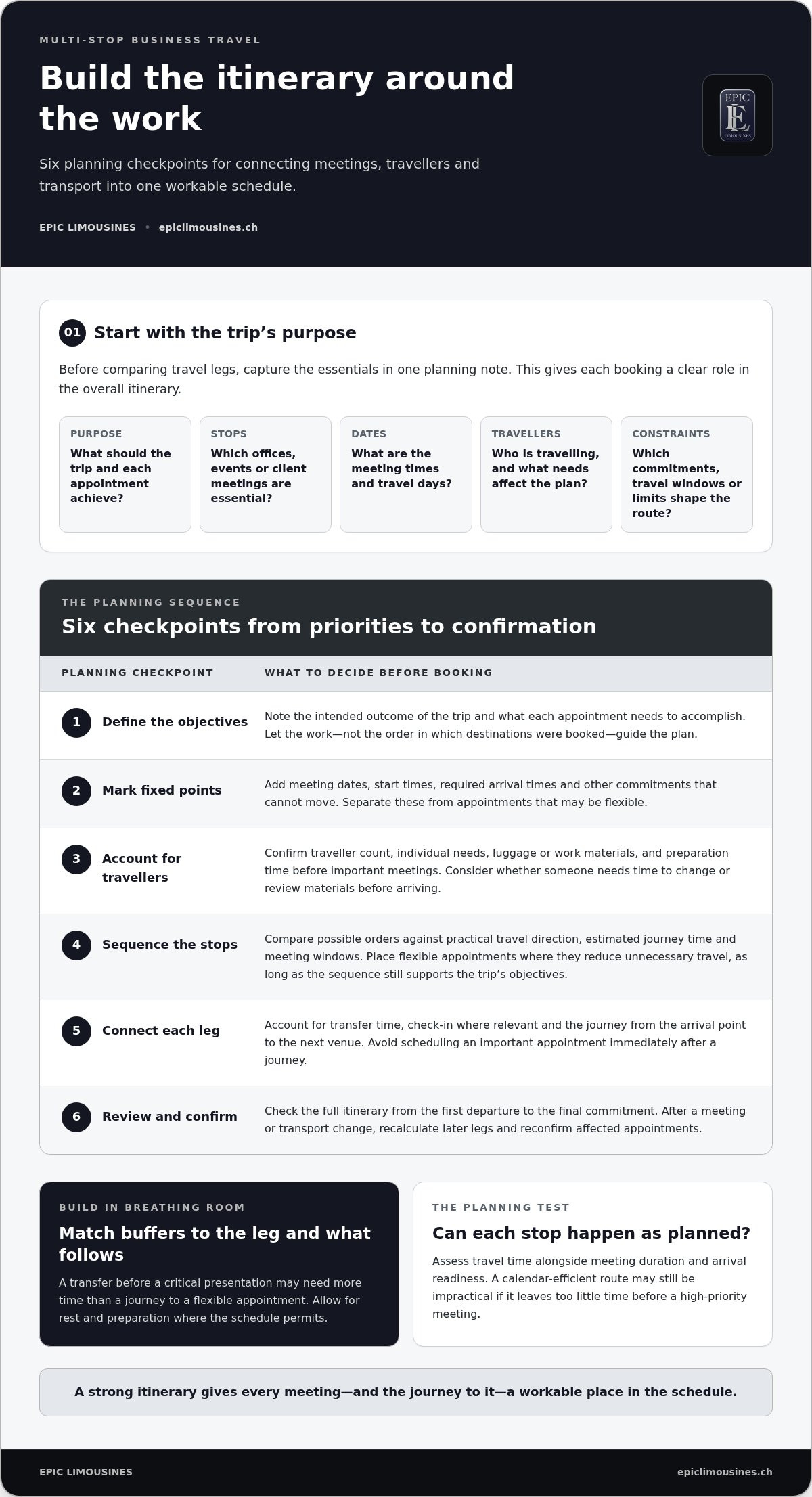
Before comparing transport options, capture the essentials in one planning note:
- Purpose: What should the trip and each appointment achieve?
- Stops: Which offices, events or client meetings are essential?
- Dates: What are the meeting times and travel days?
- Travellers: Who is travelling, and what needs affect the plan?
- Constraints: Which commitments, travel windows or schedule limits shape the route?
With these points established, you can see the trip as one connected plan. That foundation makes it easier to decide how to arrange multi-stop business travel without letting separate bookings dictate the meeting sequence.
How to Build a Multi-Stop Business Itinerary Step by Step
With the trip’s purpose and key constraints clear, turn them into a schedule that connects meetings, travellers and transport. This sequence helps prevent bookings from dictating the workday and makes the impact of a change easier to assess before it disrupts the rest of the plan.
Set priorities before choosing the route
Separate fixed commitments from meetings that can move. Record who is travelling, what they need during the journey and which documents or work materials must go with them. Consider arrival readiness too: a high-stakes meeting may call for time to prepare, change or review materials before it begins.
Connect the stops into a workable schedule
- Step 1: Define the objectives. Note the intended outcome of the trip and what each appointment needs to accomplish.
- Step 2: Mark fixed points. Add meeting dates, start times, required arrival times and any other commitments that cannot move.
- Step 3: Account for the travellers. Confirm the traveller count, individual needs, luggage or work materials, and any preparation time required before important meetings.
- Step 4: Sequence the stops. Compare possible orders against practical travel direction, estimated journey time and meeting windows. Choose a sequence that supports the work, rather than assuming the most direct-looking route is automatically best.
- Step 5: Connect each leg. Add transport between stops, including transfer time, check-in where relevant and the journey from the arrival point to the next venue. Avoid scheduling an important appointment immediately after a journey.
- Step 6: Review and confirm. Check the full itinerary from the first departure to the final commitment. After any meeting or transport change, recalculate later legs and reconfirm affected appointments.
Set buffers according to the leg and what follows it. A transfer before a critical presentation may need more breathing room than a journey to a flexible appointment. Include time for rest and preparation where the schedule allows. A plan that looks efficient but leaves travellers arriving depleted can undermine the purpose of the stop.
A strong itinerary protects the purpose of every stop by giving meetings and the journeys between them a workable place in the schedule. Keep one current itinerary as the shared reference, with confirmed times, locations and relevant contact details. This helps travellers and coordinators work from the same plan.
Once the sequence is settled, review the complete journey from the first departure through the final appointment. Check that each commitment has a realistic arrival window and that updates appear consistently in the itinerary. This final review turns how to arrange multi-stop business travel into a clear plan that supports the work instead of adding avoidable pressure.
How to Compare Flights, Rail and Chauffeur Transport for Each Leg
Choose transport one leg at a time, based on where the journey begins and ends, the meeting window and what the traveller needs on arrival. A flight or train may suit a longer intercity leg, while a chauffeur transfer can connect an airport or station with an appointment. Many practical itineraries combine modes rather than relying on one for the entire trip.
| Mode | Best suited to | Flexibility and connections | Privacy and work time |
|---|---|---|---|
| Flight | Longer distances where the timetable fits the meeting schedule | Factor in airport access, check-in, arrival procedures and onward transport. A missed or delayed connection may affect later commitments. | Work time depends on the airport process, flight and onward leg; privacy varies by setting. |
| Rail | Journeys where rail schedules and station locations align with appointments | Check departure times, any changes between trains and the transfer from the station to the meeting. | The journey may offer time to work, though privacy can be limited in a shared carriage. |
| Chauffeur-driven ground transport | Planned transfers between airports, stations, offices, events or meetings | Point-to-point legs suit defined journeys; an at-disposal arrangement can suit a schedule with several stops or changing appointment times. | A private vehicle can provide a more discreet setting and continuity between ground legs. |
When do flights or rail make sense between stops?
Compare the full door-to-door journey, not only time in the air or on the train. Include travel to the terminal or station, waiting and check-in, connections, and the onward transfer to the next commitment. Assess rail against the available timetable, the appointment’s location and the required arrival time. A shorter scheduled journey may not be the better choice if its connections leave little margin.
Where can chauffeur transport add flexibility?
A point-to-point transfer is arranged around a specific ground journey, such as a station-to-office leg. An at-disposal service provides a chauffeur-driven vehicle across a planned period of appointments, which can suit a schedule with several stops or changing times. The distinction is useful: choose fixed legs when the plan is settled, and consider at-disposal service when continuity and flexibility matter more.
Epic Limousines provides chauffeur-driven corporate transport for planned ground legs as part of a wider itinerary. It can connect a flight or rail journey with the next appointment without replacing the rest of the travel plan. This guide to a corporate ground transportation program also discusses coordination across business travel. When planning how to arrange multi-stop business travel, compare every leg by its effect on the next appointment, including the transfer from the arrival point to the meeting itself.
How to Prepare for Changes, Delays and Tight Meeting Schedules
A carefully planned itinerary can still be affected by a delayed connection, a meeting that runs over or a changed appointment time. The aim isn’t to promise that disruptions won’t happen. It’s to make their impact easier to assess, communicate and manage without rushing into changes that create further problems.
Build resilience into the itinerary before departure
Mark high-priority meetings and identify which commitments could move if needed. Allow practical time between connections and transfers, with the margin shaped by the journey and the importance of the next appointment. A traveller heading directly into a presentation may need more time to arrive and prepare than someone travelling to a flexible meeting.
Keep the current itinerary, essential booking confirmations and relevant contact details accessible to travellers and coordinators. Agree in advance who owns updates, who informs the traveller and who handles changes to ground transport. Clear responsibility helps prevent conflicting instructions when the schedule shifts.
What should the team do when plans change?
Respond in a calm sequence. First, assess which commitment or travel leg is affected, then determine what remains workable before revising the whole itinerary. A change to one appointment may affect only the next transfer, or it may alter several later commitments. Check the knock-on effects rather than assuming every booking needs to change.
- Assess the impact: Identify the affected meeting, connection or transfer, then review the time available before the next commitment.
- Notify the right people: Use the agreed communication channel to update the traveller and relevant meeting organisers with clear, current information.
- Revise the affected legs: Adjust the sequence or timing where needed, preserving high-priority meetings where practical.
- Reconfirm commitments: Check the revised itinerary with the traveller, organisers and any transport coordinators involved.
For example, if a meeting runs late, confirm whether the following appointment can move before altering the next transfer. If a flight or rail connection changes, reassess the onward journey and notify the people expecting the traveller. Keeping one updated itinerary as the reference point reduces the risk of someone following an outdated schedule.
A useful principle in how to arrange multi-stop business travel is to build in enough flexibility for considered adjustments, then communicate each change promptly. Epic Limousines’ chauffeur-driven corporate transport can be coordinated as part of revised ground legs, with affected arrangements updated alongside the itinerary.
For coordinated ground transport within a business itinerary, see Epic Limousines’ corporate travel services.
How to Coordinate Multi-Stop Business Travel with a Chauffeur Partner
Chauffeur transport works best when planned as one part of the itinerary, alongside flights, rail and meeting commitments. The right arrangement depends on how settled the schedule is, which ground legs need coordination and whether the traveller needs transport between specific points or across a planned period.
Choose the chauffeur arrangement around the itinerary
For clearly defined journeys, point-to-point transfers can connect an arrival point with an office, event or next appointment. Each leg has a specific start and destination, which suits a schedule whose timings and stops are established.
An at-disposal service may suit a planned period with several appointments or a schedule that could shift. It provides continuity across the ground legs, while separate transfers can suit a series of fixed journeys. Neither format is automatically more efficient. Compare the itinerary pattern, timing and need for flexibility.
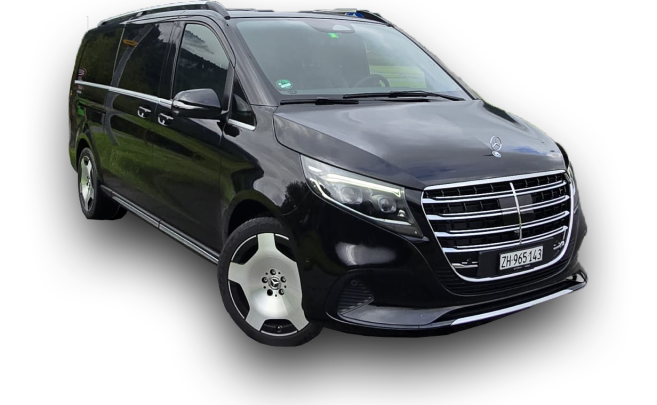
Choose a vehicle based on who is travelling and the nature of the journey. A Mercedes-Benz S-Class may suit an individual executive, while a Mercedes-Benz V-Class can be considered for small-group travel and a Mercedes-Benz Sprinter for group-travel needs. These categories help frame the decision without assuming that every traveller or itinerary has the same requirements.
Prepare a clear transport brief for the journey
A concise brief helps align chauffeur legs with the wider travel plan. Share the current itinerary and note:
- Each stop, meeting time and required arrival time
- Which legs need chauffeur transport and where flights or rail connect
- The traveller count and any relevant individual requirements
- Preferred communication arrangements if timings or plans change
This gives the transport partner a clear view of the schedule and where each ground journey fits. Epic Limousines’ Corporate Travel Management supports the broader coordination of a business trip in Switzerland, with chauffeur-driven transport planned as a connected part of the itinerary.
Move from planning to a tailored arrangement
Before finalising the ground plan, review meeting priorities, traveller needs, fixed commitments and likely schedule flexibility. Then decide which journeys call for point-to-point transfers and whether at-disposal service better suits the day. This framework makes the transport brief specific and useful.
Epic Limousines provides corporate chauffeur services with a Mercedes-Benz S-Class, V-Class and Sprinter fleet. If you’re planning how to arrange multi-stop business travel, discuss a tailored ground-transport arrangement shaped around your itinerary and its individual requirements.
Turn Your Business Itinerary into a More Composed Journey
A well-planned multi-stop trip begins with meeting priorities, then connects each journey around realistic travel time and arrival needs. Compare flights, rail and chauffeur transport leg by leg, and build in buffers so a change to one commitment doesn’t automatically unsettle the rest.
Ground transport can be tailored to the schedule: point-to-point transfers suit defined journeys, while at-disposal service may fit a planned period with several appointments. Epic Limousines offers corporate travel management, roadshow and at-disposal services, supported by a chauffeur-driven Mercedes-Benz S-Class, V-Class and Sprinter fleet.
If you’re considering how to arrange multi-stop business travel, Epic Limousines can coordinate the ground-transport element within your wider itinerary. Discuss a tailored chauffeur arrangement for your business journey, with a plan shaped around your meetings and traveller needs.
Frequently Asked Questions
How do I plan a business trip with multiple stops?
Start with the purpose of the trip, then map fixed meetings, required arrival times, traveller needs and schedule constraints before booking transport. Sequence appointments around work priorities and practical travel direction, then connect each stop with a suitable journey. Include time to transfer, check in where relevant, rest and prepare before important meetings. Keep one current itinerary that shows the complete schedule and who is responsible for communicating updates.
Is it better to book multi-city flights or separate tickets for business travel?
Choose the booking structure that best fits the flight sequence, schedule flexibility and company travel process. A multi-city booking can bring several flight legs into one itinerary, while separate tickets may suit a journey with distinct travel plans or changes between legs. Compare the full door-to-door timing and review how a change to one leg could affect the others. Before booking, check the terms that apply to each ticket and allow time for airport transfers.
Can I combine rail, flights and chauffeur transport on one business trip?
Yes. A business itinerary can combine flights or rail for longer legs with chauffeur transport between terminals, stations, offices and meetings. Plan each connection as part of the same journey, including the time needed to reach the next departure point or appointment. For example, a traveller might use rail between destinations and arrange a chauffeur transfer from the arrival station to a scheduled meeting. The best mix depends on the timetable, locations and meeting priorities.
How much time should I leave between business meetings and travel connections?
There’s no single interval that suits every connection. Allow for the full transfer, any check-in or arrival process, and the time needed to reach the meeting venue. Add a larger buffer before a high-priority appointment or when a delay would affect several later commitments. Consider the journey mode, transfer points and how prepared the traveller needs to be on arrival. Avoid scheduling an important meeting immediately after a connection with little room for change.
What happens if one delay disrupts the rest of a multi-stop business trip?
First identify which meeting, connection or transfer the delay affects, then assess its impact on the remaining itinerary. Notify the traveller and relevant organisers through the agreed communication channel. Revise only the legs and commitments that need to change, then reconfirm the new sequence, meeting times and affected ground transport. Assigning responsibility for updates in advance helps keep communications clear. Buffers can limit disruption, but they can’t prevent every delay.
Should I use a chauffeur for a multi-stop business itinerary?
A chauffeur can be useful for planned ground legs when the itinerary calls for privacy, continuity or coordinated transfers between appointments. Point-to-point transport suits clearly defined journeys; an at-disposal arrangement may suit a planned period with several stops or changing timings. Epic Limousines provides chauffeur-driven corporate transport in Switzerland, with Mercedes-Benz S-Class, V-Class and Sprinter vehicles. Consider the schedule pattern and traveller needs to decide whether chauffeur transport fits particular legs.
What information should I prepare before arranging corporate ground transport?
Prepare the itinerary’s stops, dates, meeting times and required arrival times, along with the number of travellers and any relevant travel needs. Identify which legs require a chauffeur and where rail or flights connect with the ground journey. Include practical details such as luggage or work materials, preparation time before key meetings and a preferred communication approach if plans change. Sharing one clear, current brief helps align ground transport with the wider business schedule.