
Privacy Concerns with Ridesharing for Business: A Guide

Could a routine ride booking reveal more about a business day than the passenger intends? Privacy concerns with ridesharing for business go beyond who can see the destination. Location data, trip histories and account details can create a record of where employees go and when. Lyft’s privacy policy, updated July 1, 2026, says it collects precise rider location from when the app is opened and a ride is requested until the trip ends, including when the app runs in the background.
The convenience is clear, and business profiles can help separate work trips from personal ones. But employees and companies may still have questions about what information is collected, how it’s used and which trip details are shared with an employer. A careful approach needn’t mean giving up convenient transport. It means understanding the data trail and choosing proportionate safeguards.
This guide explains the main privacy exposure points across a business journey, from app permissions and account settings to booking and expense records. You’ll find practical ways to reduce unnecessary data sharing and a balanced comparison of app-mediated rides and private chauffeur transport. A chauffeur booking offers a different, professionally arranged travel experience, but it shouldn’t be mistaken for a guarantee of data anonymity.
Key Takeaways
- Understand how journey-linked location, account and payment information can reveal business travel patterns.
- Trace potential data exposure from account setup and ride requests through payment records and retained trip histories.
- Compare app-mediated ridesharing with prearranged chauffeur transport to see which booking model better suits different business needs.
- Use practical account and location-permission checks to address privacy concerns with ridesharing for business.
- Consider Epic Limousines’ private, driver-led transport as an alternative booking model, with a stated focus on comfort, security, confidentiality and privacy.
What privacy concerns with ridesharing for business should companies understand?
Business travel privacy means managing information connected to a journey, including personal identifiers, location details and payment data. A ride booking may require information to arrange transport. Later account activity may also create or retain records such as trip histories, receipts or support interactions. These are distinct parts of the data trail, and the details depend on the platform, service and account settings.
Journey data can be sensitive because it may connect an identifiable person with a place, time and repeated business activity. One trip to a client meeting may reveal little on its own. A pattern of recurring visits, regular pickup points or travel to a confidential meeting destination could disclose routines or relationships if associated with a named account. That possibility calls for proportionate care, not an assumption that a provider has misused or exposed the information.
What information may be connected to a business ride?
Potential categories include account identifiers such as a name, email address or phone number; booking details such as pickup and destination; payment information; and location data used in connection with a trip. The privacy concerns with ridesharing companies include how personal, financial and location information is handled. Exact practices vary by platform, service and account settings, so companies should consult the relevant provider’s privacy information rather than assume every app handles data identically.
It also helps to separate app-associated information from what is visible during the ride. An app may process information to arrange and manage a booking. During the journey, the driver needs enough trip information to provide the requested transport, while people involved may see one another or the pickup and destination context. These immediate operational details differ from information later associated with account activity, such as an electronic receipt or saved journey record.
Why can business travel patterns be sensitive?
The business significance often lies in context. A series of trips linked to an identifiable employee might suggest recurring client visits, a regular work routine or attendance at a confidential meeting. A destination alone doesn’t establish the purpose of a visit. However, repeated journeys combined with a person’s identity and timing can make the pattern more revealing.
For companies, the practical questions are what journey-linked details are needed to arrange a trip, what may be associated with the account afterwards and who can access the relevant records. Treating these as separate questions helps travel teams assess privacy concerns with ridesharing for business without assuming every provider uses or exposes trip patterns in the same way.
How can ridesharing create privacy exposure before, during, and after a business trip?
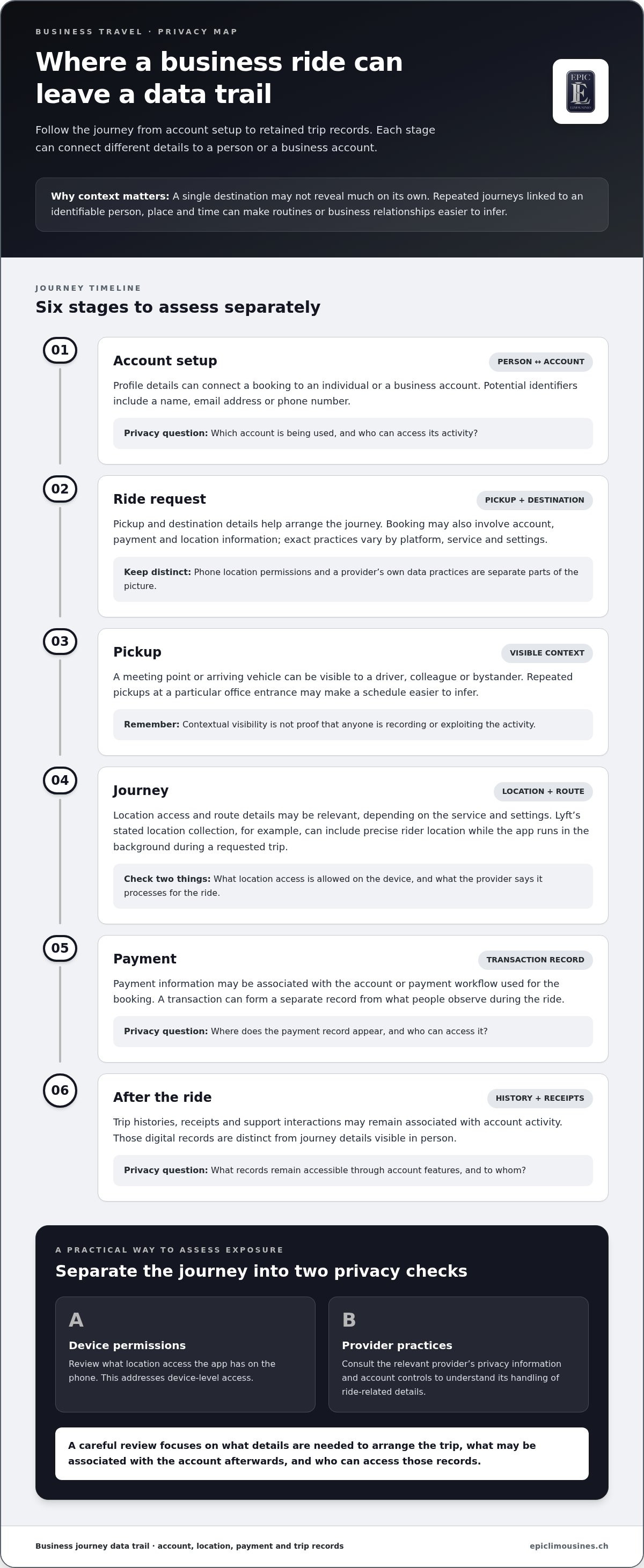
Privacy exposure can arise at several points in a journey, not only while a vehicle is moving. Account setup connects a person to a booking; a ride request can involve pickup and destination details; and payment or later account activity may leave records. For companies assessing privacy concerns with ridesharing for business, it helps to map these stages separately rather than treat “the app” as a single source of risk.
Two factors deserve separate attention: the permissions granted to an app on a phone and the provider’s own data practices. A user can review or limit device-level location access, but that alone doesn’t explain what information a platform processes when a ride is requested. The provider’s privacy notice and account controls address a different part of the picture.
Where can personal and location data enter the journey?
Booking commonly involves account and journey details, though the information requested and how it’s handled can vary by platform, service and settings. GPS-enabled devices and location permissions may affect how an app can access location. The physical journey also has visible details: a colleague, bystander or driver may observe who is picked up and where someone gets out.
- Account setup: Profile details can connect bookings to an individual or business account.
- Ride request: Pickup and destination information helps arrange the journey.
- Pickup: A visible meeting point or vehicle arrival can reveal context to people nearby.
- Journey: Location access and the route may be relevant, depending on the service and settings.
- Payment: The transaction may appear in the account or payment workflow used for the booking.
- After the ride: Trip histories and receipts may remain accessible through account features.
A visible pickup can communicate information even when no messages or documents are exposed. For example, repeated arrivals at a particular office entrance may make someone’s business schedule easier to infer. This is contextual visibility, not proof that anyone is recording or exploiting the activity.
What should businesses know about records and account activity?
Digital records differ from what someone can observe in person. Journey visibility is what people may see at the roadside; a stored trip record is what an account may retain or display later. Receipts, payment records and trip histories may be available through account workflows, but access and retention depend on the platform and account arrangements.
A business-managed account may support central expense workflows, while an employee’s personal account may keep travel activity within a personal profile. Neither arrangement is automatically better for privacy: each changes who may access records and how work and personal trips are separated. As part of internal governance, assign responsibility for account settings, review relevant privacy notices and explain to employees what trip information may be visible within the chosen workflow.
For organisations considering a prearranged, driver-provided alternative for business journeys, Epic Limousines’ corporate transport offers a different booking model. This does not imply that any transport arrangement guarantees data anonymity.
Ridesharing vs. private chauffeur: which model better fits business privacy needs?
Choosing between app-mediated ridesharing and a prearranged private chauffeur involves more than convenience. The booking process, the way trip details are handled and the journey’s visibility all matter. Neither model is automatically private: account terms and practices vary, and a chauffeur booking doesn’t guarantee anonymity or eliminate data processing.
| Comparison point | App-mediated ridesharing | Prearranged private chauffeur |
|---|---|---|
| Booking model | A passenger requests a ride through an app, typically using an account and journey details. | A journey is arranged in advance with a private, driver-led transport provider. |
| Data touchpoints | May involve app permissions, booking details, payment workflows and account activity, depending on the platform and settings. | Booking still requires coordination and may involve journey and passenger details; handling depends on the provider’s arrangements. |
| Journey visibility | Pickup and drop-off may be visible to people nearby, as well as to those involved in the ride. | A prearranged journey can still be observed at pickup and drop-off; the booking model alone doesn’t remove that visibility. |
| Operational fit | Can suit trips where app-based, on-demand booking fits the employee’s needs and company policy. | Can suit journeys where advance coordination and a driver-provided service fit the itinerary and travel requirements. |
Which comparison criteria matter for confidential business journeys?
Assess who arranges each ride, which details are needed to coordinate it, and how employees or the company can access trip records. Consider the journey’s sensitivity: a routine transfer may call for a different arrangement from travel involving an identifiable executive, a confidential meeting or a recurring pattern that could reveal business activity. Compare actual account terms and practices rather than assuming every rideshare platform or chauffeur provider handles records in the same way.
Operational needs matter too. Employees may value convenient booking, while travel teams may need an approach that fits company expense processes and guidance. A suitable policy can define which booking models are appropriate for different trip types without treating one option as universally preferable.
When might a private chauffeur be a considered alternative?
A private chauffeur service is prearranged, driver-provided transport; ridesharing is requested through an app for a particular journey. That difference may suit a business that prefers to coordinate a journey in advance, especially when the passenger, itinerary or meeting context calls for a considered travel arrangement. It doesn’t mean there are fewer data touchpoints in every case or that journey details cannot be processed.
Epic Limousines provides private, driver-led transport for individuals and groups, with a stated focus on comfort, security, confidentiality and privacy. For companies weighing privacy concerns with ridesharing for business, it offers an alternative booking model to consider alongside employee needs and internal policy, not a promise of data anonymity. The considered choice is the one that best aligns the journey’s sensitivity with the company’s operational requirements.
How can a business reduce ridesharing privacy concerns in practice?
Clear ownership turns privacy guidance into a workable travel practice. Rather than leaving each employee to make separate decisions, a company can set expectations for account use, device permissions and the handling of trip records. The aim is proportionate control: retain what’s needed for legitimate travel and expense processes while limiting unnecessary access and sharing.
What should a business travel policy say about ridesharing?
A useful policy should explain which account employees should use for business journeys, how to keep personal and company travel separate where appropriate, and who administers any business travel account. It should also describe how receipts and trip records are submitted, stored and accessed under existing company procedures. For more sensitive journeys, specify when a prearranged transport option may better fit the itinerary and employee needs.
Assign responsibilities so the guidance is clear in practice:
- Travel or account owner: Set up and manage approved business travel accounts, and review relevant account controls.
- Employees: Use only necessary account details, follow the approved booking process and handle records as directed.
- Finance or expenses team: Request only the receipt information needed for the company’s expense process and limit access according to internal procedures.
- Policy owner: Review the guidance when account arrangements or travel needs change, and make it easy for staff to find.
This checklist needn’t create a separate, complex process. Aligning it with existing travel and expense workflows can help employees understand where to book, how to report a journey and what not to share casually. Companies should verify legal or regulatory statements against current Swiss guidance before including them in formal policy. Avoid treating general privacy advice as a legal conclusion.
What can employees do in app and device settings?
Employees can review available location permissions on their device and privacy controls within their account. They should understand what a setting controls rather than assume that changing phone permissions alters every data practice of the platform. Use only the account details needed for work travel and follow company instructions for keeping business and personal activity distinct.
Everyday handling matters too. A booking screenshot forwarded to a broad group may reveal a passenger, destination or meeting time that recipients don’t need. Share trip details only through appropriate company channels and with relevant colleagues. Follow established procedures when recording, forwarding or retaining receipts, and avoid keeping extra copies in personal messages or shared folders without a business reason.
For journeys where advance coordination and private, driver-provided transport suit the company’s needs, Epic Limousines offers a chauffeur alternative with a stated focus on comfort, security, confidentiality and privacy. This is a different booking model, not a guarantee of anonymity or an assurance that data isn’t processed. To discuss private chauffeur transport for business travel, contact Epic Limousines.
A privacy-focused private chauffeur option for business transport
For some business journeys, the transport arrangement matters alongside the route and schedule. EPIC Limousines provides private, driver-led transport for individual travellers and groups, offering a prearranged alternative to requesting a ride through an app. The company’s stated focus includes comfort, security, confidentiality and privacy. These are service priorities, not a promise of anonymity or a claim that no booking information is processed.
How does private driver-led transport fit business travel?
A chauffeur service can be considered when a company wants transport arranged in advance for a specific business itinerary, rather than relying on an app-mediated, on-demand request. This booking model may suit travel involving confidential meetings, senior staff or a coordinated group itinerary. Companies can weigh it against their own priorities, including employee needs, expense procedures and the sensitivity of the journey.
EPIC Limousines’ fleet includes Mercedes-Benz S-Class, V-Class and Sprinter vehicles. These options support transport for individuals and groups, with the vehicle choice considered in relation to the journey and party. Every vehicle includes personal hand sanitizer and masks, free bottled water and refreshing towels. Mints, newspapers, Wi-Fi and phone chargers are available on request. EPIC Limousines brings more than 10 years of experience transporting people. These details don’t mean that a particular booking uses less data, eliminates visible pickup information or guarantees a specific security outcome.
For travel teams, the practical question is how a transport arrangement fits within the broader programme. Corporate travel management in Switzerland can help frame transport choices alongside wider executive logistics. Where travel involves diplomatic or VIP considerations, companies may also find relevant context in diplomatic transport and discreet chauffeur services.
When comparing options, consider the journey’s purpose, the passenger’s requirements and the company’s established travel guidance. A prearranged chauffeur service is one model to consider for professionally coordinated business transport; app-mediated ridesharing may suit other journeys. A considered policy can account for both without treating either as the universal answer to privacy concerns with ridesharing for business.
If you’re planning business transport and have particular passenger or vehicle requirements, you’re welcome to talk to EPIC Limousines about your journey.
Set a more considered standard for business journeys
Use your next travel-policy review to decide how the sensitivity of a journey should shape its booking method. A routine trip and a confidential meeting may call for different arrangements, so give employees guidance they can apply without slowing travel planning. Revisit the policy as account workflows and business needs evolve, and make sure staff know where to direct questions about trip records and booking choices.
For journeys where prearranged, private driver-led transport may better suit your requirements, EPIC Limousines offers an alternative to app-mediated ridesharing. Its approach has a stated focus on privacy, security and confidentiality, while recognising that transport arrangements don’t guarantee data anonymity. A considered conversation can help you explore whether this model fits your passengers, itinerary and company preferences.
To discuss your business transport requirements, talk to EPIC Limousines. With a clear policy and a transport choice suited to each journey, your organisation can address privacy concerns with ridesharing for business while keeping travel practical and composed.
Frequently Asked Questions
Does ridesharing collect business information?
A rideshare booking may involve personal, payment and location details, and a business account may associate a journey with company travel. The precise information and who can view it depend on the platform, account settings and arrangement. For example, an employee booking on a company-managed profile may have different record visibility from someone submitting a receipt from a personal profile. Review the relevant privacy notice and account controls before setting workplace guidance.
Can rideshare trip history reveal confidential business activity?
It can potentially reveal patterns if identifiable people repeatedly travel to recognisable destinations. A single journey to an office or meeting venue doesn’t necessarily disclose its purpose, and access to trip records varies. The potential sensitivity comes from connections across trips, such as a recurring schedule associated with a particular employee. Treat this as a reason to consider record access and retention thoughtfully, not as evidence of misuse by a provider or driver.
Does turning off location access stop a rideshare app from collecting location data?
Not necessarily in every circumstance. What an app can access may depend on device permissions, operating-system settings and the provider’s practices for the service. Review the permission options available on the phone and read the provider’s current privacy information to understand their respective roles. Also distinguish future access from past activity: changing a setting shouldn’t be assumed to remove trip details or records already associated with an account.
Should employees use personal rideshare accounts for business trips?
That depends on company policy and how the organisation handles receipts, expenses and travel records. A personal profile may place work journeys alongside private activity; a business profile may have different record access or administrative visibility. Before choosing, consider a practical scenario: who needs the receipt for reimbursement, and who should be able to view the trip details? Set one clear internal approach so employees aren’t left to decide trip by trip.
Are private chauffeur services automatically more private than ridesharing?
No. A private chauffeur booking doesn’t automatically guarantee anonymity or eliminate data processing. The booking model and information flows differ, so compare the actual arrangements against the journey’s needs rather than assuming one is universally more private. EPIC Limousines states a focus on privacy, security and confidentiality. That describes the company’s service priorities, not a guarantee about data outcomes; companies should still follow their own travel and information-handling guidance.
What should a business travel privacy policy cover?
A useful policy should state which accounts employees may use, how they should submit receipts and who within the organisation can access travel records. It can also give examples of how journey sensitivity affects transport choices, so staff know when to follow the standard process and when to seek internal guidance. Address how booking details may be shared, and keep the policy aligned with existing company procedures. Verify legal requirements before including them as obligations.