Dedicated Account Managers for Corporate Transport

A delayed pickup can disrupt an entire business itinerary. A dedicated account manager for corporate transport coordinates journeys around your company’s needs, manages service issues, and keeps communication clear until the situation is resolved. The role goes beyond arranging individual trips, supporting consistency as schedules and requirements change.
When executives, guests, or teams depend on transport to stay on schedule, a booking contact alone may not be enough. The value lies in attentive coordination, calm problem-solving, and understanding how each journey fits into the wider business plan. This article explains the account manager’s responsibilities, how they respond to changes, and which practical skills matter in corporate logistics. It also explores how thoughtful account management can support a composed, dependable travel experience in Switzerland.
Key Takeaways
- Understand how a transport account manager coordinates journeys, communication, and changing business requirements.
- See how a clear response process can help address delays, booking changes, and other transport disruptions.
- Learn which communication, planning, and logistics skills support effective account management.
- Explore how corporate travel management and chauffeur-driven transfers can support business travel in Switzerland.
Dedicated account manager responsibilities
A dedicated account manager for corporate transport coordinates business journeys through an ongoing provider relationship. For a Swiss company arranging an airport arrival and a meeting transfer, the manager connects travel details with the wider schedule and keeps the account process consistent.
Corporate transport account management can cover journey planning, booking coordination, updates when plans change, and review of recurring travel needs. The scope depends on the arrangement. A dedicated account manager for corporate transport can also help keep passenger preferences and company instructions consistent across bookings.
The benefit is continuity: a regular contact can learn preferences such as pickup points, passenger requirements, and itinerary priorities. To avoid relying too heavily on one person, clarify how requests are handled when that contact is unavailable.
Provider Account Manager Availability
In Switzerland, identify providers that describe a named business contact responsible for ongoing transport coordination. Look beyond the account-management label: determine whether that role covers bookings, itinerary updates, and follow-up. For example, a business scheduling an airport arrival and a multi-stop roadshow can assess whether one contact coordinates both journeys or handles only individual reservations.
Corporate Account Setup
Set up the account by outlining travel patterns, booking responsibilities, and preferred communication channels. Agree who manages requests and which details each booking requires, such as passenger names, pickup points, timings, and itinerary changes. A recurring airport journey followed by a client meeting is a practical example for defining the process.
Once the process is established, the manager can use the agreed details to coordinate requests and identify recurring requirements. The company and provider can review specific issues, such as missing itinerary details or repeated clarification requests, and refine the process. This keeps the arrangement grounded in actual travel needs rather than assumptions about every journey.
Issue resolution and customer support
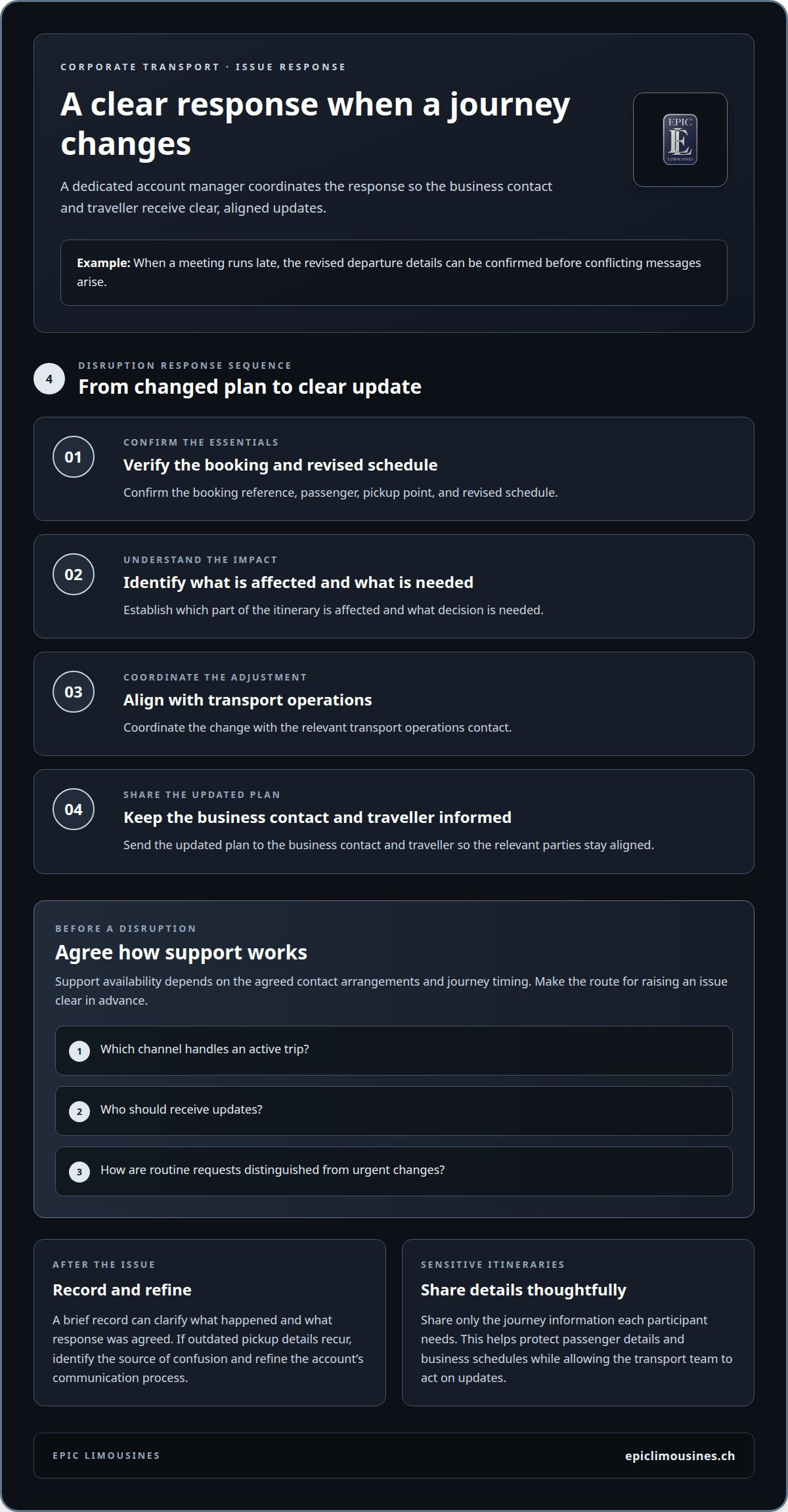
A change to a meeting’s end time can affect a corporate pickup, the next appointment, and passenger expectations. A dedicated account manager for corporate transport can coordinate the response by confirming the new timing, identifying affected journeys, and communicating a consistent plan to the business contact.
Support availability depends on the agreed contact arrangements and journey timing. The account setup should clarify which channel handles an active trip, who receives updates, and how routine requests are distinguished from urgent changes. This gives staff a clear route for raising an issue.
For a disruption, a useful response sequence is:
- Confirm the booking reference, passenger, pickup point, and revised schedule.
- Establish which part of the itinerary is affected and what decision is needed.
- Coordinate the adjustment with the relevant transport operations contact.
- Send the updated plan to the business contact and traveller.
For example, if a passenger’s meeting runs late, the manager can confirm the revised departure details before conflicting messages arise. The dedicated account manager for corporate transport keeps the relevant parties aligned, instead of leaving the traveller to relay separate instructions between contacts.
After an immediate issue is resolved, a brief record can clarify what happened and what response was agreed. If several bookings contain outdated pickup details, the manager can identify the recurring source of confusion and adjust the account’s communication process. A clear close-out also gives the business contact a concise summary of the outcome.
Sensitive itineraries also call for discretion. Sharing only the journey information each participant needs helps protect passenger details and business schedules while allowing the transport team to act on updates.
Transportation and logistics key account manager profile
A capable transport account manager combines logistics knowledge with attentive client service. The role brings travel requirements, operational coordination, and clear communication together, rather than focusing on bookings alone.
In the described industry profile, 55% of transportation and logistics account managers have a bachelor’s degree in business administration, logistics, or supply chain management. That background can help with journey planning, service workflows, and interpreting how transport supports a company’s operations. A degree matters less than applying that knowledge clearly to a client’s needs.
Experience also shapes the role. The profile describes at least seven years in the sector and three years in account management. A professional with that background may be better equipped to spot how a change to a Zurich meeting itinerary affects pickups, passenger communication, and later journeys.
For a Swiss business, useful capabilities include:
- Planning: translating a schedule into practical journey requirements.
- Communication: sharing clear updates with travellers and business contacts.
- Coordination: keeping operational details aligned when plans change.
- Account insight: noticing recurring needs across corporate travel patterns.
Providers differ in how they organise account management. Compare the named contact’s responsibilities, how requests are handled, and how journey changes are communicated. A roadshow with several appointments, for example, calls for a different coordination approach than a single airport pickup.
There is no universal fleet-size or travel-spend minimum for a dedicated manager. Account arrangements can reflect journey frequency, itinerary complexity, and the coordination needed across a company’s travel programme.
In Switzerland, corporate transport account management costs depend on the service scope and are provided after a quote request. The main cost factors include journey volume, itinerary complexity, and the level of coordination required.
The persona is typically aged 30 - 50 years and is described as 65% male and 35% female. These demographic details are part of the transportation and logistics key account manager profile.
The profile also states 7+ years of sector experience and at least 3 years in account management roles. Its stated income range is $70,000 - $120,000. Together, these details describe the persona’s typical age, gender composition, experience, and income range.
Which corporate transport providers in Switzerland offer dedicated account managers?
In Switzerland, start with providers whose corporate transport information describes account management or a named business contact. A general booking channel alone doesn’t show whether one person coordinates a company’s ongoing travel needs. For a Zurich roadshow, for example, the relevant distinction is whether the provider can manage the itinerary as a connected programme.
Assess the account relationship through the responsibilities it covers, not the label alone. A provider may describe support for bookings, itinerary changes, business travel planning, or service follow-up. Compare those details with your company’s actual travel pattern, such as recurring airport arrivals in Geneva and meetings in Basel. This reveals whether the proposed contact fits the work involved.
- Named contact: Does the arrangement identify a person responsible for business communication?
- Journey coordination: Can the contact handle connected journeys, rather than isolated bookings?
- Change handling: Is there a clear process for revised timings or pickup details?
- Follow-up: Does the service include a way to review recurring account needs?
These points help distinguish account management from a standard reservation process without assuming all providers work alike. A company arranging one transfer for a visiting executive may need a simpler process than a team coordinating airport pickups, client meetings, and a multi-stop roadshow.
For discreet or sensitive journeys, consider whether the provider’s transport services suit the passengers and itinerary. Corporate travel and diplomatic or VIP transport can involve different planning priorities. The account contact’s role should match the service required, the people travelling, and the level of coordination the schedule demands.
If your business is planning connected journeys in Switzerland, discuss corporate transport coordination as a practical next step.
A dedicated account manager is a provider contact who learns a business’s needs and proactively helps it get value from a service or software product. For corporate transport, ask how the contact will understand your travel pattern and what proactive help means for your journeys. Look for a relationship that goes beyond receiving booking requests: the contact should be able to connect the service to your business’s needs and help you get value from it. Clarify this role before choosing a provider, so the account arrangement matches the coordination your schedule requires.
Epic Limousines: Corporate Travel Management
Epic Limousines provides Corporate Travel Management for businesses coordinating journeys across Switzerland. It is a relevant option when executive travel, airport transfers, and business itineraries call for considered coordination rather than isolated bookings.
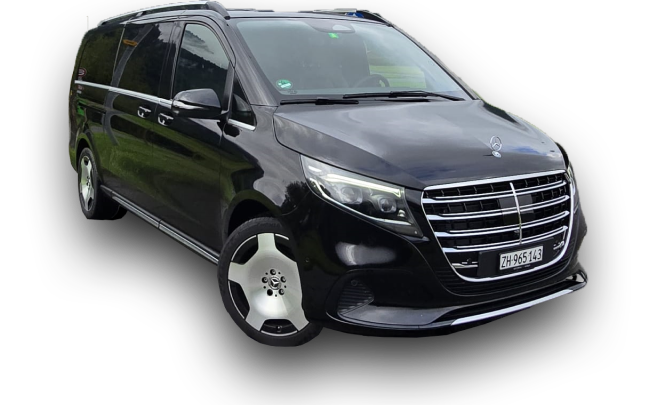
For an arrival followed by meetings, a Mercedes-Benz S-Class Transfer can suit individual executive travel, while a Mercedes-Benz Sprinter Transfer provides another option for corporate journeys. Diplomatic & VIP Protection Transport is suited to travel requiring discreet, security-focused transport. The appropriate arrangement depends on the passengers, itinerary, and service required.
Share your travel requirements with Epic Limousines to discuss a suitable corporate transport arrangement. Contact Epic Limousines directly to take the next step.
Shape your next business journey
Start by mapping the journeys your company needs to coordinate and deciding what each traveller needs from the experience. A dedicated account manager for corporate transport can provide continuity when business schedules and passenger requirements vary. The arrangement works best when it reflects your priorities rather than following a standard booking routine.
Epic Limousines offers Corporate Travel Management alongside Mercedes-Benz S-Class Transfer, Mercedes-Benz Sprinter Transfer, and Ski Resort Transfers. These options can support executive travel, group journeys, and business trips to the Swiss Alps. Share the type of travel you’re planning and the experience you want for your guests or colleagues.
Contact Epic Limousines to discuss your corporate travel requirements. A considered conversation can help you plan the next journey with greater clarity and composure.
Frequently Asked Questions
What Is a Dedicated Account Manager?
A dedicated account manager is a consistent business contact who understands an organisation’s transport requirements and helps coordinate its relationship with a provider. For example, they can learn who approves executive journeys and which travel details the company needs recorded. This continuity gives business contacts a familiar way to discuss account needs, instead of treating every request as a separate relationship.
What does a dedicated account manager provide for corporate transport clients?
An account manager can coordinate business travel preferences, passenger needs, and communication with the transport provider. For a visiting executive, this might mean keeping agreed preferences visible during journey planning and sharing relevant instructions with the service team. Confidentiality matters too: passenger names, itinerary details, and business purposes should be shared only as needed to coordinate the trip.
How do dedicated account managers handle bookings, billing, and expense reporting?
An account manager can coordinate booking information and clarify how trip charges and records are handled under the company’s arrangement. For an employee travelling between meetings, useful records may include the journey date, route, passenger, and booking reference. Billing formats, invoices, and expense reports depend on the provider’s process and the company’s accounting needs, so define these responsibilities when setting up the account.