Duty of care for employee transport and employer obligations

A safe employee journey involves more than getting from one place to another. The duty of care for employee transport concerns how work-related travel is planned and how foreseeable risks are considered, both during the journey and in the surrounding arrangements. For Swiss employers, a useful starting point is to identify the journey’s connection to work and what it entails.
When planning a work trip, you may already consider the destination, timing and transport arrangements. This article explains how those decisions relate to employee safety, what foreseeable risks mean in this context, and why night journeys need particular attention. It covers pickup and drop-off arrangements, communication and the final passenger, offering a practical framework for transport responsibilities and safer work-related travel.
Key Takeaways
- Map work-related journeys and consider how transport arrangements affect employee safety and well-being.
- Set clear night-travel procedures, including pickup and drop-off arrangements, communication, and what happens if a disruption occurs.
- Assess foreseeable risks in context: the journey, its timing, and the employer’s role in arranging or directing transport all matter.
- Clarify how responsibilities are shared between the employer, employees, and transport provider, especially when travel is part of a business trip.
What are an employer’s health and safety obligations?
For Swiss employers, transport responsibilities depend on the journey’s purpose and on who arranges or directs it. Business travel, employer-provided transport and an ordinary commute each raise different practical questions.
Business-Trip Safety and Well-Being
Business-trip safety means considering foreseeable travel risks before an employee sets out and throughout the journey. Assess the destination, route, timing and nature of the trip, then communicate relevant precautions and emergency procedures. A late arrival or unexpected route change, for example, can affect an employee’s well-being as well as their schedule. Provide a confidential way to report concerns about a driver, vehicle or journey, and record how each concern is addressed.
Vehicle Documents, Equipment, and Inspections
Vehicle checks help identify problems before a work journey begins. For employer-arranged vehicles, keep records of inspections, maintenance, breakdowns and replacements. Review the vehicle’s condition and relevant documents as part of the transport arrangements. Confirm that appropriate safety equipment is present and usable, and do not treat paperwork as a substitute for inspecting the vehicle. A written record shows what was reviewed, when an issue arose and how it was handled.
Commuting Safety Decisions and Duties
Document how the employer responds to specific commuting risks, such as severe weather or an inaccessible worksite. Ordinary travel between home and work differs from travel directed or arranged by an employer, so record the circumstances, available alternatives and decision. Ask employees about travel concerns and provide a confidential reporting route. Clear records can distinguish a routine commute from a journey arranged as part of work.
Transport Rules, Insurance, and Liability
Which Swiss laws and regulations govern employer-provided employee transport? The applicable framework depends on the arrangement and may involve employment, workplace safety, road traffic and insurance rules. The circumstances of the journey need to be established before identifying the relevant legal provisions.
What insurance coverage is required for employees using company transport or private cars for work? Coverage depends on the employee’s status, the journey’s purpose and the vehicle arrangement. Distinguish accident cover from motor-vehicle liability insurance.
What are the consequences and penalties for breaching employee transport safety duties in Switzerland? They depend on the breach and its circumstances, and may involve insurance, civil or regulatory issues. Who is liable for accidents involving employer-provided employee transport in Switzerland? Responsibility depends on the facts, including who arranged or controlled the journey and how the accident occurred.
What extra care does night travel need?
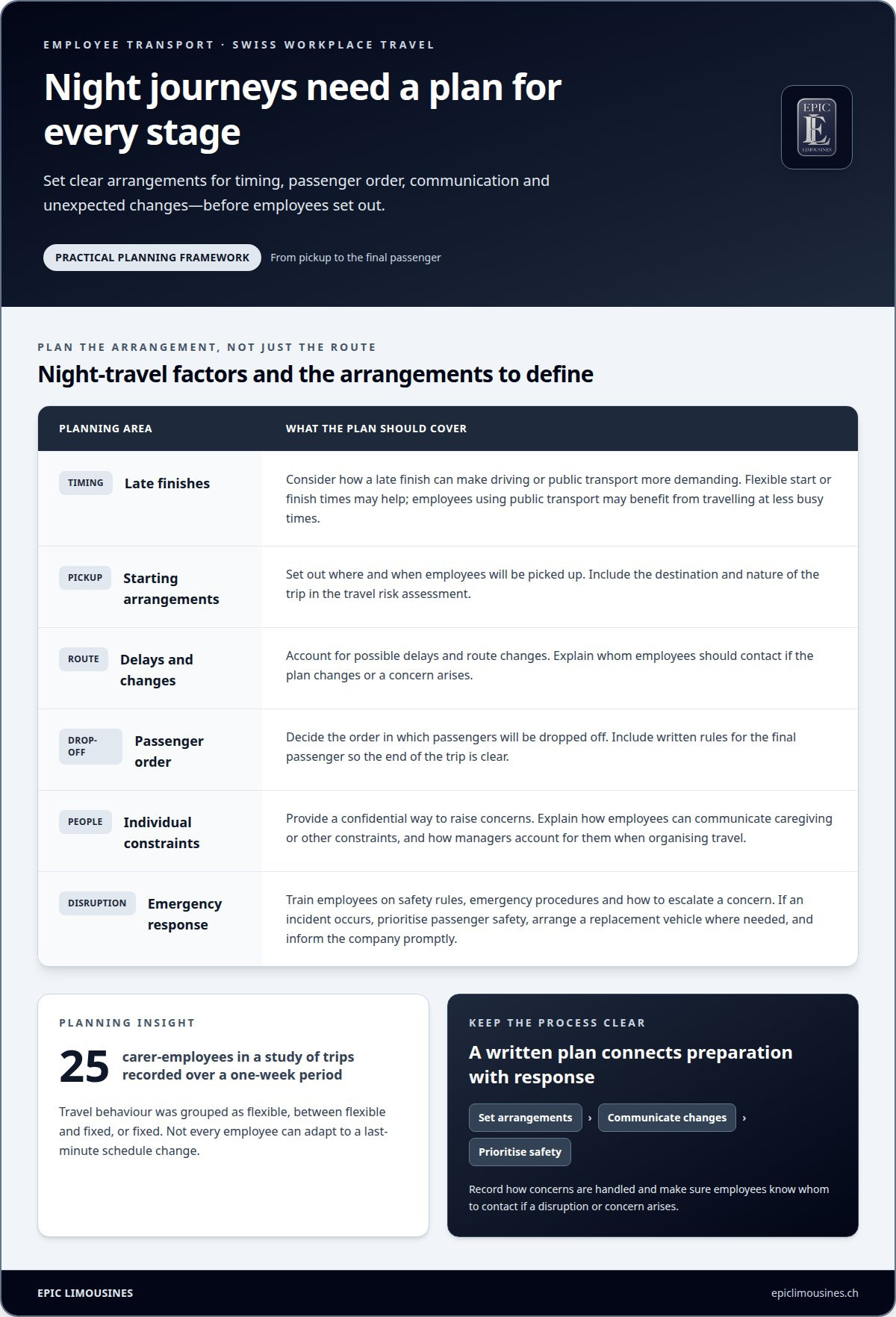
Night journeys need clear arrangements for timing, passenger order and unexpected changes. Written policies help employees understand the plan before departure.
Employee Well-Being While Travelling
Employee well-being during travel includes physical fatigue, mental strain and personal responsibilities that can affect a journey. A late finish can make driving or public transport more demanding, so employers can consider flexible start or finish times. Employees who rely on public transport may also benefit from travelling at less busy times. Provide a confidential way to raise concerns and respond constructively.
Caregiving responsibilities can affect how employees manage work-related journeys. A study examined 25 carer-employees and trips recorded over a one-week period, grouping travel behaviour into three types: flexible, between flexible and fixed, and fixed. This offers a practical planning insight: not every employee can adapt to a last-minute schedule change. A policy can explain how employees communicate constraints and how managers account for them when organising travel.
Travel Risk and Emergency Preparedness
A travel risk assessment considers the destination and nature of each business trip. For a night journey, include pickup and drop-off arrangements, possible delays, route changes and the order in which passengers will be dropped off. Written rules for the final passenger can prevent uncertainty at the end of a trip. Explain whom employees should contact if the plan changes or a concern arises.
Emergency preparation sets out actions for employees and organisers after an incident or disruption. Training can cover safety rules, emergency procedures and how to escalate a concern. If an incident occurs, prioritise passenger safety, arrange a replacement vehicle where needed, and inform the company promptly. Organisations planning business journeys can use Corporate Travel Management to coordinate transport with the trip’s schedule and requirements.
Common law negligence and foreseeability
Negligence analysis often considers whether harm was foreseeable and whether reasonable care was taken. “Common law negligence” is a framework used in common-law jurisdictions, not a label that, by itself, identifies the Swiss legal test. For a Swiss workplace journey, assess the actual transport arrangement rather than assuming a foreign legal rule applies.
Foreseeability concerns risks that could reasonably be anticipated in the circumstances. If a company arranges a bus to a remote worksite, the route, weather, access conditions and passengers’ ability to reach the site independently may all affect the risk assessment. A foreseeable risk does not mean an accident is certain. It means the circumstances warrant considering possible harm and appropriate precautions.
Consider a fictional example: an employer arranges transport after heavy snowfall, while the usual access road is closed. A sensible review would consider whether the vehicle can take an alternative route, whether to delay the journey, and how to update employees. The decision-making process matters: ignoring an obvious road closure differs from responding to changing conditions with clear communication and a considered plan.
For companies, records make the decision-making process visible. Note the information available when transport was arranged, the options considered, who made the decision and any changes communicated to employees. If a passenger reports dangerous driving or a recurring vehicle problem, record both the complaint and the response. A pattern of unresolved reports may make it harder to describe a later risk as unexpected.
Foreseeability is a practical way to assess risk, not a promise that every risk can be eliminated. For each employer-arranged journey, consider its purpose, route and timing, as well as who controls the transport. Then match precautions to the risks identified, such as changing a pickup point or pausing a journey during unsafe conditions. In Switzerland, legal responsibility depends on the applicable rules and the facts of the incident; the common-law concept alone does not determine liability.
Meaning and scope of duty of care in employee transport
In employee transport, the duty of care means taking reasonable care when arranging or providing journeys that could foreseeably harm passengers or others. It is not a promise that no incident will occur. For a Swiss employer, the practical questions are how the work journey is organised, what risks are apparent and what action follows. A journey arranged for a worksite visit differs from an employee’s ordinary commute.
The scope depends on the employer’s role and the journey’s context. Consider who selects the vehicle, sets the route, communicates pickup details and can respond if conditions change. If an employer directs staff to travel together, the risks of that journey deserve attention as part of the arrangement. An employee’s independent travel choices may involve different responsibilities. These distinctions help companies decide where transport planning and communication are needed.
Reasonable care involves actions suited to the risk. For example, a transport provider’s responsibilities may include defensive driving and securing a passenger’s mobility device. An employer arranging a journey can also consider whether the pickup point is accessible and whether employees know how to report a concern. These examples show that care relates to the transport task itself, not an abstract assurance applied identically to every trip.
Foreseeability connects information to action. A reported vehicle defect, an inaccessible route, or a known disruption gives decision-makers specific knowledge to consider. Record what was reported, who received it, and what response followed; this creates a clear account of how the risk was handled. For sensitive journeys requiring a dedicated transport arrangement, Diplomatic & VIP Protection Transport is a relevant option. The takeaway is to match precautions to the journey, the employer’s involvement, and the risks that can reasonably be anticipated.
Epic Limousines: Diplomatic & VIP Protection Transport
Epic Limousines provides Diplomatic & VIP Protection Transport for organisations arranging discreet journeys for diplomatic and VIP travellers. It can suit a work trip that needs a dedicated arrangement rather than routine employee commuting. The right arrangement depends on the traveller’s itinerary, pickup and destination requirements, and the coordination involved.
For other business travel needs, Mercedes-Benz S-Class Transfer and Mercedes-Benz Sprinter Transfer offer chauffeur-driven transport options. Clear journey details help align the arrangements with the trip’s schedule and passenger requirements. Transport planning remains one part of an employer’s wider approach to foreseeable risks, communication and employee well-being.
For a tailored discussion of a business journey, please contact Epic Limousines.
Make the next journey part of your planning
Make transport planning a considered part of each business itinerary. Before the next trip, decide what employees need from the journey and how the arrangements fit its purpose, schedule and passenger requirements. A clear process turns the duty of care for employee transport into practical decisions rather than a policy that stays on paper.
For future business journeys, Epic Limousines offers Mercedes-Benz Sprinter Transfer, Mercedes-Benz S-Class Transfer and Ski Resort Transfers. These options can support different itineraries, from group transport to executive travel or a resort-bound trip. Share the journey requirements and intended schedule to discuss an arrangement suited to the trip.
Plan your next journey with Epic Limousines, and take the next step towards a more thoughtfully arranged travel experience.
Frequently Asked Questions
What Does Duty of Care Mean?
Duty of care means taking reasonable steps to reduce foreseeable risks of harm connected with work. In transport, this can involve the employer’s arrangements, the vehicle and the circumstances of the journey. If a planned pickup point becomes inaccessible, for example, employees need a clear alternative rather than uncertainty about where to meet. Appropriate precautions depend on the risk and the employer’s role.
How should employers deal with this issue?
Make transport decisions part of travel planning, not an afterthought. Set out who arranges the journey, how employees receive updates and how they can report concerns confidentially. If an employee reports unsafe driving, record the report and the response. For a business trip, also consider whether the itinerary, travel hours and transport plan create avoidable pressure or fatigue.
What should be checked in each area?
Review the journey plan, passenger arrangements, vehicle condition and communication process as distinct parts of transport safety. For the vehicle, consider its relevant documents, inspection history and safety equipment. For the route, consider access and likely disruptions. For employees, clarify pickup details and how to report concerns. For management, document who reviews issues and how corrective actions are recorded.
What should happen after an accident or breakdown?
Prioritise passenger safety, communicate promptly with the employer and arrange suitable onward transport when needed. After a breakdown, a replacement vehicle can help employees continue their journey without leaving them to resolve the disruption alone. Record the incident, its location, the response and any vehicle replacement. Review the cause and related complaints to address any recurring operational issue.
What is an employer’s duty of care for employee transport in Switzerland?
In Switzerland, an employer’s responsibilities depend on the journey’s connection to work and the employer’s role in arranging or directing transport. A business journey or employer-organised ride raises different considerations from an employee’s independent commute. Clarify the scope by documenting the journey’s purpose, who controls the arrangements, the risks considered and the actions taken when circumstances change.
Does an employer’s duty of care cover employees’ commutes to and from work in Switzerland?
Do not automatically treat ordinary commuting as equivalent to employer-provided work transport. The key distinction is whether the journey is arranged independently or forms part of transport directed or organised by the employer. A ride arranged to reach a worksite, for example, may raise different questions from an employee’s usual route. The journey’s purpose and the employer’s involvement are central to assessing responsibility.