Justifying Executive Chauffeur Costs to Management: A Business Case

What if the transport option with the higher quoted fare isn’t the most costly choice for the business? Management is right to scrutinise executive travel expenses, especially when a basic alternative appears cheaper. But justifying executive chauffeur costs to management means comparing more than the transport charge. It means assessing the journey’s requirements, the traveller’s time and the practical costs of each alternative.
A credible case doesn’t assume every minute in a car becomes productive, or that a chauffeur is appropriate for every journey. It uses your organisation’s own figures and assumptions to distinguish time that can genuinely be used for work from time spent driving, navigating or coordinating transport. It also makes the comparison transparent, including relevant expenses and operational considerations.
This article sets out an auditable framework for evaluating chauffeur transport against options such as public transport, taxis or rental cars. You’ll learn how to document business need, compare realistic total costs and establish clear approval criteria for different trip types. EPIC Limousines provides corporate travel management, roadshow transport and at-disposal services, making it possible to consider transport arrangements in relation to the journey rather than prestige alone.
Key Takeaways
- Start with the journey’s documented business purpose and requirements, not the prestige of the vehicle.
- For justifying executive chauffeur costs to management, compare options for the same itinerary, travellers, timing and purpose.
- Use your organisation’s own records and assumptions to assess transport costs alongside traveller workload and usable work time.
- Set consistent approval criteria, including who requests, approves, books and reviews each trip.
- EPIC Limousines provides corporate travel management, roadshow and at-disposal services, with Mercedes-Benz S-Class, V-Class and Sprinter vehicles.
Why justifying executive chauffeur costs starts with the business need
A transport charge is easy to see on an expense report. The requirements it may serve, such as coordinating several appointments, moving a team together or preserving time for work between meetings, are less visible. Without a clear business purpose, a chauffeur request can look like a preference rather than a considered transport decision.
A defensible case is specific to the trip. It records why the journey is necessary, compares suitable transport options for that itinerary and states expected outcomes without presenting them as guaranteed. This follows the basic logic of understanding the business case: explain the need, consider alternatives and make the reasoning available for review. The aim isn’t to make premium transport the default. It’s to show when a particular journey warrants management’s consideration.
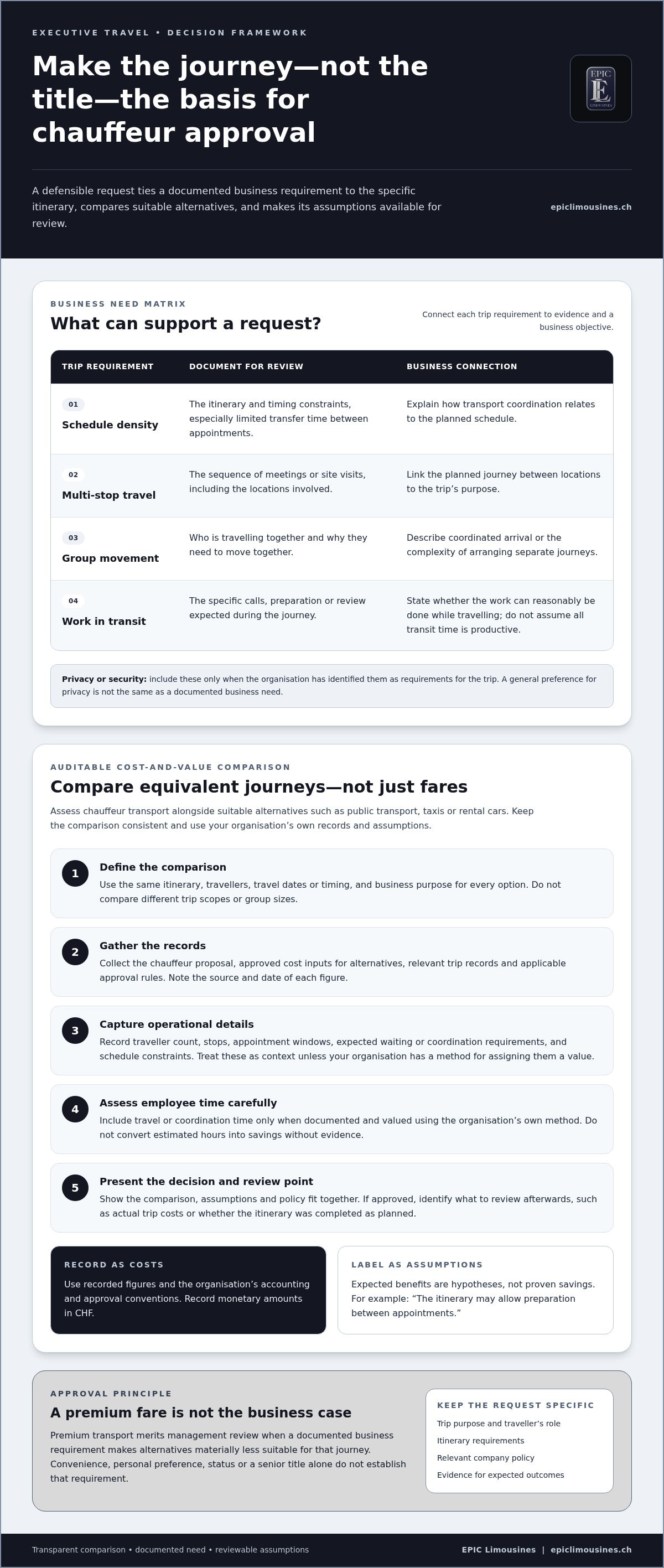
Premium transport merits management review when a documented business requirement makes the alternatives materially less suitable for the journey. Convenience, personal preference and status alone don’t establish that requirement. Nor should a senior traveller’s title automatically determine the transport choice. The request should explain what the trip involves and why the selected option fits its purpose.
Which business circumstances can support the request?
Look for requirements that can be described and evidenced, then connect each one to a business objective:
- Schedule density: Several appointments with limited transfer time can make coordination an operational consideration. Document the itinerary and timing constraints.
- Multi-stop travel: A sequence of meetings or site visits may call for a planned journey between locations. Link the stops to the trip’s purpose.
- Group movement: Travelling together may support coordinated arrival or reduce the complexity of arranging separate journeys. Record who is travelling and why they need to move together.
- Work in transit: If calls, preparation or review are expected during the journey, state the specific work and whether it can reasonably be done while travelling.
Include confidentiality or security requirements only when the organisation has identified them for the trip. A general preference for privacy isn’t the same as a documented business need.
How to frame the request without overstating benefits
Keep the request factual: state the trip purpose, traveller’s role, itinerary requirements and relevant company policy. Label anticipated benefits as hypotheses, not proven savings. For instance, “The itinerary may allow preparation between appointments” is more credible than claiming the journey will increase productivity without supporting evidence.
EPIC Limousines provides corporate transport with a focus on privacy and confidentiality, which is relevant context when privacy is part of the organisation’s stated criteria. Its corporate travel management, roadshow and at-disposal services address business travel requirements, but that context doesn’t prove a specific result for an individual trip. Keep the distinction clear: the request establishes the need, and internal records can later show whether the expected benefit occurred.
This disciplined approach makes justifying executive chauffeur costs to management more consistent. It gives approvers a reasoned basis to accept, decline or request further detail, while ensuring the decision rests on the journey rather than the traveller’s status.
Build a transparent cost-and-value case for executive chauffeur travel
A sound comparison doesn’t rely on a generic claim that chauffeur travel saves time or improves productivity. It gives management a clear view of the proposed transport, relevant alternatives and the assumptions behind each figure. Record monetary amounts in CHF and follow your organisation’s accounting and approval conventions.
Use this sequence to make the assessment consistent and auditable:
- Define the comparison. Use the same itinerary, travellers, travel dates or timing and business purpose for every option. Don’t compare a single transfer with an alternative covering multiple stops or a different number of people.
- Gather the records. Assemble the chauffeur proposal, approved cost inputs for alternative modes, relevant trip records and applicable approval rules. Note the source and date of each figure.
- Capture operational details. Record traveller count, stops, appointment windows, expected waiting or coordination requirements and schedule constraints. Include these as context unless the organisation has a method for assigning them a value.
- Assess employee time carefully. Include travel or coordination time only if it’s documented and valued using the organisation’s own method. Don’t treat all time in transit as productive or convert estimated hours into savings without evidence.
- Present the decision and review point. Show the comparison, assumptions and policy fit together. If the request is approved, identify what information will be reviewed afterwards, such as actual trip costs or whether the itinerary was completed as planned.
Measured costs are recorded figures; estimated benefits are assumptions to test, while qualitative considerations should remain clearly labelled as such.
Which inputs belong in the comparison?
Start with the actual chauffeur proposal and the organisation’s approved inputs for alternatives, rather than general market averages. Apply those inputs to the same journey and traveller group. Include employee time only under the company’s valuation approach, and distinguish scheduled travel from time that could genuinely be used for work. This keeps justifying executive chauffeur costs to management grounded in internal evidence.
For example, if the itinerary includes several appointments and a group travelling together, show those details beside each option. They may affect whether an alternative is practical, but don’t assign a monetary value unless an established internal method supports it.
How to show assumptions and uncertainty
Separate the case into confirmed figures, internal estimates and qualitative considerations. Confirmed figures might include the proposal and approved alternative-mode inputs; estimates might include travel time or coordination effort; qualitative factors could include a documented privacy requirement. Don’t blend these categories into one apparent total.
Then run a sensitivity check. Recalculate the comparison using conservative assumptions, such as less recoverable work time than the initial estimate. If the recommendation depends on an optimistic assumption, say so plainly. This is more credible than applying an unsupported savings percentage or treating a possible benefit as a guaranteed result.
EPIC Limousines’ corporate travel management services provide context for considering a defined itinerary and its transport requirements.
Compare chauffeur transport with alternatives on more than the fare
A balanced comparison asks which option fits the journey and company policy, not which mode wins in every situation. Use the same itinerary, traveller count and timing for each alternative. Mark each criterion by evidence type: measurable for recorded figures, qualitative for a reasoned assessment, or policy-dependent where internal rules determine suitability.
The matrix below is a starting point. Replace general prompts with your organisation’s own records and approval standards. A taxi or rideshare may suit one itinerary; employee driving or chauffeur transport may better fit another. No option is automatically the cheapest, safest or most productive without trip-specific evidence.
| Criterion and evidence type | Chauffeur transport | Employee driving | Taxi | Rideshare |
|---|---|---|---|---|
| Total trip fit Qualitative |
Assess against the full route, stops and traveller group. | Assess driving, parking and route demands. | Assess suitability for the planned journey and stops. | Assess suitability for the planned journey and stops. |
| Schedule coordination Qualitative |
Review how a pre-arranged journey fits appointment timings. | Review who coordinates departures and transitions. | Assess how transport is arranged between trip stages. | Assess how transport is arranged between trip stages. |
| Traveller workload Measurable, if recorded |
Record any work planned during transit, without assuming it will occur. | Account for driving time and related tasks. | Record expected travel time and any coordination tasks. | Record expected travel time and any coordination tasks. |
| Privacy requirement Qualitative, based on identified need |
Assess against the organisation’s stated privacy criteria. | Assess against the same criteria. | Assess against the same criteria. | Assess against the same criteria. |
| Policy alignment Policy-dependent |
Check the request against internal approval rules. | Check permitted use and expense rules. | Check permitted use and expense rules. | Check permitted use and expense rules. |
| Trip cost Measurable |
Use the actual proposal for the defined itinerary. | Use the organisation’s approved cost inputs. | Use the applicable recorded cost input. | Use the applicable recorded cost input. |
Where chauffeur transport may fit the itinerary
Multi-stop schedules, coordinated group travel and roadshows each create different planning needs. Compare how each option supports the specific sequence of appointments, traveller group and timing, rather than treating these use cases as interchangeable. An at-disposal service may suit an itinerary with changing or continuous transport requirements. Relate vehicle selection to traveller numbers and trip purpose, without assuming a particular capacity or level of benefit.
Where a different option may be proportionate
A straightforward journey to one destination may not call for executive transport. Employee driving, a taxi or rideshare can be proportionate when the itinerary is simple and company policy allows it. Consider the complete journey and its requirements, then record why the selected option fits. This supports justifying executive chauffeur costs to management through appropriate use, not criticism of alternatives.
Create approval criteria that make executive chauffeur spending consistent
A clear policy turns trip-by-trip judgement into a repeatable process. It should explain which business requirements can justify executive chauffeur transport, who has authority to approve it and what records support the decision. This helps ensure that similar journeys are assessed consistently, while preserving room for a documented exception.
Use the organisation’s existing approval thresholds and expense rules rather than creating informal standards around seniority or personal preference. Criteria might include a documented business purpose combined with itinerary complexity, an identified privacy requirement or the need to coordinate group travel. These are prompts for review, not automatic approval conditions. The request still needs to show how the transport choice fits the journey.
What an executive transport policy should define
Set out eligible situations, required request details and decision ownership. Specify who requests, approves, books and reviews the journey, and who retains the record. Keep the language neutral: a request may be approved, declined or sent back for further information, and exceptions should be recorded against the same criteria as other decisions.
- Request: Traveller or coordinator records the business purpose, itinerary, traveller count, relevant constraints and alternatives considered.
- Approval: The designated approver assesses the request against policy and records the rationale.
- Booking and review: The responsible coordinator arranges approved transport and preserves the final trip details and assessment.
Retain enough information for a later review, including the proposed itinerary, relevant comparison, approval decision and any material change to the journey. This creates an audit trail without treating a premium option as a standing entitlement.
How to evaluate results after approved journeys
A limited pilot can help test whether the criteria work in practice. Select journeys that meet the stated policy, record the expected operational outcomes before travel, then review the actual itinerary, internal feedback and available trip records afterwards. Don’t promise savings or assume every approved journey will produce the same benefit.
Compare results with the criteria used at approval. Did the itinerary require the anticipated coordination? Were the recorded privacy or group-travel needs relevant? Did the trip differ materially from the plan? Note evidence separately from opinion, then use the findings to clarify eligibility, request details or approval responsibilities. If the evidence is mixed, keep that uncertainty visible rather than turning one journey into a general rule.
Connect the framework to corporate travel planning
Approval criteria work best when they sit within a wider travel process, with consistent request, booking and review responsibilities. EPIC Limousines’ corporate travel management guide offers additional context for structuring executive logistics. A disciplined framework makes justifying executive chauffeur costs to management more transparent, while leaving each decision tied to its documented business purpose.
EPIC Limousines provides corporate travel management for defined business travel requirements. Its corporate transport services are relevant to organisations assessing planned journeys.
Present a credible executive chauffeur case with EPIC Limousines
A strong management proposal connects an evidenced business requirement to a suitable transport arrangement. EPIC Limousines provides private chauffeur-driven transport for individual travellers and groups, with corporate travel management, roadshow and at-disposal services. The company has more than 10 years of experience transporting people and focuses on privacy and confidentiality. These facts can inform the decision, but the case for a particular trip still rests on its documented purpose, itinerary and approval criteria.
The fleet includes Mercedes-Benz S-Class, V-Class and Sprinter vehicles. Present a vehicle preference in relation to the traveller or group’s requirements and the journey’s purpose, not as a status choice. Avoid making assumptions about capacity or other specifications. A clear request lets management consider whether the proposed arrangement is proportionate to the trip.
Match the request to the confirmed service
Connect the business need with the relevant arrangement. A roadshow involving a sequence of appointments, for example, has different transport requirements from a single transfer. At-disposal services may be relevant when the itinerary requires ongoing transport arrangements. State what the journey involves and why the service type fits, while keeping expected benefits framed as outcomes to assess rather than promises.
Every EPIC Limousines vehicle includes personal hand sanitizer and masks, free bottled water and refreshing towels. Mints, newspapers, Wi-Fi and phone chargers are available on request. Mention these amenities only where they are relevant to the traveller’s stated needs. They can inform the travel brief, but shouldn’t be presented as a substitute for the business rationale or evidence of a financial return.
Make the management handoff straightforward
Give the approver and travel coordinator one concise brief. Include the core trip facts, then attach the comparison and decision record so the request can be considered without reconstructing its rationale.
- Journey details: Travel dates, itinerary, traveller count and any known timing or coordination requirements.
- Business case: Trip purpose, relevant traveller roles, applicable policy and the alternatives assessed.
- Transport preference: Requested service type and vehicle preference, linked to the journey’s requirements.
- Decision record: Confirmed figures, estimates and qualitative considerations, clearly distinguished.
- Review plan: The operational outcomes or internal feedback that will be recorded after travel.
This format makes justifying executive chauffeur costs to management more transparent: reviewers can see what is known, what is assumed and how the decision will be assessed. A well-prepared brief also gives EPIC Limousines a clearer picture of the corporate travel requirement. For a tailored corporate journey, talk to EPIC Limousines and share the itinerary and traveller needs.
Make your next transport decision evidence-led
Turn the framework into a practical tool by creating a concise trip brief your organisation can reuse. Give requesters a consistent way to record the journey’s purpose, requirements and alternatives, and give approvers a clear place to document their decision. That makes justifying executive chauffeur costs to management less about personal persuasion and more about applying agreed criteria to a specific business need.
For your next request, begin with the journey itself. Gather the relevant records before choosing a transport option, then state what the trip requires and how you’ll assess whether the arrangement was appropriate afterwards. Keep expected benefits distinct from confirmed evidence. The result is a measured decision, with useful learning for future travel planning whether the request is approved or declined.
A consistent process can give management greater clarity while allowing transport choices to remain tailored to each journey. For a considered conversation about an upcoming requirement, discuss your executive transport requirements with EPIC Limousines. A well-prepared brief is a composed first step towards the right decision.
Frequently Asked Questions
How much detail should a management proposal for executive transport include?
Include enough detail for an approver to understand why the journey needs the proposed arrangement and what decision is being requested. For justifying executive chauffeur costs to management, attach the itinerary and relevant alternative comparison, and identify which information is confirmed versus estimated. A concise proposal might also note a late change between appointments or a requirement to move several travellers together. Keep supporting documents available, but make the decision and rationale easy to find.
Can executive chauffeur transport be justified for one traveller?
Yes, a single traveller can have a valid business need, but the request should stand on the itinerary and policy criteria rather than the traveller’s seniority. For example, a schedule with tightly timed meetings at separate locations may warrant comparison with other options. A straightforward journey to one destination may not. Record the specific constraint and assess whether it changes the suitability of the alternatives, without assuming that travelling alone rules the service in or out.
Is a chauffeur service appropriate for confidential business travel?
It can be considered if the organisation has identified confidentiality as a requirement for the trip. Explain the nature of the need at an appropriate level without placing sensitive details in a broadly circulated expense request. EPIC Limousines emphasises privacy and confidentiality in its transport services, which is relevant context for that assessment, but the proposal should not treat a privacy focus as a guarantee of a particular security outcome.
Can an executive chauffeur service support multi-stop business itineraries?
Yes. A pre-planned chauffeur journey can be considered for a sequence of business stops, particularly when the order or timing of appointments shapes the transport requirement. If plans may change during the day, describe the anticipated pattern and distinguish known stops from possible additions. An at-disposal arrangement may be relevant to ongoing itinerary needs. The final request should still follow company approval rules and reflect the actual journey being arranged.
What should an executive assistant include in a chauffeur request?
Provide the travel dates, pickup and destination details, planned stops, traveller count, business purpose and any vehicle preference. Note timing constraints or coordination needs that affect the itinerary, and attach the internal comparison or approval record if required by policy. Avoid including sensitive meeting content unless the approver needs it. A clear, complete request helps the approver assess the transport need and gives the travel coordinator a usable brief.
What happens if the proposed journey changes after approval?
Follow the organisation’s change and reapproval rules rather than assuming the original decision automatically covers a different trip. A new stop, changed traveller count or altered timing could affect the comparison or the reason for the request. Record what changed, when it changed and whether the existing approval still applies under policy. After travel, retain the actual itinerary so the final assessment reflects the journey that took place.
How can management assess chauffeur travel without historical trip data?
Use a limited, policy-governed trial rather than claiming savings in advance. Select a journey with a clearly defined need, record the planned itinerary and compare the available options using current internal inputs. Before travel, state what will be reviewed, such as schedule changes, coordination demands or traveller feedback. Afterward, assess the evidence against those criteria. Keep the result provisional until more journeys provide a reliable basis for policy decisions.