Navigating Switzerland for Business Travelers: Hours, Holidays and Time Zones
Swiss business hours generally run from 8:00 a.m. to 12:00 p.m. and 1:30 p.m. to 5:00 p.m. on weekdays, while local time is GMT+1 in winter and GMT+2 during the summer months. For business travelers navigating Switzerland, the key is to coordinate airport and rail connections with the local clock and calendar, including Swiss National Day on August 1 each year.
Even a well-planned meeting schedule can feel tight when connections, business hours and time differences compete for attention. This guide explains how to plan airport and rail journeys, account for local holidays and prepare for mobile connectivity and electrical sockets. It also covers when a private intercity transfer can add comfort and continuity to a business itinerary, helping you move between meetings and destinations with fewer separate arrangements.
Key Takeaways
- Coordinate airport arrivals and international rail connections around your meeting locations to keep transfers between destinations manageable.
- Build weekday business hours, Switzerland’s time-zone changes and August 1 into your meeting calendar.
- Prepare for mobile connectivity and Swiss electrical sockets before departure so your devices are ready for work.
- Consider a private intercity transfer when a business itinerary calls for comfortable, direct travel between meetings or destinations.
Airports and international rail links
An airport connection links an international arrival with a city or onward destination. Zurich Airport connects directly to Zurich’s rail network, while Geneva and Basel are useful gateways for meetings in western and northwestern Switzerland. For a cross-border itinerary, identify your arrival airport, final station and meeting address before choosing a connection. This makes each transfer easier to plan, especially when a rail journey follows a flight.
International rail links connect Swiss cities with destinations in neighbouring countries. Basel is a practical rail entry point from France and Germany; Geneva links with France, and Zurich offers onward international connections. Match your train’s departure station to your airport arrival, and allow time to reach the platform after collecting your baggage. If you have a meeting in Lausanne after landing in Geneva, plan the journey from the airport to the station as part of the trip, not as an afterthought.
Business travel status depends on planned work activities, not simply the trip’s duration. According to sem.admin.ch, foreign employers posting workers to Switzerland generally must notify Swiss labor authorities in advance, unless the assignment lasts no more than 8 days per calendar year and qualifies for an exemption. According to sem.admin.ch, the posted-worker rule allows each employee to work in Switzerland for up to 90 days per calendar year, subject to the stated employer-employee combination limit. According to sem.admin.ch, if you work for a company registered in an EU-27/EFTA state, your employer can second you to Switzerland for up to 90 days per calendar year if you have been integrated long-term in an EU or EFTA member state’s regular labour market, meaning you held a temporary or permanent residence permit for at least 12 months. Eligible Schengen travelers may stay in Switzerland without a visa for a short business trip for up to 90 days within a 180-day period, according to EUR-Lex. Meetings and hands-on project work can have different authorization requirements, so employers should assess planned activities before travel.
Before driving, check the requirements for your route and follow local parking signs, as arrangements can vary by location. If you are driving a rental car, follow the rental agreement and Swiss road signs, and check the route’s vignette requirements and parking rules at each destination before setting off. This matters especially when a meeting is in a city centre, where parking arrangements may differ from those outside town.
Swiss public transport is generally dependable, but a missed connection can disrupt a tightly timed itinerary. If plans change, check the station departure boards, take the next suitable connection and notify your meeting contact if you will be late. In Zurich, Geneva, Basel and Lausanne, local transport connects stations with city destinations. Confirm the right stop and route for your address before boarding. These steps make navigating Switzerland for business travelers more orderly, whether the next leg is by rail or local transit.
Business hours, time zone and holidays
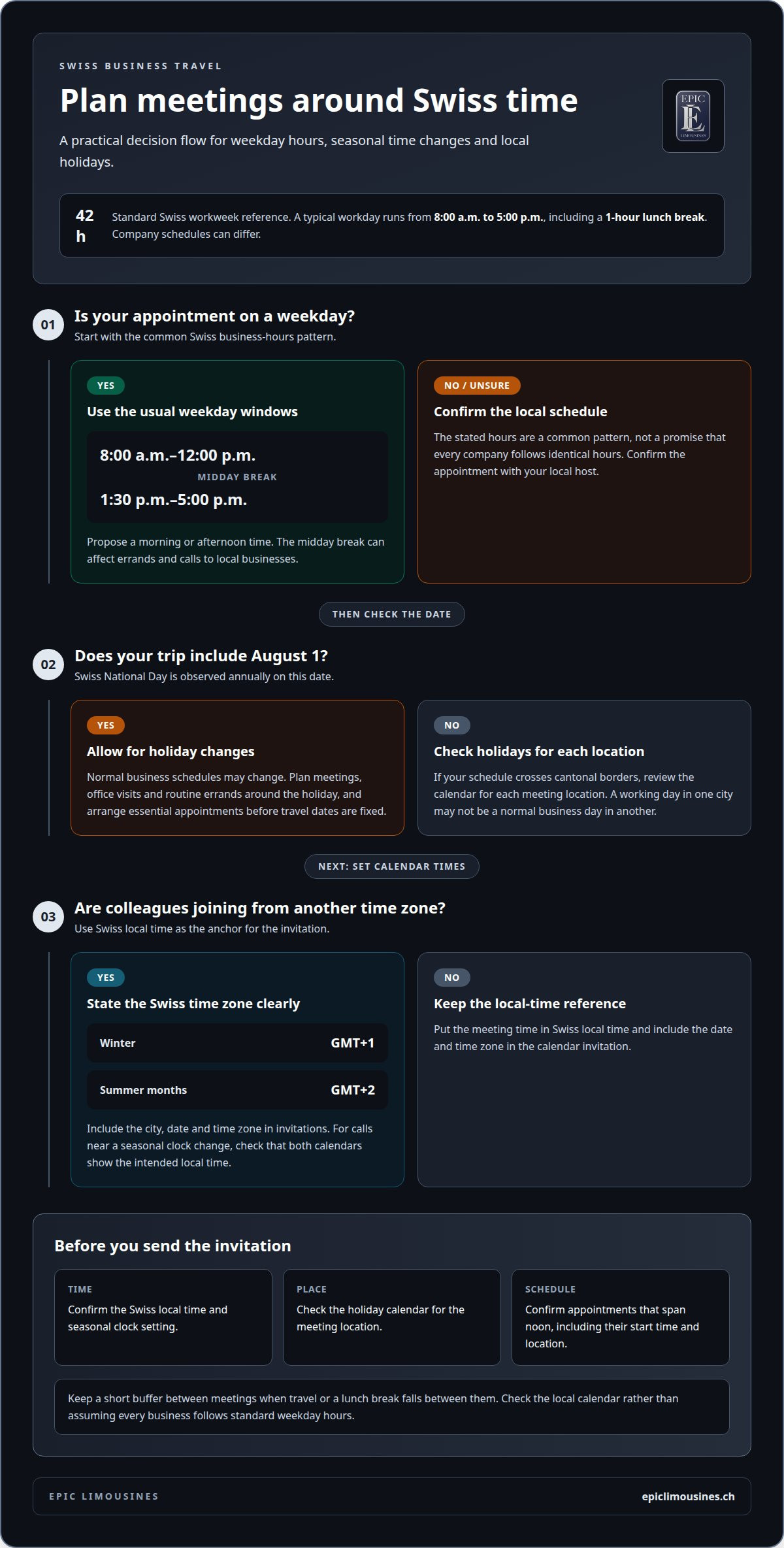
Swiss business hours are the usual weekday periods when offices and shops operate. A common schedule is 8:00 a.m. to 12:00 p.m., then 1:30 p.m. to 5:00 p.m. The midday break can affect in-person errands and calls to local businesses. For a meeting request, propose a time within the morning or afternoon period. If an appointment spans noon, confirm its start time and location in writing.
Switzerland’s standard workweek is 42 hours, and a typical workday runs from 8:00 a.m. to 5:00 p.m., including a 1-hour lunch break. These are useful planning reference points, not a promise that every company follows identical hours. For example, schedule a client meeting before lunch, then leave the midday period clear for travel or preparation. A later meeting can begin in the afternoon window, with enough time to reach the venue.
Swiss local time is Central European Standard Time, GMT+1, during winter. In the summer months, Switzerland observes daylight saving time at GMT+2. The one-hour seasonal shift matters when coordinating calls with colleagues abroad. Put the meeting time in Swiss local time and include the date and time zone in calendar invitations. For a call scheduled near a seasonal clock change, check that both calendars display the intended local time.
A public holiday is a calendar day when normal business schedules may change. Swiss National Day is observed annually on August 1. If a trip falls near that date, plan meetings, office visits and routine errands around the holiday. Avoid assuming that every business will follow its standard weekday opening hours. Build flexibility into the itinerary and arrange essential appointments before travel dates are fixed.
Holiday calendars matter when your schedule crosses cantonal borders. Before arranging meetings in Zurich and Geneva, review the dates for each location and confirm appointments with local hosts. This helps avoid mistaking a working day in one city for a normal business day in another. Keep the calendar tied to the meeting location, not just your hotel or arrival city.
For international calls, convert each appointment from Swiss local time before sending invitations. Include the city, date and time zone in the message, especially when participants work across several countries. Keep a short buffer between meetings when a journey or lunch break falls between them. A clear calendar, checked against weekday hours and August 1, makes it easier to protect meeting time and avoid avoidable scheduling conflicts.
For this itinerary, the traveller planned to arrive in Zurich on Aug 30 and stay there until September 14, with free time until September 2. Use that open period to arrange flexible local appointments.
Mobile networks, Wi-Fi and electrical sockets
A mobile network connects your phone to calls and data services while travelling. Switzerland widely uses 4G, and several mobile providers have rolled out 5G services. These network generations support common work tasks, such as messaging, email and online meeting access. Actual signal strength can vary by location, building and device, so don’t assume one connection method will work everywhere. Before departure, check that your phone can use the network bands and roaming settings needed for your trip. Save meeting addresses and essential travel details for access when data service is unavailable.
Wi-Fi provides wireless internet access through a local network and can help with laptop work in hotels, offices and other places that offer guest access. Treat each connection as a separate network: choose the correct network name, follow its sign-in instructions and avoid sending confidential material over a connection you do not trust. Before a video meeting, test the audio and connection quality. Keep mobile data available as a backup if Wi-Fi drops, particularly before a scheduled client call. Separating work activity from casual browsing can also help you stay focused.
An electrical socket is the wall connection that supplies power to a device. Switzerland uses type C and type J sockets, with standard voltage of 230 volts and frequency of 50 hertz. Type C plugs fit type J sockets, which can simplify charging for devices with that plug. Check the shape and voltage information printed on each charger before packing it. A plug adapter changes the physical connection; it doesn’t automatically change voltage. If a device’s label doesn’t support Switzerland’s 230 volts, use an appropriate voltage converter rather than assuming an adapter is enough.
Prepare a compact work setup before travelling between Swiss cities. Pack charging cables, the correct adapter for your plug, and a power bank if you use one. Charge your phone and laptop before leaving a hotel, then keep essential meeting details available offline. For a presentation, store a local copy of the file instead of relying entirely on hotel Wi-Fi or mobile data. If you’ll work from an office, ask for its guest-network process when arranging the visit. These steps help maintain access across 4G, 5G and Wi-Fi without relying on a single connection.
For a trip that combines meetings with several destinations, plan your Swiss business travel arrangements with connectivity and charging needs in mind.
Epic Limousines: Corporate Travel Management
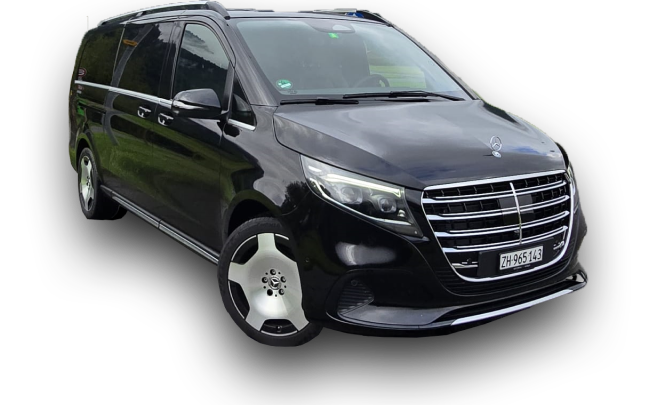
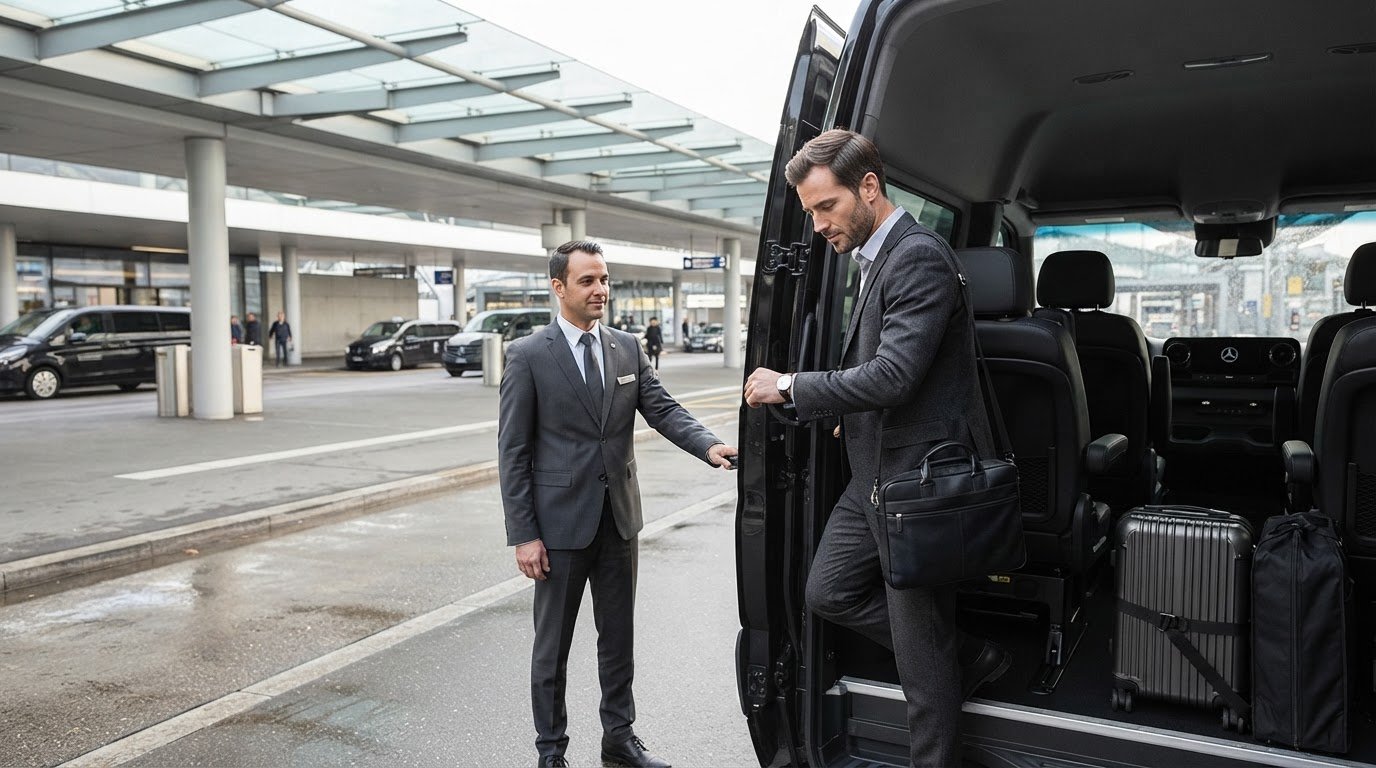
Epic Limousines provides Corporate Travel Management for business itineraries requiring coordinated private transport across Switzerland. When airport arrivals, meeting schedules and onward journeys need to fit together, this service offers a transport-focused solution. A Mercedes-Benz S-Class Transfer suits individual executive travel, while a Mercedes-Benz Sprinter Transfer can accommodate business groups. Ski Resort Transfers can connect a business trip with a stay at a mountain resort. These chauffeur-driven services complement rail planning when direct travel better suits your itinerary. Share your travel plans with Epic Limousines to discuss Corporate Travel Management for your Swiss business trip.
Shape Your Next Swiss Business Journey
A productive trip depends not only on appointments, but also on the transitions between them. When navigating Switzerland for business travelers, start by identifying the journeys that need the most attention: an airport arrival before a meeting, private travel between cities or onward transport to a mountain stay. With those priorities clear, you can build an itinerary that supports your work without treating every transfer as a separate task.
Epic Limousines offers Mercedes-Benz S-Class and Sprinter Transfers, as well as Ski Resort Transfers, for different travel needs. Whether your schedule calls for an executive journey, group transport or onward travel to a resort, choose the arrangement that best fits your plans.
Contact Epic Limousines to discuss your transfers and give your next Swiss business trip a composed, thoughtful start.
Frequently Asked Questions
What are the best ways for business travelers to get around Switzerland between cities?
Choose rail for travel between cities when stations suit your meeting locations; choose a private chauffeur-driven transfer when you need direct travel between addresses. For example, a day with meetings in separate cities may work best by combining a train journey with a private car for the final leg. Consider your luggage, meeting locations and schedule flexibility when deciding which option suits each part of the trip.
How do business travelers travel from Zurich, Geneva, and Basel airports to city centers?
From each airport, use public transport for a practical route into the city, or arrange a private airport transfer for direct travel to your destination. A pre-arranged transfer can be useful when you are carrying presentation materials, travelling with colleagues or heading straight to a meeting. Epic Limousines provides Zurich, Geneva and Basel Airport Transfers as a chauffeur-driven option for these arrivals.
What transport options are available for late-night travel and travel to smaller Swiss towns?
Public transport connects Swiss cities, while a private intercity transfer provides direct travel between destinations.