Reducing Travel Risk for Executives Before and During Business Trips

Even a familiar destination can create new exposure when an executive’s schedule, profile or travel arrangements change. Reducing travel risk for executives means treating each trip as an ongoing process: assess the destination and traveller before departure, prepare for disruption, and maintain clear communication and support throughout the journey.
That takes more than a general travel policy. Executives may have complex itineraries, limited time and a higher public profile, so practical planning should account for personal and destination-specific risks while protecting privacy. This article explains travel risk management, what to consider in a pre-trip assessment, how crisis communications support a response, and why executive travel may need additional attention. The goal is to make considered decisions before uncertainty becomes an urgent problem.
Key Takeaways
- Connect an organisation’s duty of care to a clear travel risk process that continues throughout each business trip.
- Assess destination conditions and traveller needs before departure, then use the findings to shape approvals and travel plans.
- Define who communicates, makes decisions and supports a traveller during an emergency before a disruption occurs.
- Account for executive-specific factors, including complex itineraries, personal profiles and privacy, when setting travel arrangements.
What is travel risk management?
Travel risk management coordinates how an organization identifies, assesses and reduces risks to employees travelling for business. It connects an employer’s duty of care with practical decisions before, during and after a trip.
Employer Duty of Care
Employer duty of care is the legal and moral responsibility to protect employees travelling for work. For Swiss employers sending staff abroad, this means considering foreseeable travel risks and arranging appropriate safeguards. A destination assessment, clear travel policy and emergency response plan turn that responsibility into practical decisions. If an executive travelling between meetings encounters a disruption, for example, colleagues should know who makes decisions and coordinates support.
Travel Risk Management Services
Executive travel risk management services and platforms coordinate risk information, traveller communications and response procedures. The most useful approach reflects the organization’s destinations, traveller profile and trip purpose, rather than relying on a generic tool alone. A platform may support itinerary visibility, check-ins and alerts, while a risk management provider can help structure assessments and crisis planning. These services become especially relevant when an executive’s schedule changes or a threat disrupts travel.
Corporate travel risk management is an ongoing process, not a one-time approval before departure. A travel risk policy sets the rules; the programme applies them to each journey. Before booking, an organization can assess political, health, local security and natural disaster risks. During travel, clear communication channels help employees understand changing conditions. Afterward, reviewing disruptions can improve future assessments and policy decisions.
ISO 31030 is a recognised framework for structuring travel risk management and duty of care. It can help an organization organise responsibilities across travel planning, risk assessment, traveller preparation and emergency response. Reducing travel risk for executives also depends on consistent policy use: seniority should not remove approval steps or safety measures. A documented process gives travel managers and employees shared expectations, including who acts when conditions change.
For business travellers, duty of care means providing suitable preparation, relevant destination information and access to a defined response process. Executives may have complex itineraries, but the same core principles apply: assess the journey, clarify responsibilities and plan how support will work if an incident occurs.
Pre-trip destination and traveller risk assessment
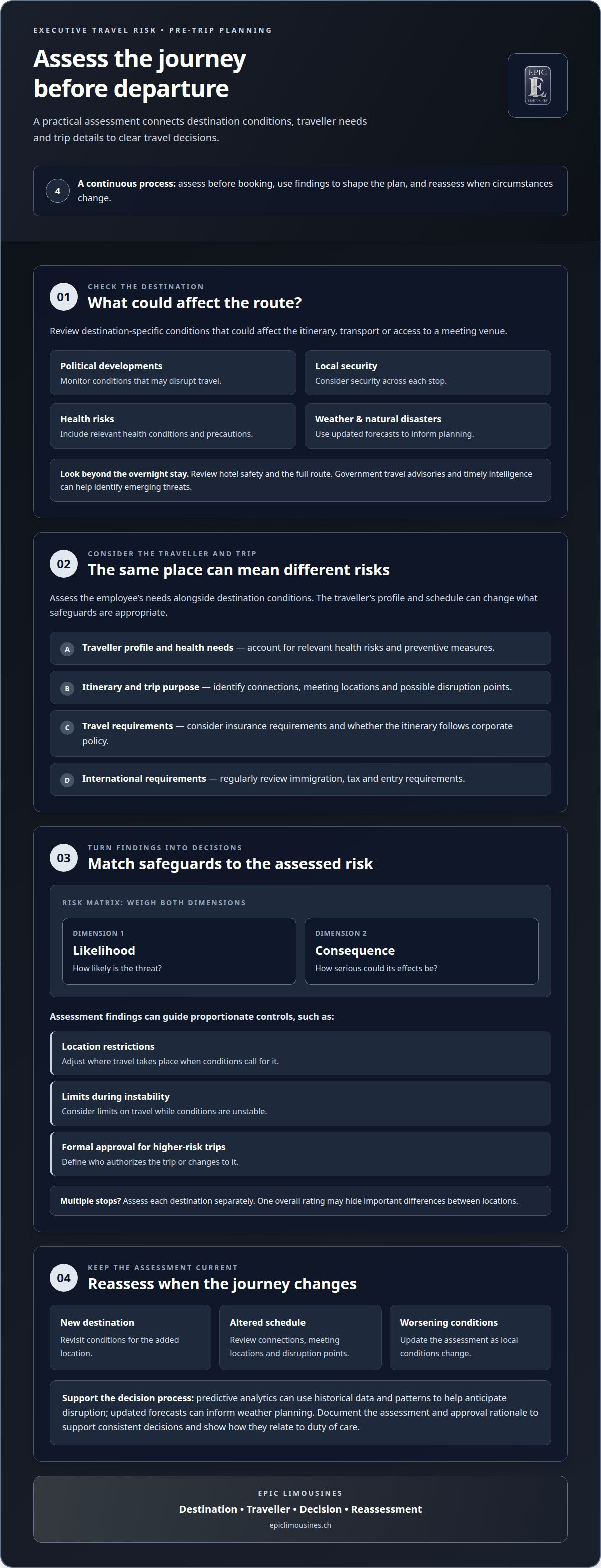
A pre-trip assessment considers the destination, traveller and purpose of the trip before booking. Its findings can guide travel approval, transport choices and safeguards that support an employer’s duty of care.
Destination and Hotel Safety
A destination-specific assessment reviews conditions that could affect the itinerary, including political developments, local security, health risks, severe weather and natural disasters. Conditions can disrupt transport or access to a meeting venue, changing what seemed like a safe arrival plan. An approaching storm, for example, may call for a revised schedule or alternative transport. Government travel advisories and timely intelligence can help identify emerging threats, while hotel and destination safety assessments should consider the full route, not only the overnight stay.
A risk matrix helps travel managers weigh each threat by its likelihood and the seriousness of its consequences. The findings can guide proportionate controls, such as location restrictions, limits on travel during instability or formal approval for higher-risk trips. For an itinerary with several stops, assess each destination separately. A single overall rating may hide important differences between locations.
Traveller Risk and Travel Approvals
A traveller assessment considers the employee’s profile, health needs, itinerary and trip purpose alongside destination conditions. The same location can present different concerns depending on who is travelling and what the schedule requires. Before booking, organizations can consider relevant health risks, preventive measures, travel insurance requirements and whether the itinerary follows corporate policy.
Approval should follow the assessment, not replace it. A policy can require formal review when a destination presents elevated risks and specify who authorizes the trip or changes to it. Immigration, tax and entry requirements also need regular review for international executive travel. Clear itinerary details help managers identify connections, meeting locations and possible disruption points.
Reassess when important details change, such as a new destination, an altered schedule or worsening local conditions. Predictive analytics can use historical data and patterns to help anticipate disruption, while updated forecasts inform weather planning. Documenting the assessment and approval rationale supports consistent compliance and shows how travel risk decisions relate to the organization’s duty of care.
Emergency communications and crisis response
A crisis plan turns a risk assessment into clear responsibilities, communication channels and response steps. It helps corporate travel teams coordinate support when illness, transport disruption or a disaster affects an executive abroad.
For destination guidance, Swiss travellers can consult the Federal Department of Foreign Affairs’ country-specific travel advice. During an emergency, the company’s response plan should specify who contacts the traveller and which assistance channel to use.
Emergency Assistance and Crisis Planning
An emergency response plan defines who receives alerts, who makes decisions and how the traveller gets support. Clear responsibilities help prevent delays and inconsistent responses across teams. Set out escalation steps, contact details and alternative communication channels before departure. If a flight disruption prevents an executive from reaching a scheduled meeting, for example, the plan should show who coordinates updates and revised arrangements.
According to AlertMedia, a study it cited found that 22% of business travellers had not been briefed on whom to contact in an emergency. A written contact path can close that gap. Plans can also cover local medical care, secure transport, evacuation decisions and cybersecurity measures, with clear authority for each decision.
Response Exercises and Medical Emergencies
A crisis response exercise rehearses roles and communication chains before an actual incident. Participants need to understand their responsibilities under pressure, rather than discover them during a crisis. Use realistic scenarios involving several hazards, such as severe weather followed by transport disruption, and include the teams expected to respond.
For health preparation, companies should consider destination-specific health risks, relevant vaccinations and preventive measures before travel. They should also ensure medical and health insurance addresses emergency medical assistance and evacuation, including security evacuation for high-risk locations. Executives need clear instructions for accessing local medical care and notifying the company. A tabletop exercise can test whether the contact chain, insurance details and decision process work together.
After an exercise or incident, review delays and unclear handoffs, then update the plan. If an alert reaches the travel manager but not the executive’s designated contact, for example, revise the communication sequence before the next trip.
Executive travel risk considerations
Executive travel can combine complex itineraries, high visibility and little time to make changes. A risk management programme should account for the traveller’s profile as well as political, medical and local conditions.
Assessing and Managing Executive Travel Risk
Companies assess executive travel risk by combining destination intelligence with the traveller’s profile, itinerary and business purpose. Recognisability, family considerations or a tendency to travel outside policy can change the exposure. For an international schedule with several stops, travel management should assess each location and transfer, then update plans as conditions change. Political unrest, health concerns and transport disruption may each require different controls.
Executives should follow the same corporate approval process as other employees. Seniority does not remove the need for itinerary visibility or clear communication. Travel managers can document policy concerns discreetly and discuss them in terms of the well-being of the traveller, staff and family.
Executive Travel Security Planning
An executive travel security plan sets out approved arrangements, emergency contacts, escalation steps and responsibilities. A clear plan helps colleagues respond consistently if an executive becomes unreachable or local conditions deteriorate. Include a destination assessment, insurance and medical support, communication procedures, and a process for itinerary changes. Balance location information with privacy, consent and responsible data handling.
Risk insights should reflect different traveller experiences. According to World Travel Protection’s 2023 survey, 71% of female business travellers believed work travel was less safe for women than men, while 18% of travel policies specifically addressed female traveller safety. These findings highlight why a policy should consider individual needs rather than assume one approach suits every executive.
Keep travel arrangers and executive assistants familiar with the policy, available resources and escalation process. Regular check-ins can surface itinerary changes before they undermine visibility or support. A concise plan also helps leaders understand the importance of approved arrangements: when senior executives bypass policy, other employees may follow their example.
For coordinated executive journeys, explore tailored travel arrangements.
Epic Limousines: Corporate Travel Management
Epic Limousines provides Corporate Travel Management for businesses coordinating executive journeys in Switzerland. When a trip involves several meetings, airport arrivals or transfers between destinations, planned ground transport can add structure to the itinerary. Mercedes-Benz S-Class and Sprinter Transfers provide chauffeur-driven options for executive travel, while Ski Resort Transfers support business journeys to alpine destinations.
These transport arrangements can support travel planning, but they do not replace a company’s risk assessments, emergency procedures or insurance arrangements. They are a practical option when an organization wants to incorporate executive ground transport into a carefully coordinated itinerary.
For discreet, tailored business travel arrangements, contact Epic Limousines.
Make the next journey a considered one
Reducing travel risk for executives is an ongoing commitment shaped by the organization’s decisions and the traveller’s needs. Make those decisions part of routine trip planning, so a change in itinerary or destination can be considered before it creates avoidable pressure.
Ground transport is one element companies can coordinate within a wider travel plan. Epic Limousines offers Mercedes-Benz S-Class and Sprinter Transfers, as well as Ski Resort Transfers, for executive journeys in Switzerland. These services can support transport arrangements for a business trip, while the organization remains responsible for its own risk assessments and emergency procedures.
For a journey that calls for carefully arranged chauffeur-driven transport, contact Epic Limousines to plan. A thoughtful next trip begins with clear decisions and arrangements suited to its itinerary.
Frequently Asked Questions
What is Duty of Care?
Duty of care is an employer’s responsibility to take reasonable steps to protect employees travelling for work. In practice, it means considering how a work itinerary affects an employee’s safety and well-being, not simply approving the business purpose. A late meeting followed by an unfamiliar journey, for example, may call for a different arrangement from a daytime trip between known locations.
What is corporate travel safety?
Corporate travel safety comprises the organizational practices that help employees travel for work with informed preparation and support. It connects travel policy to practical decisions: who receives itinerary changes, how employees access assistance, and what happens if a meeting location becomes inaccessible. A clear process also helps executive assistants and travel managers coordinate their responsibilities without relying on informal messages.
What are the main travel risks for business executives?
Business executives may face risks from political unrest, medical needs, severe weather, transport disruption and local security conditions. Their profile can add further considerations: a recognizable leader attending a public event may need different arrangements from an employee travelling privately between offices. Tight schedules and multiple destinations can also mean a missed connection affects several meetings, increasing the impact of disruption.
How can companies monitor travel advisories and emerging threats?
Companies can use the Swiss Federal Department of Foreign Affairs’ country-specific travel advice alongside reliable, timely intelligence. Compare updates with the executive’s actual itinerary, including planned stops and connecting routes, rather than monitoring only the main destination. Assign responsibility for reviewing changes and sharing relevant updates with the traveller and decision-makers. A change in local conditions should prompt a fresh review of the affected arrangements.
What emergency response and evacuation support should executives have abroad?
Executives should know how to reach their company’s emergency contact and who coordinates medical care, insurer notifications and evacuation decisions. Before departure, the organization should establish how assistance will be arranged if local treatment is unavailable or security conditions change. The plan should also cover communication with the traveller’s designated contact and a process for recording decisions while protecting personal information.
What are the best executive travel risk management services and platforms?
Useful platforms can support itinerary visibility, traveller check-ins and alerts, while a travel risk management provider can help structure assessments and crisis planning. A travel management company may also support traveller risk management. The right approach should reflect the organization’s destinations, traveller profile and trip purpose.