Swiss Public Transport or a Private Chauffeur for Business Travel?
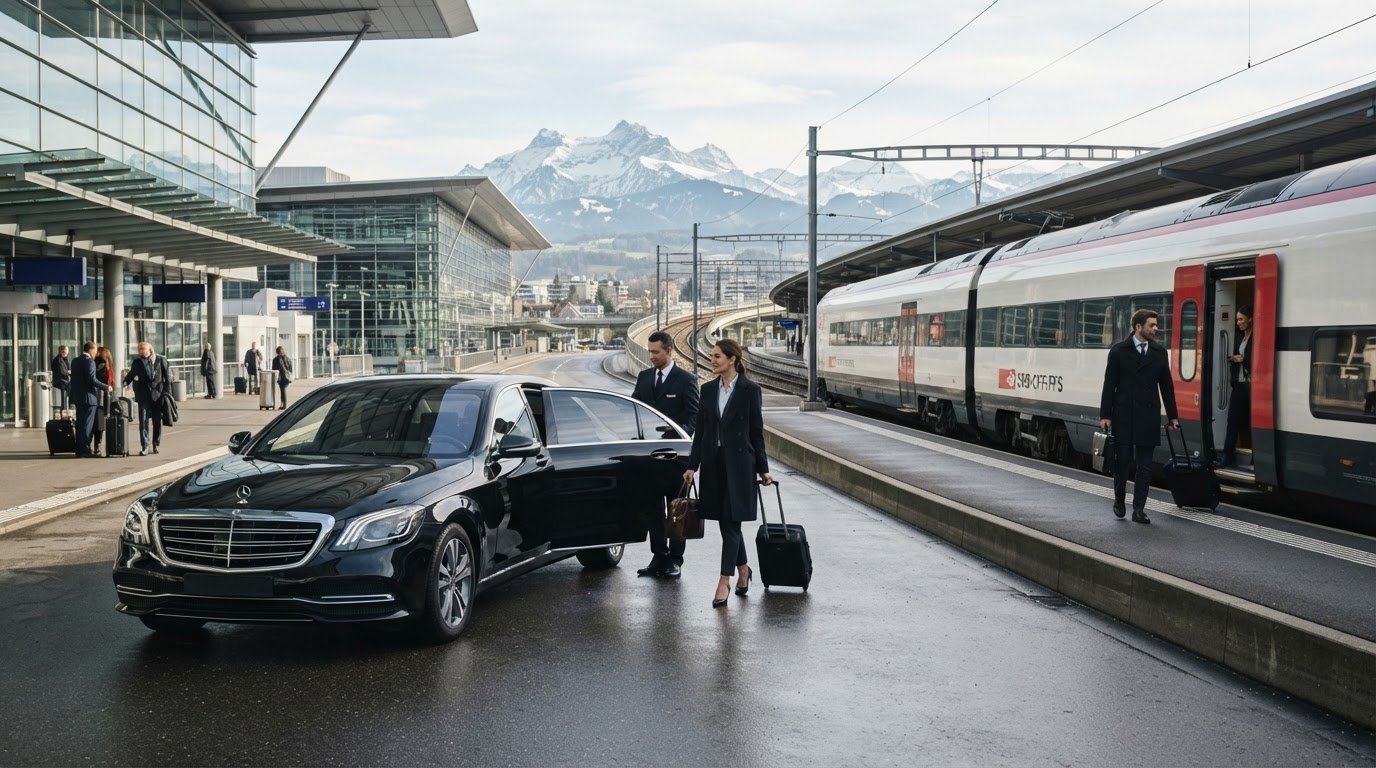
For journeys between well-connected Swiss destinations, public transport is often straightforward. A private chauffeur can suit airport transfers and business itineraries when door-to-door travel, privacy and a tailored schedule matter. The Swiss public transport vs private chauffeur decision is less about which option is always better and more about how much coordination your journey allows. A chauffeur service is pre-booked transport with a driver, while public transport follows scheduled routes and connections.
It’s understandable to weigh convenience against cost, especially when a flight arrival or business meeting sets the pace of the day. This guide compares airport transfers, executive travel, passenger safety, booking arrangements and pricing in Switzerland. A chauffeur journey’s price depends on the route, timing and vehicle required, and is provided after a quote request. By looking at where each option fits best, you can choose the travel arrangement that supports your itinerary with greater ease and confidence.
Key Takeaways
- Choose public transport for straightforward journeys between well-connected destinations; consider a chauffeur when door-to-door convenience and a tailored schedule matter more.
- For airport arrivals and business itineraries, weigh connections and timing against the value of a private, direct journey.
- Plan passenger needs in advance, including child-seat arrangements when travelling with children.
- Pre-booked chauffeur journeys offer a different pricing structure from immediate taxi rides, so compare how each option fits your itinerary and budget.
Airport pickups and transfers
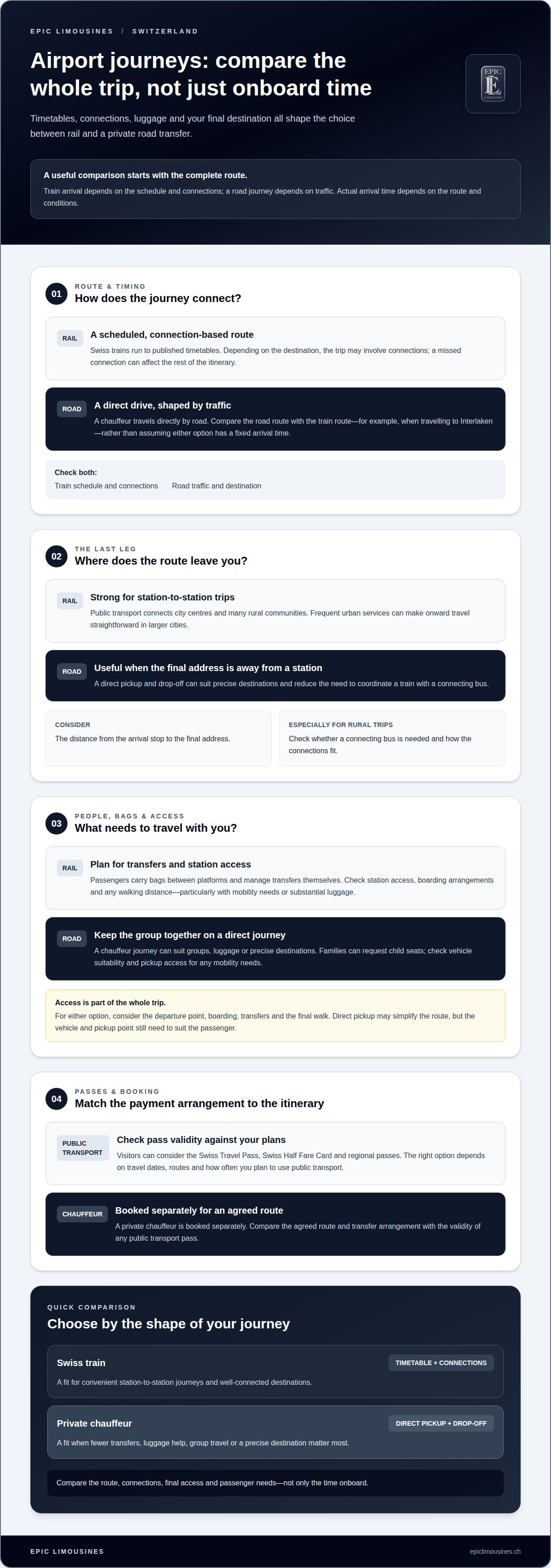
From an airport, compare the full journey, not just time onboard. Swiss trains run to published timetables, while a chauffeur travels directly by road. For example, compare the rail and road routes to Interlaken, as each may involve different arrangements. Actual arrival time depends on the train schedule, connections, road traffic and destination.
Swiss public transport connects city centres and many rural communities by train and bus. Frequent urban services make onward travel straightforward in larger cities. Rural journeys may require coordination between a train and a connecting bus, particularly when the final destination is away from a station. The network is broadly dependable, but a missed connection can affect the rest of your itinerary.
Luggage, group size, children and mobility needs can change the balance. On a train, passengers carry bags between platforms and manage transfers themselves; a direct chauffeur journey keeps the group together. Families can request child seats for chauffeur services. If a passenger has limited mobility, compare station access, boarding arrangements and the distance from the arrival stop to the final address.
Visitors can consider the Swiss Travel Pass, Swiss Half Fare Card and regional passes. The right option depends on travel dates, routes and how often you plan to use public transport. Before buying, compare the pass’s validity with your airport journey and onward itinerary. A private chauffeur is booked separately for an agreed route.
| Option | Journey time | Luggage and access | Best fit |
|---|---|---|---|
| Swiss train | Timetable and connections | Carry bags between platforms | Station-to-station journeys |
| Private chauffeur | Road route and traffic | Direct pickup and drop-off | Groups, luggage or precise destinations |
Choose the train for a convenient station-to-station trip; choose a chauffeur when direct access, help with luggage or fewer transfers matters most.
Business and executive travel
For business itineraries, the Swiss public transport vs private chauffeur comparison starts with your agenda. A single appointment near a station may be simple by train. A day with a client briefing, conference venue and team dinner needs more coordination. List each address and arrival time first, then compare transfers, walking and waiting between commitments.
A Swiss public transport vs private chauffeur decision also depends on how executives use travel time. Rail journeys follow set routes, and passengers may be working alongside other travellers. A private journey offers a more discreet setting for calls or reviewing meeting notes. A visiting executive with presentation materials may value an uninterrupted transfer between appointments, while a solo traveller with one central meeting may prefer the train.
Build a practical schedule around your least flexible commitment. Note the meeting location, expected finish and next destination, then account for the mode of transport and its route. A delayed meeting can affect a later connection or pickup, so leave some margin in the schedule. For a group, coordinate everyone’s arrival point and onward departure before the workday begins.
- One fixed appointment: compare the station location with the venue and walking route.
- Several business stops: map each transfer and consider how schedule changes affect the next meeting.
- Executive calls or preparation: weigh privacy and uninterrupted travel time against the rail itinerary.
For organisations arranging recurring journeys, Corporate Travel Management can support a coordinated approach to business transport. Choose the mode that serves the day’s priorities, and shape the itinerary around the people, meetings and decisions that matter.
Passenger safety
Public transport is shared, while a chauffeur provides a private vehicle. Your choice affects privacy, boarding arrangements and how assistance is organised.
Public Transport
Swiss trains, trams and buses carry multiple passengers, so conversations and personal space are less private. Stations and interchanges may involve stairs, platforms or changes between services. Check access arrangements for each leg, especially when travelling with a wheelchair, mobility aid or substantial luggage. A route with fewer transfers can reduce the effort involved in reaching your destination.
Private Chauffeurs
A private chauffeur travels with your party, offering a more discreet setting than a shared carriage. Child seats can be provided on request, helping families plan for younger passengers. Accessibility still depends on the vehicle and pickup point, so consider the passenger’s mobility needs alongside the route. Direct pickup can avoid station changes, though it does not remove every access consideration.
Driver work and rest rules also form part of Switzerland’s transport safety framework. Under ARV 2, covered professional drivers must take at least a 45-minute break after 4.5 hours of driving. This rule concerns driver working conditions, rather than a promise about a particular journey’s timing. A planned itinerary should account for the route and any required rest.
For a passenger using a wheelchair, compare the complete trip: access to the departure point, boarding, transfers and the final walk. Each leg of a public transport journey may have different access arrangements. With a chauffeur, direct pickup may simplify the route, but the vehicle must suit the passenger’s needs. Families should arrange child seats before travel.
A solo visitor travelling between central stations may value a shared, well-connected route. A family carrying bags, or a guest who prefers a more private setting, may favour a direct vehicle journey. Weigh privacy, transfers, mobility requirements and the assistance needed at each stage.
Pre-booking and fixed pricing
Public transport and chauffeur journeys use different booking rhythms. For a train, select a route and ticket before boarding, then follow the timetable and connections. A taxi is usually available immediately, while chauffeur services in Switzerland are pre-booked. That advance arrangement suits a planned airport pickup, meeting schedule or transfer between destinations.
To organise a chauffeur journey, set out your pickup point, destination, travel date and timing. Include planned stops and passenger requirements in the itinerary. These details help define the journey in advance. A transfer to a meeting followed by another address, for example, needs different planning from a direct trip to a hotel.
Pricing also works differently. Chauffeur services in Switzerland are described as offering fixed pricing, unlike taxis, which usually don’t. A fixed quote can make a planned journey easier to budget because the amount is established before the ride. Taxi fares can vary with the journey, and traffic delays may increase the fare. Public transport fares depend on the ticket or pass selected.
For a private chauffeur journey, the price depends on the route, timing, vehicle and itinerary, with a quote provided after a request. Booking details matter: a direct transfer and a multi-stop itinerary are different journeys. Compare the quoted amount with your full public transport route, including separate tickets and connections.
- Choose public transport when scheduled routes suit your plans and ticket costs fit your budget.
- Pre-book a chauffeur when pickup timing, direct routing or a known journey price matters.
- Before booking, finalise addresses, stops and timing so the itinerary reflects your actual plans.
For a planned Swiss journey, request a tailored travel quote based on your itinerary.
Epic Limousines: Mercedes-Benz Sprinter Transfer
Epic Limousines offers Mercedes-Benz Sprinter transfers for journeys where a private, pre-arranged vehicle suits the itinerary. Consider one for an airport arrival, a business schedule across several destinations, or travel where keeping your party together is preferable to coordinating separate public transport connections. The route and timing can be planned around your journey.
For an executive travelling alone, a Mercedes-Benz S-Class transfer may be a suitable option. Epic Limousines also provides ski resort transfers and transport for the World Economic Forum in Davos. Choose according to your destination, itinerary and preferred style of travel.
If a chauffeur-driven transfer fits your plans, contact Epic Limousines to discuss your itinerary.
Plan the journey around the day ahead
For your next Swiss itinerary, start with how you want to arrive and what needs to happen between departure and destination. The Swiss public transport vs private chauffeur decision can be made trip by trip, rather than as a fixed rule. A train may suit a familiar route, while a private vehicle offers a more tailored setting for a particular engagement.
When a dedicated vehicle better fits your plans, Epic Limousines offers Mercedes-Benz Sprinter and S-Class transfers, as well as ski resort transfers. Choose the service that aligns with your itinerary, then share your route and travel requirements when planning.
Contact Epic Limousines to plan your trip and take the next step with a travel arrangement suited to your plans.
Frequently Asked Questions
What Is a Chauffeur Service Switzerland?
A chauffeur service is private, pre-booked transport with a professional driver, arranged for a specific journey or itinerary. Unlike public transport, it takes passengers between selected pickup and drop-off points instead of following a fixed route. For example, a traveller can arrange a direct transfer from an airport to a hotel or plan several business stops in one journey.
What are typical private chauffeur rates in Switzerland per hour, day, or kilometre?
Hourly, daily and kilometre-based bookings describe different journey arrangements, so there is no single comparable rate across them. The total depends on factors such as route, timing, vehicle and planned stops. Epic Limousines provides a quote based on the individual request. Compare the quoted itinerary with your full public transport route.
When is a private chauffeur more convenient than public transport in Switzerland?
A chauffeur can be more convenient when your plans involve several addresses, little time between appointments or a destination away from a station. A business traveller visiting separate meeting venues, for example, can avoid coordinating a new route for each leg. Public transport may suit a single stop near a station. Consider luggage, mobility needs and how much flexibility your schedule requires.
How do airport transfers from Zurich, Geneva, and Basel compare by train and chauffeur?
At Zurich, Geneva and Basel airports, trains connect passengers with the rail network, while a chauffeur provides a direct road journey to the chosen address. Compare the complete trip: rail connections and any final walk, against the road route and traffic conditions. The better fit depends on your destination, arrival time, luggage and whether you prefer a station-based journey or door-to-door transport.
How do booking, cancellation, and payment rules differ for Swiss trains and chauffeurs?
For train travel, select a ticket suited to your route and plans; change or refund conditions depend on the ticket purchased. Chauffeur journeys are arranged in advance, with the itinerary and booking terms established for the service. Before booking, compare the train ticket conditions with the chauffeur booking terms, particularly if your schedule may change.